
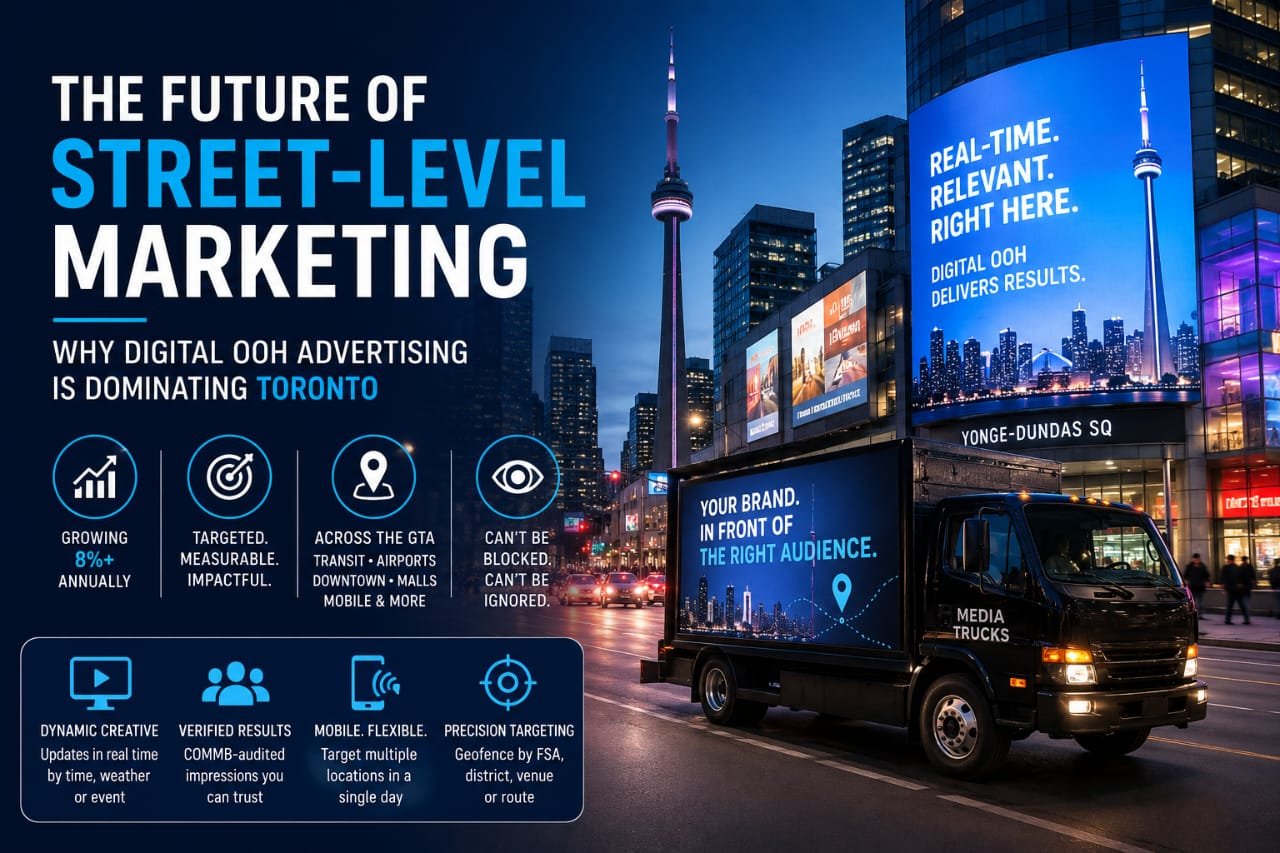
Digital out-of-home (DOOH) advertising already makes up roughly 65% or more of total Canadian OOH ad spend. That puts Toronto ahead of every other Canadian market, and among the top 10 DOOH markets in North America. It’s not a forecast for later this decade – it’s where the market sits right now, in 2026. Q1 2026 Canadian OOH revenue hit $180.9 million, up year-over-year, and transit and place-based formats each posted double-digit growth. So for B2B brands operating across the GTA, street-level advertising has quietly stopped being the static, seasonal buy it used to be. It’s become a data-driven channel that behaves a lot more like digital media.
What Digital OOH Advertising Means for Toronto Advertisers
Digital OOH (DOOH) advertising means running ad creative on LED and LCD screens rather than printed vinyl or paper posters. A traditional billboard locks in one design for a four-week posting period and stays that way. A DOOH screen doesn’t – it can swap creative by time of day, react to weather, pull in live sports scores, or shift based on transit status. Media Trucks runs mobile digital billboard trucks and an indoor screen network across the GTA built around this same dynamic-creative capability.
Key differences from traditional OOH:
| Factor | Traditional OOH | Digital OOH (DOOH) |
| Creative changes | Fixed for full campaign | Can rotate by daypart, location, or trigger |
| Pricing model | Flat in-charge rate | CPM, share-of-voice, or programmatic |
| Setup time | Days for printing and installation | Minutes to upload new creative |
| Measurement | Estimated exposure | COMMB-verified impressions |
| Mobility | Fixed location only | Mobile trucks can target multiple sites per day |
DOOH Is Growing Faster Than Every Other Ad Format in Canada
Canada’s digital OOH segment is growing at roughly 8% a year, while traditional print billboards are crawling along at under 1%. Specifically, print billboards sit at a 0.5% CAGR against DOOH’s 8.0%. Zoom out to the global picture and the gap holds: the digital OOH market is projected to go from USD 20.22 billion in 2026 to USD 32.98 billion by 2031, a 10.28% CAGR. None of this is happening because DOOH is trendier. It’s happening because it’s measurable. Canadian DOOH campaigns get audited by COMMB (the Canadian Out-of-Home Marketing and Measurement Bureau), and that gives advertisers verified reach and frequency numbers that a print billboard simply can’t produce.
Why B2B Brands in the GTA Are Shifting Budget to DOOH
B2B brands are pulling budget toward DOOH because it sidesteps three problems that plague digital-only channels: ad blockers, banner blindness, and impressions nobody can actually verify.
- You can’t block or skip a physical screen. A digital billboard on the Gardiner Expressway, or a mobile truck parked outside a trade show, gets seen by everyone in view – no scrolling past it like a social ad.
- Geofencing gets specific. Toronto DOOH campaigns can be geofenced down to the Forward Sortation Area (FSA) level, so a brand can target the Financial District, the PATH network, or one specific industrial park and nowhere else.
- The numbers hold up under scrutiny. COMMB pulls together traffic counts, Statistics Canada census data, and mobile verification into weekly reach and frequency reports – the kind of data a marketing team can actually take to finance.
- Mobile trucks go where fixed screens can’t. One truck can cover a Financial District morning route and a conference-centre evening route on the same day, which matters if you’re chasing event attendees or corporate campuses scattered across the GTA.
Where DOOH Inventory Exists Across Toronto
Toronto’s DOOH inventory shows up across transit, aviation, and the city’s busiest commercial zones – think the TTC subway and streetcar network, GO Transit stations, Toronto Pearson and Billy Bishop airports, Yonge-Dundas Square, the PATH underground network, and malls like CF Toronto Eaton Centre, Yorkdale, and Square One. Not all of it is equally useful for a B2B campaign, though. PATH screens reach downtown office workers directly. Union Station and GO Transit screens catch commuters and business travellers. And mobile truck routes can be pointed straight at a conference venue, a corporate campus, or an industrial park out in Mississauga, Vaughan, or Markham.
How AI and Real-Time Data Are Changing DOOH Creative in 2026
DOOH creative in 2026 is getting more contextual – messaging that adjusts in real time based on outside data, not a fixed design running on loop. Industry analysts are pointing to three forces converging at once this year: digital saturation, fast DOOH growth, and real progress in measurement, all happening as Canadians go back to shared spaces – transit, retail, stadiums, festivals. What that means in practice: a B2B brand’s DOOH creative can now shift based on weather, time of day, or a live event schedule. Same personalization logic as digital advertising, just running on a physical screen.
How B2B Brands Should Budget for DOOH in the GTA
Most Toronto DOOH inventory sells on one of three pricing models. Which one fits depends on the campaign goal:
- CPM (cost per thousand impressions): works well for brand-awareness campaigns aimed at a broad business audience across multiple screens.
- Share of Voice (SOV): makes more sense when a brand wants guaranteed frequency in one specific high-traffic spot, like a single PATH corridor screen.
- Programmatic guaranteed (PG): fits short, event-triggered campaigns – creative that only runs during a particular trade show or conference week, for instance.
Mobile digital billboard trucks sit outside all three models – they’re usually priced per day or per route. That makes them a better fit for one-off activations, like a product launch or a conference sponsorship, than for an always-on brand campaign.
The Bottom Line for GTA B2B Marketers in 2026
Digital OOH isn’t a supplementary channel anymore – it’s how outdoor advertising reaches Toronto audiences now, and the measurement finally holds up to what B2B marketers expect from any digital channel. The brands capturing this growth are the ones treating DOOH like an extension of their digital media plan: targeted, measured, creative that can actually change. Media Trucks’ mobile billboard trucks and indoor screen network give GTA B2B brands a way into this market without locking into a long-term fixed-screen lease.
Related reading: Mobile Billboard Advertising Truck | Indoor Screen & Billboards
FAQ
What is digital OOH (DOOH) advertising?
Digital OOH advertising displays ad creative on LED or LCD screens instead of printed posters, allowing content to change by time, location, or live data triggers.
How much of Toronto’s OOH market is digital in 2026?
Digital now accounts for roughly 65% or more of total Toronto OOH ad spend, with most new screen deployments being digital-first.
Who measures DOOH impressions in Canada?
COMMB (the Canadian Out-of-Home Marketing and Measurement Bureau) measures Canadian DOOH audiences, combining traffic counts, Statistics Canada census data, mobile device verification, and a visibility model.
Is DOOH more expensive than traditional billboards for B2B brands?
Not necessarily. DOOH is typically priced on CPM or share-of-voice rather than a flat in-charge rate, so brands can scale spend to a specific budget instead of paying for a fixed four-week posting period.
What makes mobile digital billboard trucks useful for B2B marketing?
Mobile trucks can change location throughout a single day, allowing a B2B brand to target a downtown business district in the morning and a conference venue or trade show in the evening on the same campaign.
