
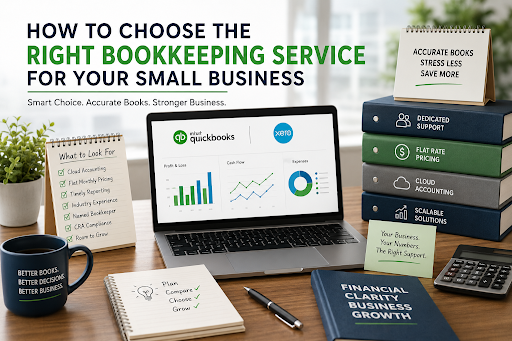
The right bookkeeping service fits your business’s actual size, runs on cloud software like QuickBooks Online or Xero instead of spreadsheets, charges a flat rate you can actually predict, and gives you a dedicated bookkeeper who understands both your industry and your local tax rules – in Canada, that means someone comfortable with CRA compliance. Before signing anything, compare at least three providers on price, software, response time, and scope.
Start By Figuring Out What You Actually Need
Your transaction volume and business size decide what kind of service makes sense. A solo freelancer running 20 transactions a month needs something completely different from a 15-person company juggling payroll and inventory.
Before you even start looking, sit with three questions: how many transactions are you processing each month? Do you need payroll and accounts payable/receivable, or is it really just reconciliation you’re after? And is this a year-round relationship, or mostly tax-season help?
Getting this wrong at the start is honestly the biggest reason small businesses end up switching bookkeeping providers within the first year.
What to Actually Check Before Hiring Anyone
Score any provider you’re considering against this list. If a provider fails three or more of these, that’s not really a safe long-term bet.
| What to Look For | The Standard |
| Software used | Cloud platforms like QuickBooks Online or Xero – not spreadsheets |
| Pricing model | Flat monthly rate, not vague hourly billing |
| Turnaround time | Books reconciled within 5–10 business days of month-end |
| Industry experience | Existing clients in your sector – retail, e-commerce, professional services |
| Communication | A named bookkeeper, not a rotating support queue |
| Compliance knowledge | Comfortable with local tax authority rules – CRA, for Canadian businesses |
| Scalability | Can add payroll, CFO advisory, or tax filing as the business grows |
Outsourced, In-House, or Just DIY Software?
Each of these fits a different stage of growth, and there’s no single right answer – it depends where the business actually is right now.
DIY software like QuickBooks Self-Employed works fine for solo founders under about 30 transactions a month, and it’s basically free – but the time cost is real, and errors tend to go unchecked since nobody’s reviewing the work. An outsourced bookkeeping service usually runs $200 to $800 a month and suits most businesses with 1-20 employees, though the risk shifts to picking an inexperienced provider. An in-house bookkeeper makes more sense once a business hits 20+ employees or genuinely complex finances, but that’s a 3,000-5,000+ monthly salary commitment, plus the risk of relying on a single person for everything.
For most small businesses, something like Next Gen Business Solutions’ cloud bookkeeping and accounting services hits the sweet spot – trained-accountant-level accuracy without carrying a full-time employee.
Red Flags Worth Walking Away From
Any single one of these is reason enough to keep looking elsewhere.
No named point of contact is a big one – if you get a different person every time you have a question, that’s a continuity problem waiting to happen. Vague pricing is another: “it depends,” with no sample invoice or rate card offered, usually means the real number is higher than they’re letting on upfront. You should also always have your own login to QuickBooks Online or Xero – if a provider won’t give you access to see your own books, that’s a serious problem. A real onboarding process matters too; a provider worth using migrates your historical data and confirms opening balances before doing anything else. And ask for a reference client – if a provider’s sample engagements show missed filing deadlines, that tells you what to expect.
A Real Example
A retail client of ours had been using a bookkeeper who billed hourly with no real cap, and their monthly invoice bounced between $300 and $1,100 depending on the month – with no clear explanation of why. Once they switched to a flat-rate provider with a named bookkeeper and CRA-familiar reporting, not only did the cost stabilize, but errors that had gone unnoticed for two years – mostly miscategorized expenses – got caught and corrected within the first month of the new arrangement.
Final Recommendation
Look for a bookkeeping service running cloud accounting software, charging a flat monthly rate, assigning a named bookkeeper, and capable of growing with the business into payroll or CFO advisory support down the line. Compare at least three providers against the checklist above before committing, and always ask for a sample client reference – it tells you more than any sales pitch will.
If you’re comparing options right now, our Best Online Bookkeeping Services page walks through how we structure engagements for Canadian small businesses at every stage.
Questions Worth Asking Before You Sign
What accounting software will you actually use for my books?
They should name a specific platform – QuickBooks Online, Xero, or Wave – not describe it in vague terms. If they’re still on manual spreadsheets, that’s a pass.
Who’s my dedicated bookkeeper?
You want a name and direct contact, not a shared support inbox. This matters more than it sounds – a bookkeeper who actually knows your business catches errors a lot faster than someone starting fresh each time.
What’s actually included in the flat monthly fee?
Ask directly whether reconciliation, financial statements, accounts payable/receivable, and year-end tax prep support are all bundled in, or billed as extras later.
How do they handle CRA or tax authority correspondence?
A solid provider should be able to respond to basic CRA notices themselves, or at minimum coordinate directly with your accountant during tax season.
Can this actually grow with the business?
Worth confirming whether they also offer payroll or outsourced CFO advisory, so switching providers later isn’t necessary just because the business scaled up.
Is it worth switching bookkeeping providers mid-year?
Usually yes, if the current setup is causing real problems – a good provider will handle the historical data migration cleanly. The disruption is smaller than most owners expect.
Should pricing scale with transaction volume?
It often does, and that’s fine as long as it’s transparent upfront. What matters is knowing the pricing tiers in advance, not discovering a jump after the fact.
Does a small business really need industry-specific experience?
It helps more than people assume – a bookkeeper who’s worked with similar businesses tends to spot unusual patterns faster and knows which expense categories typically draw scrutiny in that sector.
