
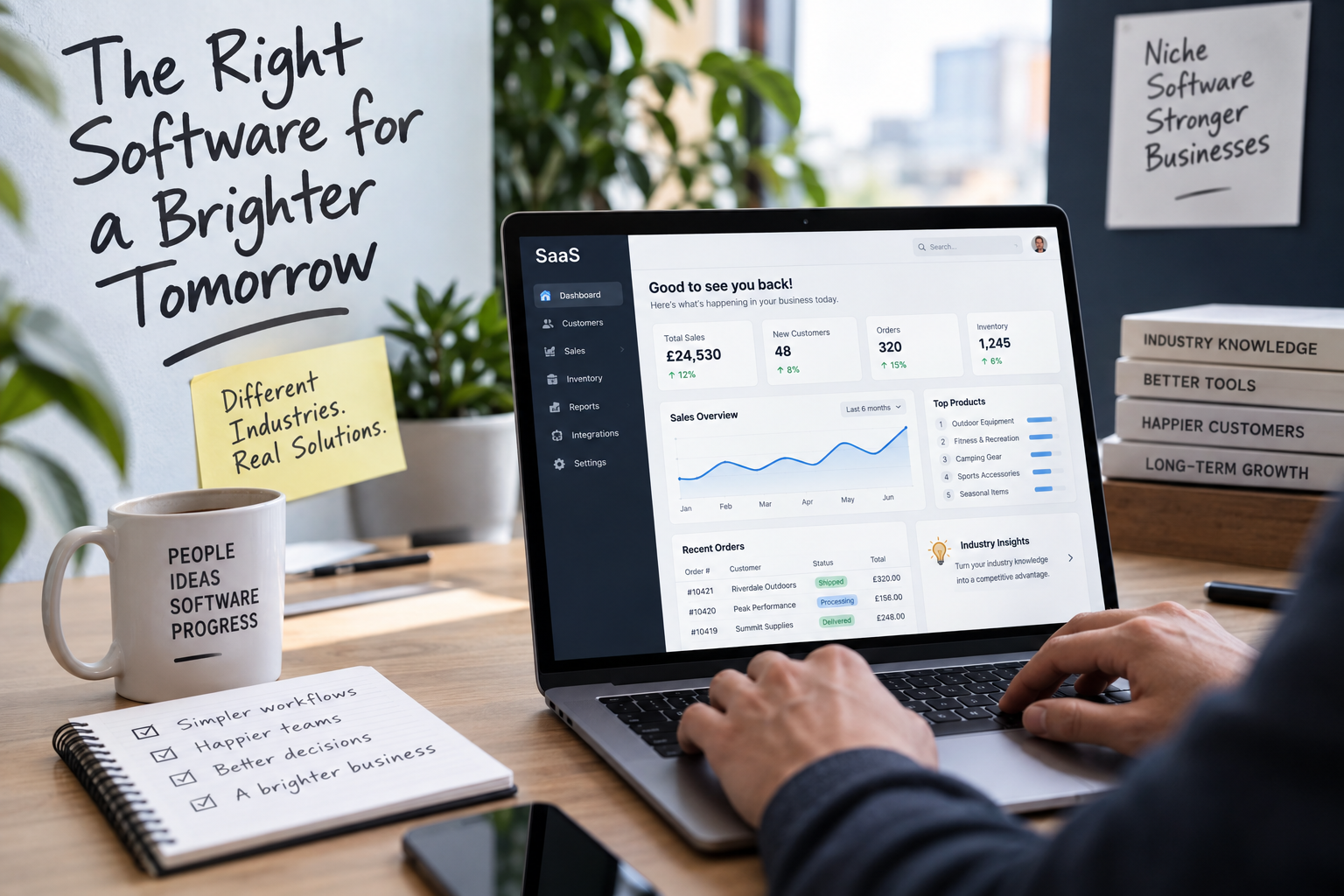
There was a time when business software tried to do everything.
One platform would promise to manage your customers, projects, reports, inventory, emails, and half a dozen other things. For some companies, that worked perfectly well. For others, it meant spending weeks changing settings and building workarounds just to make the software fit the way their team actually worked.
That’s one reason we’re seeing more interest in vertical SaaS — software built for a particular industry rather than for everyone.
It sounds like a smaller idea, but in practice, being more specific can make software much more useful.
Sometimes, General Software Is Too General
Think about what happens when a small business signs up for a large, all-purpose platform.
At first, having dozens of features sounds great. Then the team starts using it and realizes that half of those features aren’t relevant. Meanwhile, something they genuinely need isn’t available without another plugin, integration, or spreadsheet.
A specialist platform starts from a different place. Instead of asking, “What features would most businesses use?” it asks, “What does this type of business actually need every day?”
That small difference can completely change the experience.
A property management platform, for example, doesn’t need to be taught what a lease, tenant, maintenance request, or property inspection is. Those things are already part of the system because they’re part of the customer’s daily work.
Knowing the Industry Makes a Difference
Industry knowledge can be surprisingly valuable when building software.
Imagine you’re creating an inventory platform for a sporting goods retailer. A standard inventory system might treat a rectangle trampoline like any other item on a shelf: product name, SKU, quantity, and price.
But anyone familiar with that market knows there’s more to it. Products can come in different sizes, require specific replacement parts, include optional accessories, and take up considerable warehouse space.
Software built specifically for that retailer could account for those details from day one.
That’s difficult to achieve when you’re trying to build one product for thousands of completely different businesses.
Useful Data Beats More Data
Businesses already have plenty of data. The harder part is figuring out what to do with it.
A dashboard packed with graphs might look impressive, but it isn’t particularly helpful if someone still has to export everything into Excel to understand what’s happening.
Suppose an outdoor retailer notices that trampoline sales have jumped during a particular month. A useful platform wouldn’t stop at showing the increase. It could help the retailer see which models are selling, whether accessories are being purchased alongside them, which locations are running low on stock, and how sales compare with the same period last year.
Now the data is answering actual business questions.
That’s where specialized SaaS products can stand out. They don’t necessarily need more reporting features. They need reports that make sense to the people reading them.
A Smaller Audience Isn’t Always a Bad Thing
One concern with vertical SaaS is obvious: you’re deliberately reducing the size of your potential market.
A platform built for “small businesses” can theoretically sell to millions of companies. A platform built specifically for independent dental clinics has a much smaller audience.
But there’s another side to that.
When you know exactly who your customer is, marketing becomes easier to focus. Your website can talk about problems those customers recognize. Sales demonstrations can use situations they deal with every week. Even customer support gets better because the team isn’t jumping between completely unrelated industries.
That knowledge builds up over time.
Eventually, a specialized SaaS company may understand its customers’ workflows almost as well as the customers themselves.
It Can Also Make Integrations More Useful
Most businesses don’t use one piece of software in isolation.
They might have accounting software, payment tools, email platforms, scheduling systems, analytics tools, and industry-specific applications running at the same time.
A vertical SaaS company doesn’t need to integrate with every tool on the market. It can focus on the ones its customers actually use.
That’s a much more manageable problem.
And from the customer’s perspective, it means fewer awkward connections between systems that were never really designed to work together.
Going Niche Still Comes With Risks
Of course, choosing a niche doesn’t guarantee success.
A market can be too small. Customers might be reluctant to replace the software they already use. Regulations can change. Building specialist features can also become expensive if every customer expects something slightly different.
That’s why research matters before development begins.
Founders need to spend time talking to the people who would actually use the product. What do they still manage manually? What do they hate about their current software? Where are they constantly switching between tools?
Those conversations are often more valuable than another brainstorming session about features.
If ten businesses in the same industry are all using the same messy spreadsheet because existing software doesn’t solve the problem properly, that’s worth paying attention to.
The Best SaaS Products Don’t Need to Do Everything
SaaS doesn’t always have to mean building a giant platform with hundreds of features.
Sometimes the better opportunity is much smaller: understand one group of customers, learn how they work, and solve a handful of problems really well.
That’s the appeal of vertical SaaS.
Businesses aren’t necessarily looking for more software. They want software that feels like it was built with their work in mind. And for SaaS companies willing to understand a specific industry properly, that creates plenty of room to build something genuinely useful.
Meta Title
Why Niche SaaS Tools Make More Sense for Businesses
Meta Description
Explore why vertical SaaS is growing and how niche software can solve industry-specific problems, improve workflows, and give businesses more useful data.
