
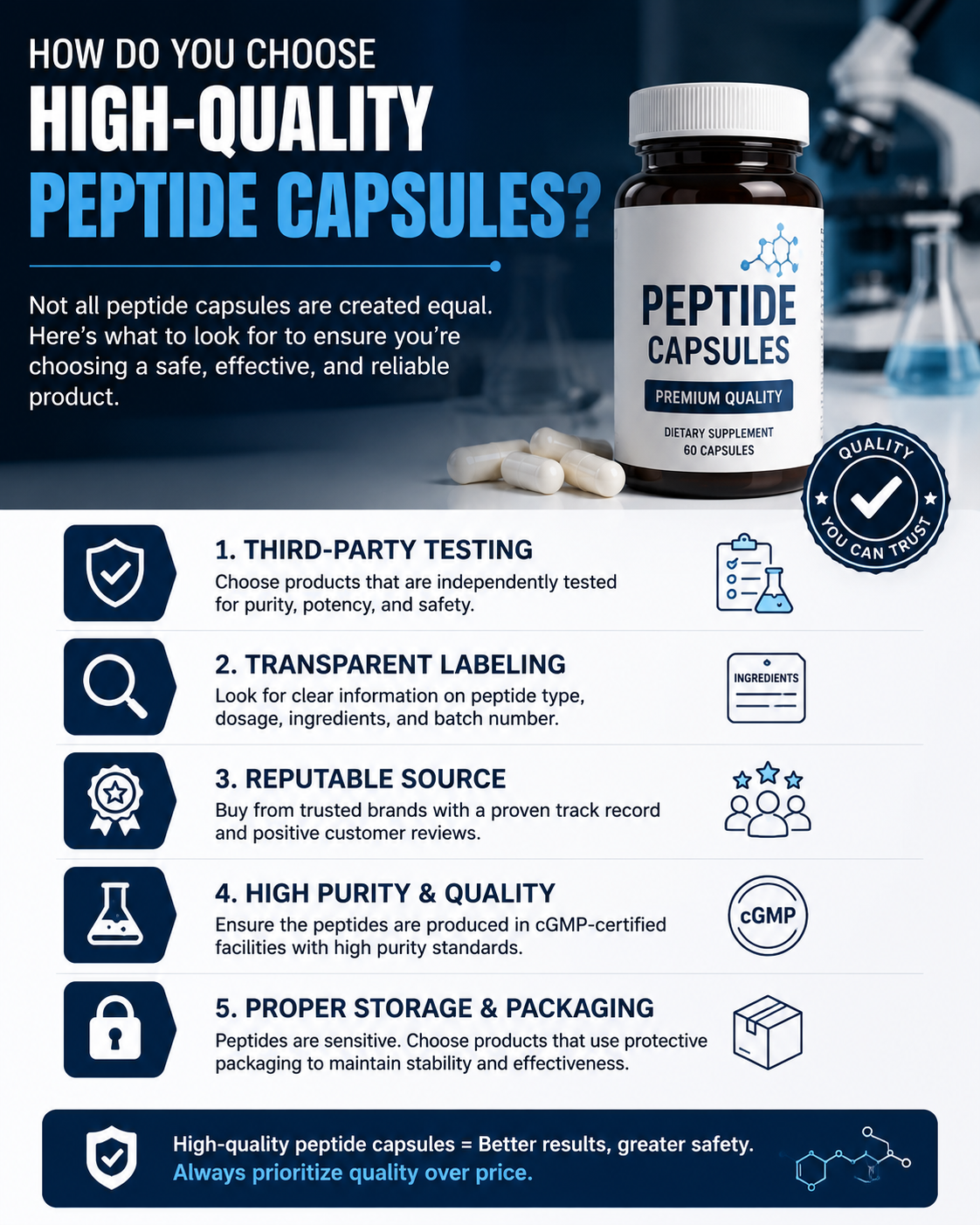
Not every product on the market lives up to its label, and that’s especially true in the oral peptide category, where formulation quality varies more than most beginners expect. Anyone comparing peptide capsules for sale for the first time needs a practical way to separate genuinely well-made products from ones that simply look professional on the outside. This guide breaks down exactly what to check.
Start With How the Product Addresses Digestion
The single biggest quality differentiator for oral peptides is whether — and how — a product addresses the fact that digestion is designed to break peptides apart before they can be absorbed. A high-quality capsule typically uses some form of protective formulation, most commonly an enteric coating, to help the compound survive the stomach’s acidic environment and reach the intestine where absorption conditions are somewhat more favorable.
If a product doesn’t mention any strategy for addressing this challenge at all, that’s a meaningful gap. It suggests the supplier may simply be encapsulating raw peptide powder without accounting for one of the most basic obstacles oral peptides face.
Check for Batch-Specific Third-Party Testing
Concentration claims on a label are only as trustworthy as the testing behind them. High-quality suppliers provide certificates of analysis (COAs) tied to specific manufacturing batches, verified by an independent lab rather than the manufacturer itself. Generic testing documents that don’t correspond to the actual batch you’re purchasing offer far less assurance, since formulation consistency can vary meaningfully from one production run to another, especially for smaller manufacturers.
When reviewing a COA, look for confirmation of both purity and actual peptide content — not just an absence of contaminants. A product can be free of harmful substances and still contain significantly less active compound than the label claims, which is a distinct issue that purity testing alone doesn’t catch.
Look at Concentration Transparency
A quality capsule product will clearly state how much of the active compound is present per capsule, not just a total amount somewhere on the packaging that requires guesswork to translate into an actual per-dose figure. Vague labeling makes it difficult to dose consistently and is often a sign that a supplier hasn’t invested much thought into the practical usability of their product.
Evaluate the Supplier’s Overall Track Record
A single well-reviewed product doesn’t guarantee a supplier maintains that same quality across their entire catalog. It’s worth checking whether a supplier applies consistent formulation standards, testing practices, and documentation across multiple products, rather than just the one you’re currently considering. Suppliers who treat quality as a consistent standard — not a one-off effort tied to a single popular item — tend to be more reliable long-term sources.
Read Instructions as Closely as Ingredients
Quality isn’t only about what’s inside the capsule; it’s also about whether the supplier gives you enough information to use the product correctly. Clear guidance on timing relative to meals, storage conditions, and shelf life all matter, since these factors can meaningfully affect how consistently a capsule performs. A product with vague or missing usage instructions puts more of the burden on the buyer to figure things out through trial and error.
Be Skeptical of Overstated Claims
Be cautious of listings that make broad, unqualified effectiveness claims without linking to any specific research, or that lean heavily on urgency-based marketing language rather than substantive product information. Suppliers confident in their formulation and testing tend to let that documentation speak for itself rather than relying primarily on persuasive marketing copy.
Weigh Price in Context, Not in Isolation
Price alone isn’t a reliable quality signal, but it’s a useful data point when considered alongside everything else. An unusually low price paired with no testing documentation is a bigger warning sign than a higher price backed by full transparency. The more productive approach is to filter for quality indicators first — formulation strategy, testing, concentration clarity — and then compare pricing among suppliers that already clear that bar.
Why Transparency Is the Clearest Signal
Across all of these factors, the common thread is transparency. Suppliers willing to explain their formulation approach, publish batch-specific testing, and provide clear dosing information before you buy — rather than only after you ask — are consistently the ones worth trusting. Brands like Iron Peptides have built their approach around exactly this kind of upfront documentation, which makes it considerably easier to evaluate a product on its actual merits rather than its packaging or marketing.
Building a Repeatable Evaluation Habit
As you compare capsule products, it helps to run through the same short checklist each time: Does the product address digestive breakdown through enteric coating or another strategy? Is there batch-specific third-party testing confirming both purity and concentration? Is dosing information clearly stated? Does the supplier’s documentation hold up consistently across their broader product line? Treating this as a habit rather than a one-time check makes it far easier to build a reliable shortlist of trustworthy suppliers over time.
The Bottom Line
Choosing high-quality peptide capsules comes down to documentation and formulation strategy more than packaging or price. Products that hold up under scrutiny are the ones whose suppliers are willing to show exactly how they’ve addressed the digestive challenge, how they’ve tested their product, and how it should be used. Taking the time to verify these details before buying is a small investment that pays off in far more consistent, trustworthy results.
None of this requires specialized expertise to evaluate — it simply requires asking the right questions before purchasing rather than after. A supplier’s willingness to answer those questions clearly, with actual documentation rather than reassurance alone, is usually the clearest indicator of whether a product is genuinely well made.
