
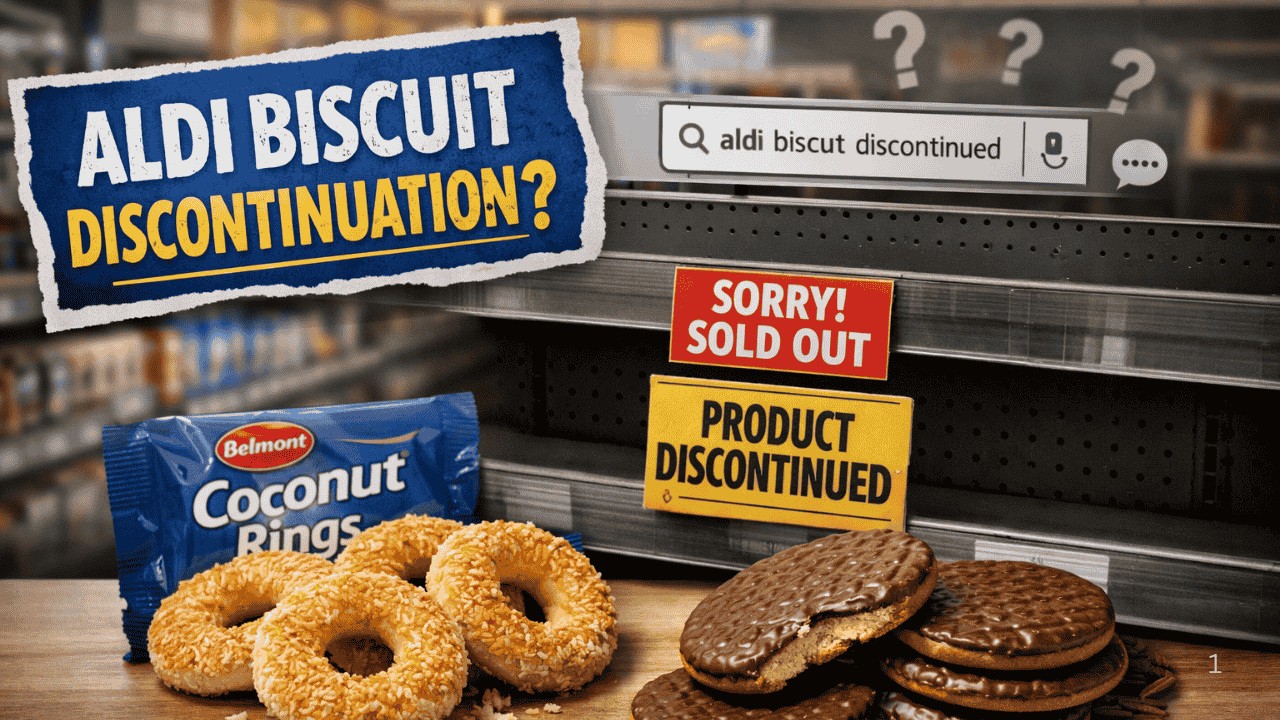
Few things frustrate loyal supermarket shoppers more than walking into a store, heading straight for a favorite snack, and discovering an empty space where it once sat. Over the past year, the phrase Aldi biscuit discontinuation has gained traction online as customers search for answers about missing products. From coconut rings to chocolate-coated classics, beloved Aldi biscuits have quietly disappeared — leaving shoppers confused, disappointed, and eager for explanations. But why does Aldi discontinue certain biscuits? Is it permanent? And could your favorite snack return? This article explores the causes behind Aldi’s biscuit discontinuation, highlights specific examples, and explains what it reveals about the retailer’s business strategy.
The Rise of Aldi Biscuit Discontinuation as a Trending Search
Search trends and social media discussions show growing interest in Aldi biscuit discontinuation. When shoppers notice a product missing for several weeks, they often turn to Google or Reddit to confirm their suspicions. Unlike major branded manufacturers, which issue press releases, Aldi frequently quietly makes product range adjustments.
This low-profile approach aligns with Aldi’s minimalist retail strategy — but it also leaves room for speculation. Consumers increasingly rely on online forums and Facebook groups to determine whether a product is:
- Temporarily out of stock
- Seasonally rotated
- Reformulated
- Permanently discontinued
As a result, the term “Aldi biscuit discontinuation” has become a recurring search query, especially in the UK and Australia.
Notable Examples of Aldi Biscuit Discontinuation
Several biscuit products have recently sparked discussion due to their sudden absence.
Belmont Biscuit Coconut Rings
One of the most talked-about cases of Aldi biscuit discontinuation involves Belmont Biscuit Coconut Rings. These ring-shaped coconut biscuits developed a strong following among shoppers looking for affordable alternatives to branded coconut cookies.
Customers began noticing the product’s absence in late 2024, and after weeks of empty shelves, many concluded it had been discontinued. Social media posts showed shoppers expressing disappointment and even attempting to stockpile remaining packs in certain locations.
Chocolate Rich Tea Biscuits
Another case tied to Aldi biscuit discontinuation was Chocolate Rich Tea biscuits. This product combined the classic British tea biscuit with a chocolate coating, making it a popular everyday treat.
When these biscuits disappeared, shoppers quickly questioned whether they were gone for good. As with many Aldi range changes, no widespread announcement was made — reinforcing the mystery around product removals.
Why Does Aldi Discontinue Biscuits?
Understanding Aldi biscuit discontinuation requires understanding Aldi’s business model. Unlike traditional supermarkets, Aldi operates with a lean product range. Most stores carry around 1,500–2,000 core items, compared to 30,000 or more in large supermarkets.
This limited assortment means:
- Shelf space is extremely competitive
- Products must sell consistently
- New launches frequently replace older lines
There are several key reasons why Aldi discontinues biscuit products.
Performance and Sales Data
If a biscuit does not meet internal sales targets, it may be removed to make space for faster-selling alternatives. Even if a product has a loyal fan base, overall volume matters more than individual enthusiasm.
Supplier or Production Changes
Private-label products, such as those under the Belmont label, are manufactured by third-party suppliers. If production costs rise or contracts change, Aldi may choose to reformulate or discontinue the item entirely.
Seasonal Rotation Strategy
Aldi is known for its rotating “Specialbuys” and limited-time offerings. Some biscuit varieties may not be permanently discontinued but instead cycle in and out seasonally.
Cost Pressures and Inflation
In periods of rising ingredient costs — such as cocoa, sugar, and wheat — lower-margin products may be removed from the range.
Customer Reaction to Aldi Biscuit Discontinuation
One reason the phrase Aldi biscuit discontinuation continues to trend is the emotional attachment shoppers develop to certain products.
Unlike premium brands, Aldi biscuits often represent:
- Affordable comfort food
- Reliable pantry staples
- Unique alternatives to big-name brands
When these items vanish without explanation, shoppers feel blindsided. Online forums often include comments like:
- “Has anyone seen these lately?”
- “I think they’ve discontinued them!”
- “They were better than the branded version.”
In some cases, customers directly contact Aldi’s customer service or tag the retailer on social media platforms to ask about discontinued items.
Do Discontinued Aldi Biscuits Ever Come Back?
One of the most important aspects of Aldi biscuit discontinuation is that it isn’t always permanent.
There have been instances where customer demand influenced reintroductions. In Australia, for example, certain biscuit lines have been reintroduced following public feedback.
Products such as Elkes Sports Shortcake Biscuits were reintroduced after shopper demand. While not every discontinued biscuit comes back, Aldi closely monitors customer feedback.
If a product shows strong seasonal spikes or sustained demand, it may reappear in an updated form.
How Aldi’s Business Model Encourages Discontinuation
Aldi operates differently from most supermarkets. The retailer focuses on:
- Private-label dominance
- Low operational costs
- Efficient inventory turnover
- Minimal in-store complexity
Because of this, Aldi biscuit discontinuation is not unusual — it is part of the brand’s operational DNA.
Each time Aldi introduces a new biscuit product, something else often gets left behind. This constant refresh keeps the range streamlined and competitive.
What Shoppers Can Do If Their Favorite Biscuit Is Discontinued
If you suspect an Aldi biscuit discontinuation, there are several steps you can take:
Ask In-Store Staff
Employees can sometimes confirm whether an item is out of stock or permanently removed.
Contact Customer Service
Aldi’s customer support teams can verify product status.
Monitor Seasonal Rotations
Some products return during holidays or special promotions.
Look for Alternatives
Aldi often replaces discontinued biscuits with similar or improved versions.
The Bigger Picture: Retail Evolution and Consumer Habits
The growing attention around Aldi biscuit discontinuation reflects broader retail shifts.
Modern grocery retail is highly data-driven. Every product is tracked for:
- Sales performance
- Customer purchase frequency
- Profit margins
- Shelf efficiency
In this environment, sentiment alone does not guarantee survival. Even popular items can disappear if they do not meet financial benchmarks.
However, Aldi’s willingness to adapt quickly also benefits shoppers. By eliminating slow sellers, the retailer can:
- Introduce trend-driven flavors
- Maintain low prices
- Keep shelves fresh and exciting
Is Aldi Biscuit Discontinuation a Bad Thing?
While disappointing for fans of specific products, Aldi biscuit discontinuation is not necessarily negative.
From a business perspective, it allows:
- Competitive pricing
- Agile product development
- Faster adaptation to trends
- Efficient supply chains
From a shopper’s perspective, though, it can feel abrupt. The key frustration is often the lack of clear communication rather than the discontinuity itself.
Greater transparency around product removals could reduce speculation and improve customer satisfaction.
The Future of Aldi Biscuits
Looking ahead, Aldi is likely to continue refining its biscuit range. Consumer trends currently influencing biscuit offerings include:
- Premium-style indulgent biscuits
- Health-conscious options (reduced sugar, gluten-free)
- Seasonal novelty flavors
- Plant-based formulations
As tastes evolve, some older lines may give way to new innovations. The cycle of Aldi biscuit discontinuation and introduction will likely remain a constant feature of the brand.
Conclusion
The Aldi biscuit discontinuation represents more than a missing snack — it reflects the realities of modern retail strategy. Aldi operates on efficiency, data, and constant range optimization. While this approach keeps prices competitive and shelves dynamic, it also means that even beloved biscuit varieties can vanish without warning.
