
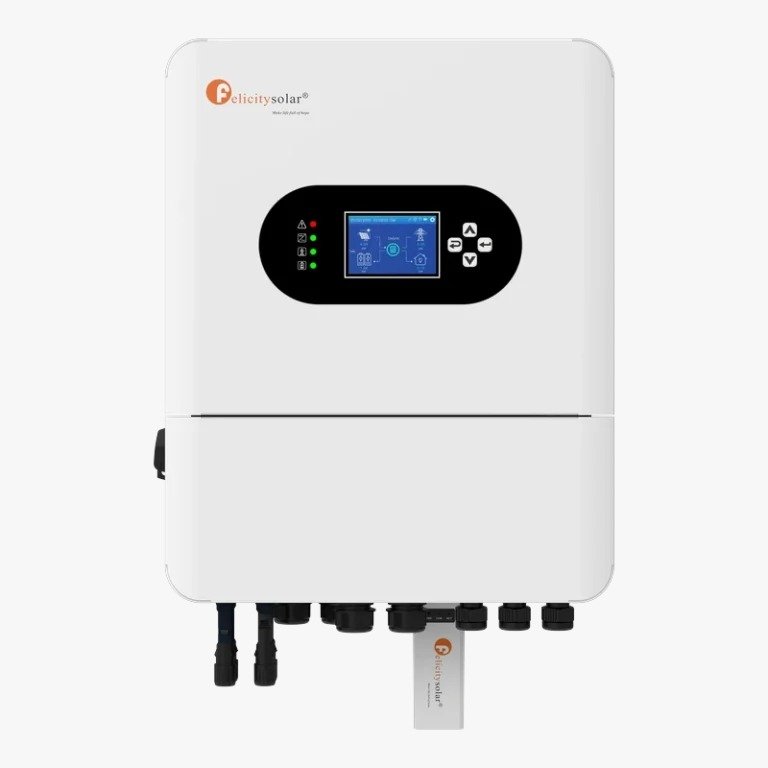
Commercial facilities run on three-phase power. Your hybrid solar inverter must distribute solar energy evenly across all three phases. Many installers connect solar to only one phase. The inverter produces power. That power offsets only one third of your facility’s load. The other two phases still draw full price from the grid. Your utility bill drops less than expected. A properly configured commercial inverter monitors all three phases. It injects solar power where it is needed most. It can even pull from one phase and supply another to balance the load. Ask your installer to show the phase balancing configuration. If they have not set it up, your solar savings are capped at one third of your potential. Demand three-phase monitoring and active balancing. Your return on investment depends on it.
The Power Factor Penalty That Hides In Your Bill
Your utility charges for real power and for poor power factor. A low power factor means your facility uses more current than necessary. That extra current heats wires and transformers. The utility penalizes you. A standard solar inverter operates at unity power factor. It does not help. A hybrid solar inverter with reactive power control can improve your facility’s power factor. It injects or absorbs reactive power as needed. Your power factor improves. Your penalty disappears. Ask your installer about reactive power capability. If their inverter cannot provide it, your solar system solves half your electrical problems. The other half remains. Your utility bill still includes power factor penalties. Specify an inverter with full reactive power control. Your savings will include the penalty reduction.
The Peak Demand Charge That Solar Alone Cannot Fix
Your utility charges for peak demand. The highest fifteen minutes of power use in the month. That charge can be half your bill. Solar reduces your energy use. It does not always reduce your peak demand. A cloud passes. Your solar drops. Your facility pulls from the grid. The peak registers. A hybrid solar inverter with battery storage solves this. The battery discharges during clouds. Your grid draw stays flat. Your peak demand stays low. The inverter must be configured for peak shaving, not just time-of-use arbitrage. Ask your installer about peak demand management. If they have never heard of it, their solar-only approach leaves money on the table. Add storage. Configure peak shaving. Your demand charges will finally drop.
The Islanding Detection That Shuts You Down Unnecessarily
Your inverter must detect when the grid fails. It must stop exporting power. This is islanding detection. Required by law. But some inverters are too sensitive. They see grid disturbances as failures. They shut down. Your commercial facility loses solar power even though the grid is fine. A quality inverter uses multiple detection methods. It distinguishes between real grid failures and normal disturbances. It stays online when it should. Ask your supplier about islanding detection sensitivity. If they cannot adjust it, your inverter will nuisance-trip. Your solar production will be unreliable. Your facility will pull from the grid when it could have used solar. Specify adjustable detection. Your inverter will stay online when the grid is healthy.
The Anti-Islanding Zone That Changes By Utility
Different utilities have different requirements. Voltage windows. Frequency windows. Trip times. Reconnect delays. A hybrid solar inverter programmed for one utility may fail inspection at another. Your installer must program the correct grid profile for your utility. Not a generic profile. The specific profile approved by your utility. Ask to see the grid profile selection. If your installer does not know your utility’s requirements, your system will not pass inspection. Or it will pass but trip unnecessarily. Or it will fail to trip when it should. Either outcome is bad. Demand the correct grid profile. Your utility interconnection agreement depends on it.
The One Report That Proves Your System Is Compliant
Ask your installer for a grid compliance test report. Not a self-certification. A report from a third-party test instrument. The report should show trip times, voltage windows, frequency response, and anti-islanding performance. This report is your proof that the inverter meets utility requirements. Without it, your utility can disconnect you at any time. With it, you have documentation. Your hybrid solar inverter may be compliant. The report proves it. Demand the report before final payment. Your utility relationship and your solar savings both depend on compliance. Not assumed. Proven. Get the proof. Keep it on file. Your future self will thank you during every utility audit.
