
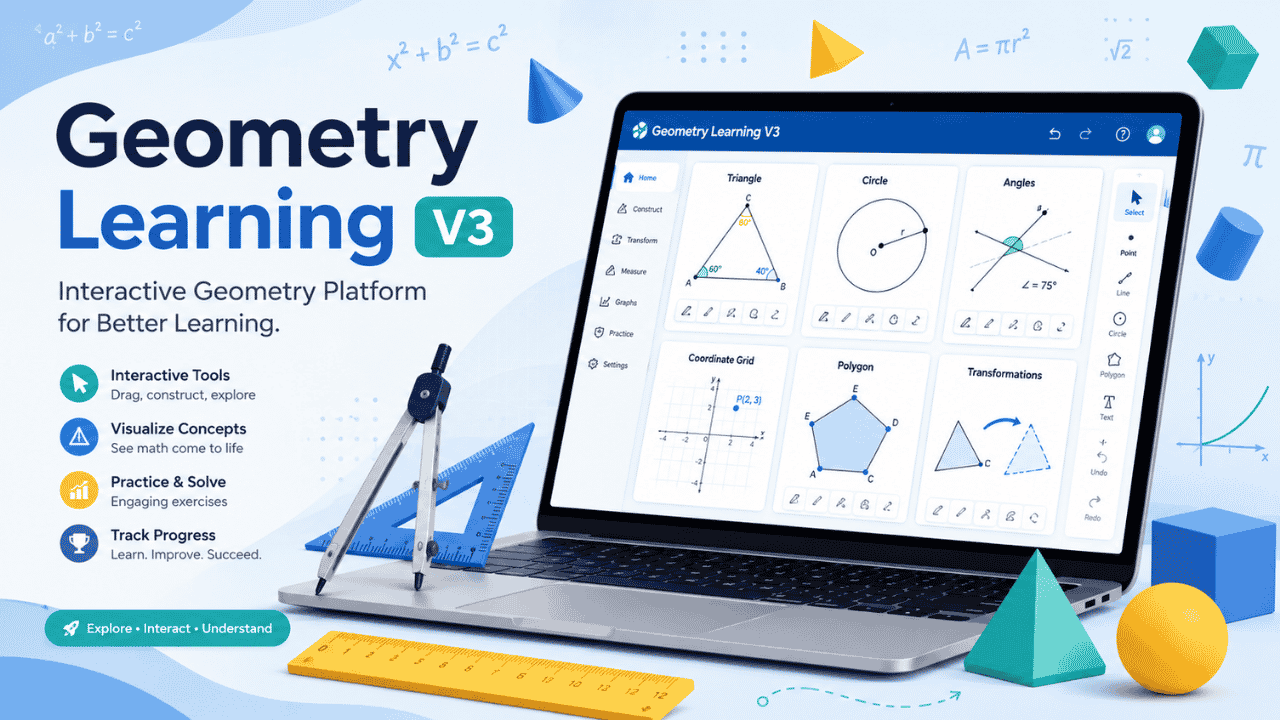
Geometry is one of the most important branches of mathematics, helping students understand shapes, sizes, angles, distances, and spatial relationships. Traditional classroom learning often relies on textbooks and static diagrams, but modern educational platforms aim to make geometry more engaging and interactive. One resource that has attracted attention is Geometry Learning v3, a browser-based educational platform designed to help learners explore geometric concepts through visual lessons, interactive activities, and practice exercises. Whether you are a student preparing for exams, a teacher looking for classroom resources, or a parent supporting a child’s education, understanding what Geometry Learning v3 offers can help you choose an effective learning tool. This guide explains everything you need to know about geometry learning v3, including its features, topics, advantages, educational benefits, and limitations.
What Is Geometry Learning V3?
Geometry Learning V3 is commonly described as an online educational resource that focuses on teaching geometry through interactive learning methods. Instead of relying only on printed diagrams and memorization, the platform encourages students to explore geometric concepts visually using browser-based tools, exercises, and demonstrations.
Although limited official documentation is available regarding its development, many educational articles describe Geometry Learning v3 as a lightweight platform that makes geometry easier to understand through practical examples and interactive content.
Its primary goal is to improve conceptual understanding while making mathematics more engaging for learners of different ages.
Why Geometry Learning Matters
Geometry plays an essential role in mathematics and everyday life. Students use geometry to understand:
- Shapes and figures
- Angles and measurements
- Distance calculations
- Area and perimeter
- Volume and surface area
- Coordinate systems
- Symmetry
- Transformations
Beyond the classroom, geometry is used in architecture, engineering, construction, graphic design, robotics, navigation, computer graphics, and game development.
Interactive learning platforms such as Geometry Learning V3 attempt to simplify these concepts by allowing learners to visualize them rather than read definitions.
Main Topics Covered in Geometry Learning V3
The platform is commonly associated with lessons covering the fundamental concepts of geometry.
Points, Lines, and Planes
Students begin by learning the basic building blocks of geometry, including:
- Points
- Lines
- Line segments
- Rays
- Parallel lines
- Perpendicular lines
Understanding these concepts provides the foundation for more advanced geometry topics.
Angles
Geometry learning v3 introduces different types of angles, including:
- Acute angles
- Right angles
- Obtuse angles
- Straight angles
- Reflex angles
Students also learn how complementary and supplementary angles work and how angle relationships appear in real geometric figures.
Triangles
Triangles are one of the most important topics in geometry.
Students typically learn about:
- Equilateral triangles
- Isosceles triangles
- Scalene triangles
- Right triangles
- Acute triangles
- Obtuse triangles
Lessons may include properties, angle relationships, side classifications, and area calculations.
Quadrilaterals
Another important section focuses on four-sided figures, including:
- Squares
- Rectangles
- Rhombuses
- Parallelograms
- Trapezoids
- Kites
Students compare similarities and differences between these shapes while learning their properties.
Polygons
Geometry learning v3 also introduces polygons with different numbers of sides, such as pentagons, hexagons, octagons, and decagons. Learners explore how interior and exterior angles change as the number of sides increases.
Circles
Circle geometry is another major topic.
Students learn about:
- Radius
- Diameter
- Circumference
- Chords
- Tangents
- Arcs
- Sectors
Lessons often explain how these elements relate to one another.
Coordinate Geometry
Coordinate geometry combines algebra and geometry by plotting points on a coordinate plane.
Students practice:
- Graphing points
- Finding distances
- Determining midpoints
- Understanding slopes
- Working with coordinate systems
Transformations
Geometry learning v3 also introduces geometric transformations, including:
- Translation
- Rotation
- Reflection
- Dilation
These concepts help students understand how shapes move while maintaining or changing their dimensions.
Interactive Learning Features
One of the reasons geometry learning v3 is frequently discussed is its interactive learning approach.
Commonly reported features include:
Visual Demonstrations
Instead of static textbook images, learners can observe shapes from multiple perspectives, making abstract concepts easier to understand.
Practice Activities
Students can reinforce lessons through exercises that test their understanding immediately after learning new material.
Step-by-Step Learning
Complex geometry problems are typically broken into smaller steps, helping beginners understand the reasoning behind each solution.
Browser Accessibility
Because geometry learning v3 is browser-based, users generally do not need to install additional software. They can access lessons directly through a compatible web browser.
Self-Paced Study
Students can review lessons multiple times until they fully understand the concepts before moving on to more advanced topics.
Benefits of Geometry Learning V3
Many learners appreciate interactive geometry platforms because they provide several educational advantages.
Better Conceptual Understanding
Interactive diagrams allow students to visualize geometric relationships rather than memorizing formulas without understanding them.
Increased Student Engagement
Colorful illustrations, animations, and interactive exercises can make geometry feel less intimidating compared to traditional textbooks.
Improved Problem-Solving Skills
Regular practice encourages learners to analyze geometric problems logically and develop stronger mathematical reasoning.
Flexible Learning
Students can study at their own pace, making the platform useful for classroom learning, homeschooling, or independent study.
Immediate Feedback
Practice exercises often provide instant feedback, allowing students to identify mistakes and improve their understanding quickly.
Who Can Use Geometry Learning V3?
Geometry Learning V3 is generally suitable for various types of learners, including:
- Elementary school students
- Middle school students
- High school students
- College beginners
- Teachers
- Parents
- Homeschool educators
- Adult learners reviewing mathematics
Its beginner-friendly explanations make it accessible even for learners with limited geometry experience.
Real-World Applications of Geometry
Learning geometry extends far beyond classroom assignments.
Professionals use geometric principles in numerous industries, including:
Architecture
Architects design buildings using geometric measurements, symmetry, and spatial planning.
Engineering
Mechanical, civil, and structural engineers rely heavily on geometry when designing bridges, machines, roads, and infrastructure.
Construction
Builders use angles, measurements, and geometric calculations throughout construction projects.
Graphic Design
Designers apply geometric principles when creating logos, illustrations, and digital artwork.
Computer Graphics
Modern video games and animation use geometry extensively for modeling three-dimensional objects and environments.
Robotics
Robotics engineers use geometric calculations to determine movement, positioning, and navigation.
Navigation and Mapping
GPS systems, maps, and geographic information systems all depend on geometric concepts.
Tips for Learning Geometry More Effectively
To get the most from geometry learning v3 or any geometry resource, consider these study strategies:
- Practice solving problems every day.
- Draw diagrams whenever possible.
- Understand concepts before memorizing formulas.
- Review mistakes carefully.
- Use interactive tools to visualize shapes.
- Learn how formulas are derived.
- Apply geometry to real-world examples.
- Revise previous topics before starting new ones.
Consistent practice is one of the best ways to improve geometry skills.
Advantages and Limitations
Like any educational platform, Geometry Learning v3 has both strengths and limitations.
Advantages
- Interactive learning experience
- Beginner-friendly lessons
- Browser-based accessibility
- Visual explanations
- Self-paced study
- Practice exercises
- Useful for independent learning
- Covers many foundational geometry topics
Limitations
- Limited official information about the platform
- Features may vary over time
- May not replace a complete school curriculum
- Advanced mathematical topics may require additional resources
- Users should verify information directly from the official website when possible
Frequently Asked Questions
Is Geometry Learning v3 free?
Availability and pricing may vary depending on how the platform is accessed. Users should check the official website for the latest information.
Is Geometry Learning v3 suitable for beginners?
Yes. It is commonly described as beginner-friendly, with visual explanations and step-by-step lessons.
Can teachers use Geometry Learning v3?
Teachers may use it as a supplementary classroom resource alongside textbooks and lesson plans.
Does Geometry Learning v3 cover advanced geometry?
Most publicly available descriptions focus on foundational and intermediate geometry topics. Learners seeking advanced mathematics may need additional resources.
Can students use it for exam preparation?
Yes. Interactive lessons and practice exercises can help reinforce geometry concepts commonly covered in school exams.
Conclusion
Geometry learning v3 represents a modern approach to geometry education by combining visual explanations, interactive exercises, and self-paced learning. Rather than relying solely on memorization, it encourages students to explore mathematical concepts through practical demonstrations that improve conceptual understanding and problem-solving skills.
You May Like: Use of Trigonometry in Architecture: Importance, Applications, and Real-World Examples
