
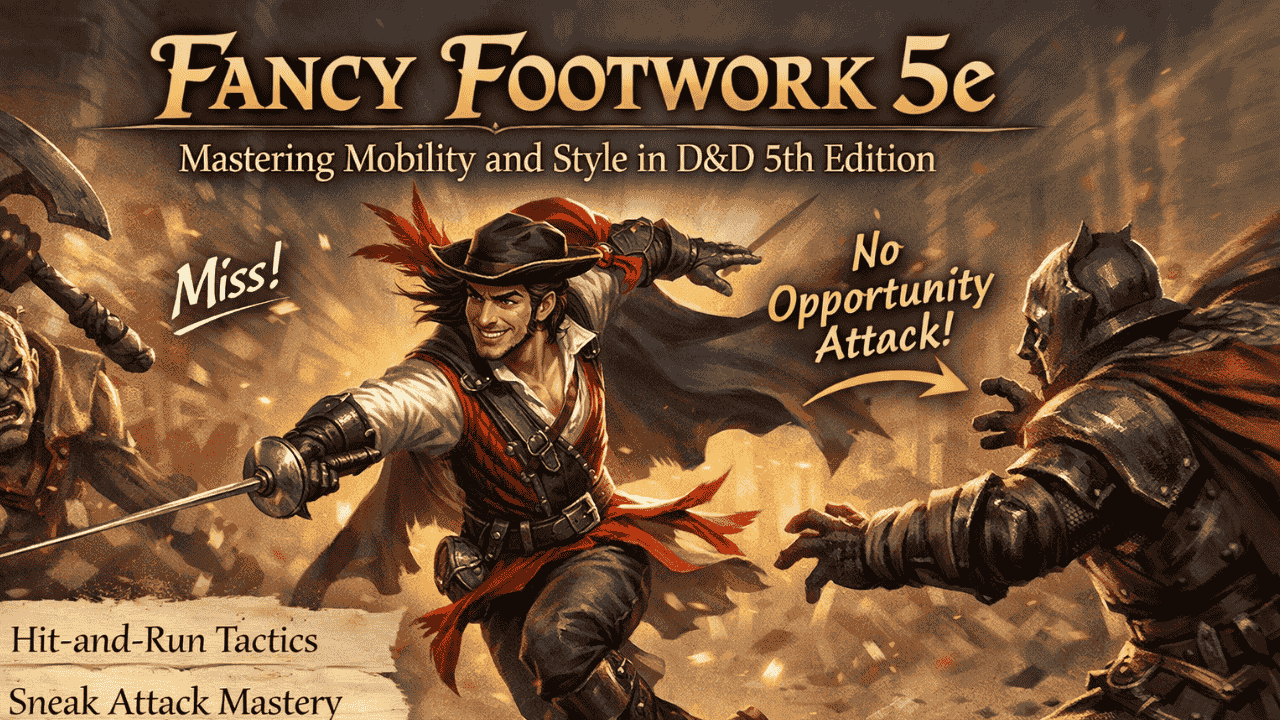
In Dungeons & Dragons Fifth Edition, combat is often imagined as a static exchange of blows, but some characters turn the battlefield into a dance floor. One of the most iconic examples of this agile, hit-and-run style is fancy footwork 5e, a defining feature of the Swashbuckler Rogue. This ability captures the fantasy of a daring duelist who slips in, strikes with precision, and glides away before enemies can react. This article provides a deep, practical, and rules-accurate exploration of fancy footwork 5e. We will cover how it works, why it is powerful, how it interacts with other rules, how to optimize it in play, and how it shapes roleplay and narrative at the table. Whether you are a new player considering Swashbuckler or an experienced Dungeon Master adjudicating tricky movement rules, this guide will give you a complete understanding of the feature.
What is Fancy ootwork 5e?
Fancy footwork 5e is a class feature gained by Rogues who choose the Swashbuckler archetype at Rogue level 3. At its core, it modifies how opportunity attacks work against the rogue.
The feature states, in effect, that during your turn, if you make a melee attack, an attack directed at a creature prevents that creature from performing opportunity attacks against you for the remainder of your turn. This single sentence dramatically changes how the rogue can move in combat.
Unlike the Disengage action, Fancy Footwork does not cost an action, bonus action, or resource. It is always on, always available, and rewards aggressive, confident positioning. If you step in and make a melee attack—even if it misses—you earn the freedom to step away safely.
The Core Mechanics Explained Simply
To understand fancy footwork 5e, it helps to break it down into its essential components:
- It only works on your turn
The protection from opportunity attacks applies only during your turn. Once your turn ends, the normal rules return. - It requires a melee attack
You must make a melee attack against a creature. Ranged attacks do not trigger the feature. - It applies only to the creature you attacked
If you attack one enemy, only that enemy is prevented from making opportunity attacks against you. Other nearby enemies can still react normally. - The attack does not need to hit
This is crucial. The rules specify “make a melee attack,” not “hit with a melee attack.” Even a miss activates Fancy Footwork.
These four points form the foundation of how the ability works and why it is so effective.
Why Fancy Footwork 5e Is So Powerful
On paper, Fancy Footwork may look like a niche mobility perk, but in practice it is one of the strongest positioning tools available to a martial character.
First, it effectively gives the Swashbuckler a free Disengage, every turn, against at least one enemy. Most characters must spend their action (or a bonus action, if they are a rogue using Cunning Action) to disengage safely. Fancy Footwork removes that cost entirely.
Second, it allows the Swashbuckler to dictate the flow of combat. You can dart into melee, deliver Sneak Attack damage, and retreat to safety—forcing enemies to chase you, reposition, or waste actions.
Third, Fancy Footwork synergizes perfectly with the Swashbuckler’s other level 3 feature, Rakish Audacity, which encourages one-on-one duels. Together, these features reward bold, stylish play where the rogue thrives in isolated engagements.
Fancy Footwork 5e vs Disengage
A common question is how fancy footwork 5e compares to the Disengage action, especially since rogues already have access to Disengage as a bonus action through Cunning Action.
The key difference is scope:
- Disengage: Prevents opportunity attacks from all enemies for the rest of your turn.
- Fancy Footwork: Prevents opportunity attacks from one specific enemy you attacked.
In situations where you are surrounded, Disengage is still superior. However, in the most common Swashbuckler scenario—dueling a single foe—Fancy Footwork is strictly better, since it costs nothing.
This distinction encourages tactical thinking. Skilled Swashbucklers switch fluidly between Fancy Footwork and Disengage depending on battlefield conditions.
Rules, Interactions, and Edge Cases
Because fancy footwork 5e hinges on the phrase “make a melee attack,” it interacts with many other rules in interesting ways.
Missing Still Works
As mentioned earlier, a missed attack still counts. This means you can safely provoke Fancy Footwork even when attacking heavily armored enemies. You are not gambling your mobility on a hit roll.
Special Melee Attacks
Grapples and shoves are defined as special melee attacks. Attempting a grapple or shove against a creature is enough to activate Fancy Footwork, even if the attempt fails. This opens up creative tactics, such as shoving an enemy prone and then stepping away without retaliation.
Spell Attacks in Melee
Some spells involve melee attacks, such as booming blade. When you cast such a spell and make the melee attack as part of it, you still qualify for Fancy Footwork. This is especially popular with Swashbucklers who multiclass or gain spellcasting through feats.
Opportunity Attacks vs Other Reactions
Fancy Footwork only prevents opportunity attacks, not all reactions. If a creature has a reaction that is not an opportunity attack, it may still use it normally.
Sentinel, Mobile, and Other Comparisons
Players often compare fancy footwork 5e to other mobility-related abilities, especially the Mobile feat.
Mobile includes a feature that states that when you make a melee attack, an attack directed at a creature prevents that creature from executing opportunity attacks against you for the remainder of the turn—nearly identical wording to Fancy Footwork. The main difference is that Mobile applies to any character who takes the feat, while Fancy Footwork is exclusive to Swashbucklers.
Another frequent topic is the Sentinel feat, which allows creatures to make opportunity attacks even against enemies who take the Disengage action. Importantly, Fancy Footwork does not rely on Disengage, so Sentinel does not bypass it. This makes Swashbucklers uniquely slippery, even against heavily controlling enemies.
Tactical Uses in Combat
Mastering fancy footwork 5e means thinking beyond simple hit-and-run tactics.
Isolating Enemies
By striking and retreating, you can lure enemies away from their allies. This works especially well in tight dungeon corridors or urban environments where movement matters.
Protecting Allies
You can engage an enemy threatening a weaker party member, attack to trigger Fancy Footwork, and then reposition yourself to block movement or draw attention elsewhere.
Maximizing Sneak Attack
Because Sneak Attack often requires specific positioning or ally proximity, Fancy Footwork helps you enter ideal positions without being trapped afterward.
Roleplay and Narrative Flavor
Beyond mechanics, fancy footwork 5e reinforces a strong narrative identity. Swashbucklers are not just rogues with swords—they are duelists, performers, and charismatic daredevils.
In roleplay, Fancy Footwork might look like:
- A rapier flick followed by a theatrical bow as the rogue steps out of reach
- A spinning slash and effortless sidestep, cloak swirling dramatically
- A taunting grin as the enemy swings at empty air
Dungeon Masters can lean into this flavor, describing enemies growing frustrated or impressed by the rogue’s effortless movements.
Common Mistakes to Avoid
Even experienced players sometimes misunderstand 5e fancy footwork. Here are a few common pitfalls:
- Assuming it works against multiple enemies: It does not. Only the creature you attacked is affected.
- Forgetting the “your turn” limit: The protection ends when your turn ends.
- Trying to trigger it with ranged attacks: Only melee attacks count.
Avoiding these mistakes ensures smooth play and fewer rules disputes at the table.
Conclusion: Why Fancy Footwork 5e Defines the Swashbuckler
In the landscape of D&D Fifth Edition, fancy footwork 5e stands out as a feature that perfectly blends mechanics, tactics, and fantasy. It empowers the Swashbuckler to fight with confidence, mobility, and flair, transforming combat into a dynamic exchange rather than a static slugfest.
