
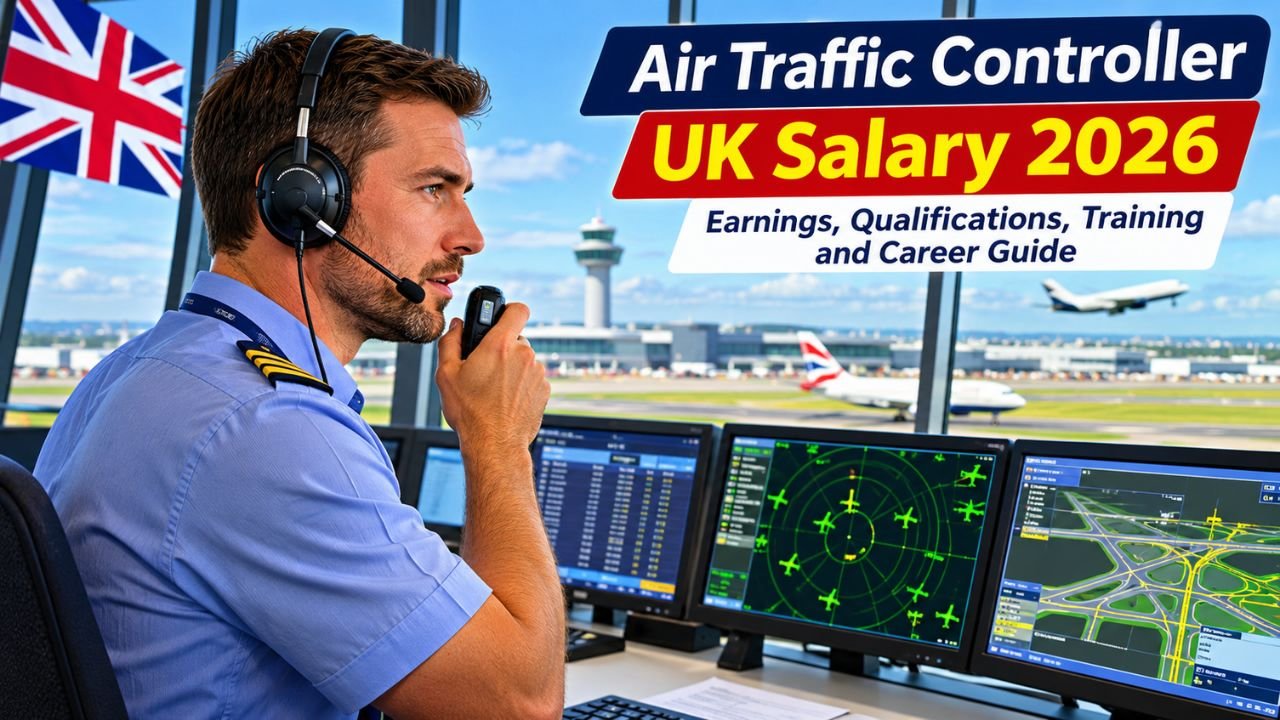
The aviation industry offers many rewarding career opportunities, and air traffic control is among the most financially attractive professions in the United Kingdom. Air traffic controllers play an essential role in maintaining aviation safety, coordinating aircraft movements and ensuring that millions of passengers reach their destinations safely.
The air traffic controller UK salary varies depending on professional experience, qualifications, location and employer. While trainees receive competitive financial packages, experienced controllers can earn more than £100,000 annually at major airports.
With paid professional training, attractive employment benefits and opportunities for career advancement, air traffic control is an appealing career choice for individuals interested in aviation, technology and problem-solving.
This comprehensive guide explores air traffic controller salaries in the UK, monthly earnings, training requirements, qualifications, responsibilities and career development opportunities.
1. What Is an Air Traffic Controller?
An air traffic controller is a trained aviation professional responsible for coordinating the safe and efficient movement of aircraft.
These professionals communicate directly with pilots, monitor aircraft positions and provide instructions concerning flight routes, landing procedures and take-offs.
Air traffic controllers use sophisticated radar systems, communication equipment and aviation software to manage aircraft movements. Their decisions are essential in preventing collisions, reducing delays and maintaining an organised aviation network.
Air traffic control requires excellent concentration, communication skills, attention to detail and the ability to make accurate decisions under pressure.
The significant responsibilities associated with this profession help explain its attractive earning potential.
2. Average Air Traffic Controller UK Salary in 2026
According to the UK’s National Careers Service, air traffic controller salaries generally range from £48,000 for qualified beginners to £100,000 for experienced professionals.
Senior controllers working at larger airports may earn more than £100,000 annually. Get careers information and advice
The following table provides an overview of potential annual earnings.
| Career Level | Annual Salary |
|---|---|
| Trainee basic salary | £25,500 |
| Trainee package with accommodation allowance | £34,611.60 |
| Unit-based trainee | £37,490–£42,786 |
| Newly qualified NATS controller | £50,468–£56,247 |
| Senior air traffic controller | £70,000–£100,000+ |
These figures combine published NATS training and qualification rates for 2026 with broader industry salary guidance. Actual earnings depend on individual employment arrangements. NATS+1
3. Trainee Air Traffic Controller Salary in the UK
One of the most attractive aspects of becoming an air traffic controller is the opportunity to earn money during professional training.
NATS, a major UK air navigation service provider, offers a basic annual trainee salary of £25,500 in 2026.
Trainees also receive an annualised accommodation allowance of £9,111.60 during basic training, bringing their total package to £34,611.60.
Additional financial incentives include a £1,000 welcome bonus and a £500 bonus after completing college training. NATS
Unlike many professions requiring expensive university education, air traffic control provides an opportunity to develop specialised skills while earning an income.
However, candidates must successfully complete assessments and meet strict professional standards before being accepted into training.
4. Air Traffic Controller UK Salary Per Month
Understanding monthly earnings can help prospective air traffic controllers evaluate the financial benefits of this career.
| Annual Earnings | Gross Monthly Earnings |
|---|---|
| £25,500 | £2,125 |
| £34,611.60 | £2,884.30 |
| £37,490 | £3,124.17 |
| £42,786 | £3,565.50 |
| £50,468 | £4,205.67 |
| £56,247 | £4,687.25 |
| £70,000 | £5,833.33 |
| £100,000 | £8,333.33 |
These monthly figures represent gross annual earnings divided by 12. Income tax, National Insurance, pension contributions and other deductions may reduce actual take-home pay.
Accommodation allowances, bonuses and additional payments may also affect monthly income.
5. NATS Air Traffic Controller Salary
NATS is one of the most important organisations in the UK aviation industry. It provides air traffic management services and employs highly trained aviation professionals.
The NATS salary structure reflects different stages of professional development. Controllers begin with a trainee salary before progressing to higher earnings following practical training and professional qualification.
During unit-based training, earnings can rise to approximately £37,490–£42,786, including shift allowances. Successfully qualified controllers can earn between £50,468 and £56,247, depending on their assigned operational unit. NATS
As controllers gain experience, they may become eligible for additional responsibilities and higher salary grades.
6. Experienced Air Traffic Controller Salary in the UK
Experienced air traffic controllers generally earn significantly more than newly qualified professionals.
Their extensive operational knowledge, professional qualifications and ability to manage complicated airspace contribute to their earning potential.
Senior controllers at larger UK airports can earn between £70,000 and more than £100,000 annually.
Experienced professionals may also pursue opportunities in management, operational supervision, training and assessment. Get careers information and advice
Career progression depends on performance, available positions, professional competence and employer requirements rather than experience alone.
7. Factors Affecting Air Traffic Controller UK Salary
Several important factors influence how much an air traffic controller earns in the United Kingdom.
Professional Experience
Experienced controllers may qualify for higher salary grades because of their operational knowledge and ability to handle complex responsibilities.
Employment Location
Controllers working at major airports and busy control centres may have different salary arrangements compared with those employed at smaller regional airports.
Employer
Different aviation organisations offer different salaries, allowances, pension arrangements and employment benefits.
Professional Qualifications
Specialist licences, operational ratings and additional professional training can create opportunities for career advancement.
Shift Allowances
Air traffic control services often operate around the clock. Depending on employment contracts, controllers may receive allowances associated with irregular working hours.
Additional Responsibilities
Supervisory duties, staff training and operational management can influence overall compensation.
8. Highest-Paying Air Traffic Control Workplaces in the UK
Major airports and air traffic management centres provide important employment opportunities for qualified controllers.
Examples of significant UK aviation workplaces include:
- Heathrow Airport
- Gatwick Airport
- Manchester Airport
- Birmingham Airport
- London Stansted Airport
- Edinburgh Airport
- Swanwick Control Centre
- Prestwick Control Centre
Busy aviation environments require highly skilled professionals capable of managing complex aircraft movements.
Although experienced controllers at major airports may earn substantial salaries, exact workplace-specific pay rates vary. A reliable ranking of the highest-paying individual UK airports is not publicly established by the salary sources used in this article.
9. Different Types of Air Traffic Controllers
Air traffic control includes several professional specialisations, each involving different responsibilities.
Tower Controllers
Tower controllers coordinate aircraft movements around airports, including runway operations, departures, arrivals and ground movements.
Approach Controllers
Approach controllers manage aircraft arriving at and departing from airports. They coordinate flight paths and help maintain appropriate separation between aircraft.
Area Controllers
Area controllers oversee aircraft travelling through designated sections of airspace. They monitor flight movements and coordinate transfers between control sectors.
Military Air Traffic Controllers
Military controllers support armed forces aviation operations. Their employment conditions, training and salaries follow different arrangements from civilian air traffic control.
Each specialisation requires appropriate professional training and qualifications.
10. Qualifications Required to Become an Air Traffic Controller
A university degree is not necessarily required to become an air traffic controller in the UK. However, applicants must demonstrate strong academic abilities, professional aptitude and suitability for safety-critical work.
Entry requirements typically include suitable secondary school qualifications, including English and mathematics, medical fitness, successful completion of selection assessments and security clearance.
Applicants must also have appropriate permission to work in the United Kingdom. NATS requires applicants to have an indefinite and unrestricted right to work in the UK.
The Civil Aviation Authority requires licensed air traffic controllers to hold a valid Class 3 medical certificate. UK Civil Aviation Authority+2
Candidates should always review the latest entry requirements before submitting an application.
11. How to Become an Air Traffic Controller in the UK
Becoming an air traffic controller requires several stages of professional development.
Step 1: Meet the Entry Requirements
Candidates must possess the necessary educational qualifications, employment eligibility and personal skills.
Step 2: Submit an Application
Prospective controllers can apply through recognised aviation employers and approved professional training programmes.
Step 3: Complete Aptitude Assessments
Applicants undergo assessments designed to evaluate their problem-solving abilities, concentration, spatial awareness and decision-making skills.
Step 4: Pass Medical and Security Checks
Candidates must satisfy the relevant medical and security requirements before progressing into operational employment.
Step 5: Complete Professional Training
Initial training combines theoretical aviation education with practical simulation exercises.
NATS basic training generally takes approximately 12–15 months, followed by additional training at an operational unit.
Step 6: Obtain Professional Licensing
Controllers must meet the Civil Aviation Authority’s licensing requirements before independently undertaking operational responsibilities.
12. Essential Skills for Air Traffic Controllers
Air traffic control is a demanding profession that requires a combination of technical knowledge and personal abilities.
Important skills include clear communication, logical reasoning, multitasking, situational awareness, problem-solving and emotional control.
Controllers must process information accurately while communicating with pilots and colleagues. They must also remain focused during busy periods and unexpected situations.
Teamwork is another essential component of air traffic control. Professionals regularly coordinate with colleagues across different operational areas to maintain safe and efficient aircraft movements.
Developing these abilities can improve professional performance and support long-term career progression.
13. Air Traffic Controller Working Hours in the UK
Air traffic controllers typically work between 35 and 45 hours per week, according to the National Careers Service.
However, working arrangements vary depending on operational requirements. Many controllers work rotating shifts covering mornings, evenings, nights, weekends and public holidays. Get careers information and advice
Because aviation services operate throughout the year, controllers must remain flexible regarding their schedules.
Maintaining healthy sleeping habits, managing fatigue and balancing professional commitments with personal life are important considerations for anyone entering this profession.
14. Benefits of Becoming an Air Traffic Controller
The air traffic controller UK salary is only one advantage of working in this specialised industry.
Depending on the employer, additional benefits may include paid training, pension contributions, annual leave, professional development opportunities, employee support programmes and attractive career progression prospects.
The profession also provides opportunities to work with advanced technology and contribute directly to aviation safety.
For individuals who enjoy challenging work, air traffic control can offer a strong sense of professional achievement and responsibility.
15. Challenges of Working as an Air Traffic Controller
Despite its attractive financial rewards, air traffic control involves considerable challenges.
Controllers must maintain concentration for extended periods, manage complex information and respond appropriately to changing operational conditions.
Unexpected weather conditions, technical problems and flight disruptions can increase workloads.
The profession also requires ongoing training, medical certification and compliance with aviation safety regulations.
Irregular working hours and potential relocation may present additional challenges for individuals with family or personal commitments.
Prospective applicants should carefully consider these responsibilities alongside the financial benefits.
16. Air Traffic Controller Career Growth Opportunities
Air traffic controllers can explore various professional development opportunities throughout their careers.
Experienced individuals may progress into supervisory positions, training roles, aviation safety management, operational planning or airport management.
Specialist positions may involve developing new procedures, supporting technological improvements and evaluating operational performance.
Continuous learning is particularly important because aviation systems and technologies continue to evolve.
Controllers who develop strong leadership abilities and specialist expertise may improve their prospects of securing advanced professional positions.
17. Future of Air Traffic Control in the UK
Technological advancements are transforming the aviation industry. Digital control towers, advanced radar systems, automation and sophisticated flight management software are changing how aviation professionals perform their duties.
These technologies can improve operational efficiency, support decision-making and reduce certain administrative workloads.
However, human judgement remains important in managing complex and unexpected aviation situations.
Future air traffic controllers will need to adapt to emerging technologies while maintaining strong communication, decision-making and safety management skills.
Although future recruitment levels and salary increases cannot be guaranteed, air traffic management remains an essential component of the UK’s aviation infrastructure.
18. Is Becoming an Air Traffic Controller Worth It?
Becoming an air traffic controller can be a rewarding career decision for individuals who enjoy aviation, technology and challenging professional environments.
Competitive salaries, paid training and opportunities for advancement make the profession financially attractive.
Unlike careers that require several years of university education, certain air traffic control training programmes allow candidates to earn money while developing professional qualifications.
However, the demanding selection process, irregular schedules and significant safety responsibilities mean that the profession is not suitable for everyone.
Individuals with strong concentration, communication skills and an interest in aviation may find air traffic control particularly rewarding.
19. Frequently Asked Questions
How much does an air traffic controller earn in the UK?
Qualified air traffic controllers generally earn between £48,000 and £100,000 annually, depending on experience and employment conditions.
Can air traffic controllers earn over £100,000 in the UK?
Yes. Senior controllers working at certain major UK airports can earn more than £100,000 annually.
What is the starting salary for a trainee air traffic controller?
In 2026, NATS offers a basic trainee salary of £25,500, with an accommodation allowance bringing the initial annualised package to £34,611.60.
Do air traffic controllers need a university degree?
No. Candidates can enter the profession through specialist training schemes or apprenticeships without necessarily obtaining a university degree.
How long does air traffic controller training take?
NATS basic training takes approximately 12–15 months, followed by further operational training. The total qualification period varies between individuals
Conclusion
The air traffic controller UK salary makes this profession an attractive career option for individuals interested in aviation. With qualified salaries starting at around £48,000 and experienced professionals potentially earning more than £100,000 annually, air traffic control offers substantial financial rewards.
Paid training programmes, employment benefits, specialist qualifications and career development opportunities further enhance the profession’s appeal.
However, becoming an air traffic controller requires dedication, excellent communication skills, strong concentration and the ability to manage pressure. Candidates must successfully complete professional training, medical assessments and licensing requirements.
