
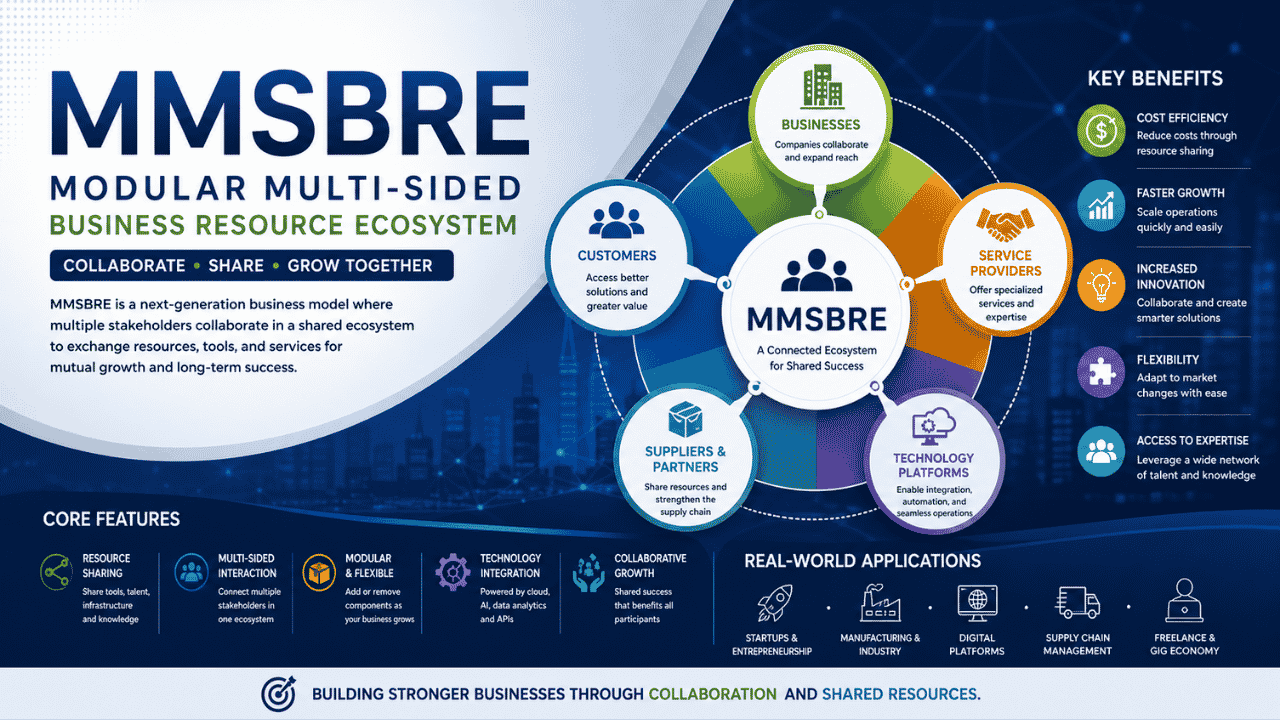
In today’s digital world, businesses are constantly searching for smarter, more efficient ways to grow, collaborate, and remain competitive. Traditional business models—where companies operate independently and invest heavily in their own resources—are gradually being replaced by more flexible, collaborative systems. One emerging concept that reflects this shift is mmsbre. Although still relatively new and evolving, mmsbre is gaining attention as a powerful framework for modern business operations. This comprehensive, SEO-friendly guide explores everything you need to know about mmsbre, including its meaning, features, benefits, applications, challenges, and future potential.
What Is MMSBRE?
The term mmsbre is most commonly understood as an acronym for:
👉 Modular Multi-Sided Business Resource Ecosystem
At its core, mmsbre represents a business model where multiple stakeholders—such as companies, service providers, and customers—collaborate within a shared ecosystem. Instead of operating in isolation, participants share resources, tools, and services to achieve mutual growth.
Breaking Down the Term MMSBRE
- Modular → Flexible components that can be added or removed easily
- Multi-Sided → Involves multiple participants (buyers, sellers, partners)
- Business Resource → Shared tools, infrastructure, talent, and knowledge
- Ecosystem → A connected network where all participants interact and benefit
📌 In simple terms, mmsbre is a system where businesses work together in a shared environment to reduce costs, improve efficiency, and scale faster.
The Evolution of MMSBRE
The concept of mmsbre didn’t appear overnight. It evolved from several existing business trends:
Platform Economy
Companies like Uber, Airbnb, and Amazon popularized multi-sided platforms that enable different user groups to interact within a single system.
Sharing Economy
The idea of sharing resources—such as equipment, services, or even office spaces—has become increasingly common.
Digital Transformation
Cloud computing, SaaS platforms, and automation tools have made it easier than ever to build interconnected ecosystems.
Collaborative Business Models
Modern businesses are shifting from competition-only strategies to collaboration-driven growth.
Together, these trends laid the foundation for what we now call mmsbre.
Key Features of MMSBRE
Understanding the core features of mmsbre is essential to grasping how it works in real-world scenarios.
Resource Sharing
One of the most important aspects of mmsbre is the ability to share resources.
- Shared tools and software
- Access to skilled professionals
- Shared infrastructure and logistics
This reduces the need for individual investment and lowers operational costs.
Multi-Sided Interaction
Unlike traditional one-to-one business models, mmsbre involves multiple participants interacting simultaneously.
For example:
- Businesses connect with suppliers
- Service providers connect with customers
- Partners collaborate on joint projects
This creates a dynamic and interconnected system.
Modularity and Flexibility
The modular nature of mmsbre allows businesses to:
- Add new services or partners
- Scale operations quickly
- Customize their ecosystem
This flexibility is especially valuable in fast-changing markets.
Technology Integration
Modern mmsbre systems rely heavily on technology, including:
- Cloud platforms
- Data analytics
- Artificial Intelligence (AI)
- APIs for integration
Technology ensures seamless communication and efficient operations.
Collaborative Growth
In an MMSBRE system, growth is not limited to a single entity. Instead, all participants benefit from shared success.
How MMSBRE Works
To better understand mmsbre, let’s break down how it operates:
Ecosystem Creation
A platform or network is established where participants can join.
Resource Integration
Businesses contribute or access shared resources such as tools, services, or infrastructure.
Interaction Between Participants
Different stakeholders interact within the system, creating value through collaboration.
Continuous Expansion
New participants and resources are added, making the ecosystem stronger over time.
Real-World Applications of MMSBRE
The concept of mmsbre can be applied across multiple industries.
Startups and Entrepreneurship
Startups often lack resources. Through mmsbre, they can:
- Access shared tools and funding
- Collaborate with experienced professionals
- Reduce startup costs
Manufacturing and Industrial Sectors
Industries can share:
- Machinery
- Logistics systems
- Labor resources
This is similar to cooperative models used in agriculture and heavy industries.
Digital Platforms
Many SaaS platforms already operate like mmsbre ecosystems by integrating multiple services.
Examples include:
- Marketing tools
- Payment systems
- CRM platforms
Supply Chain Management
Companies can collaborate to:
- Optimize logistics
- Reduce waste
- Improve delivery efficiency
Freelance and Gig Economy
Freelancers and businesses can connect through shared platforms, creating a flexible and scalable workforce.
Benefits of MMSBRE
Adopting an mmsbre model offers numerous advantages.
Cost Efficiency
Sharing resources significantly reduces operational expenses.
Faster Growth
Businesses can scale quickly by leveraging existing resources.
Increased Innovation
Collaboration leads to new ideas and solutions.
Improved Flexibility
The modular structure allows businesses to adapt to market changes.
Access to Expertise
Companies can tap into a wider pool of talent and knowledge.
Challenges of MMSBRE
Despite its advantages, mmsbre also comes with challenges.
Lack of Standardization
Since mmsbre is still an emerging concept, there are no universal guidelines.
Coordination Complexity
Managing multiple participants can be difficult.
Trust and Transparency Issues
Participants must trust one another, which requires robust governance systems.
Data Security Concerns
Sharing resources often involves sharing data, which must be protected.
Dependency Risks
Over-reliance on shared resources can create vulnerabilities.
MMSBRE vs Traditional Business Models
| Resource Ownership | Individual | Shared |
| Scalability | Limited | High |
| Collaboration | Low | High |
| Cost Structure | High | Reduced |
| Flexibility | Rigid | Flexible |
This comparison clearly shows why mmsbre is gaining popularity.
Future of MMSBRE
The future of mmsbre looks promising, especially as technology continues to evolve.
Integration with AI and Automation
AI will help optimize resource allocation and decision-making.
Expansion of Digital Ecosystems
More industries will adopt interconnected platforms.
Growth of Remote Collaboration
Global teams will increasingly rely on shared ecosystems.
Increased Adoption by SMEs
Small and medium-sized businesses will benefit the most from mmsbre.
Sustainability and Efficiency
Resource sharing reduces waste and environmental impact.
SEO Insights for the Keyword MMSBRE
For content creators and marketers, mmsbre presents a unique SEO opportunity.
Keyword Characteristics
- Search Intent: Informational
- Competition Level: Low
- Trend: Emerging
Related Keywords
- Modular business ecosystem
- Multi-sided platforms
- Resource sharing economy
- Collaborative business models
Using these related keywords can improve search rankings and visibility.
How to Implement MMSBRE in Your Business
If you want to adopt the mmsbre model, consider these steps:
Identify Shareable Resources
Determine what assets you can share or access.
Build or Join a Platform
Create or participate in a collaborative ecosystem.
Establish Clear Agreements
Define roles, responsibilities, and rules.
Use Technology
Leverage digital tools for communication and integration.
Monitor and Optimize
Continuously evaluate performance and improve processes.
Conclusion
The concept of mmsbre—or Modular Multi-Sided Business Resource Ecosystem—represents a significant shift in how businesses operate in the modern world. By focusing on collaboration, resource sharing, and modular design, mmsbre enables companies to reduce costs, increase efficiency, and scale rapidly.
You May Like: Woeken: Meaning, Uses, Benefits, and Its Growing Role in the Digital World
