
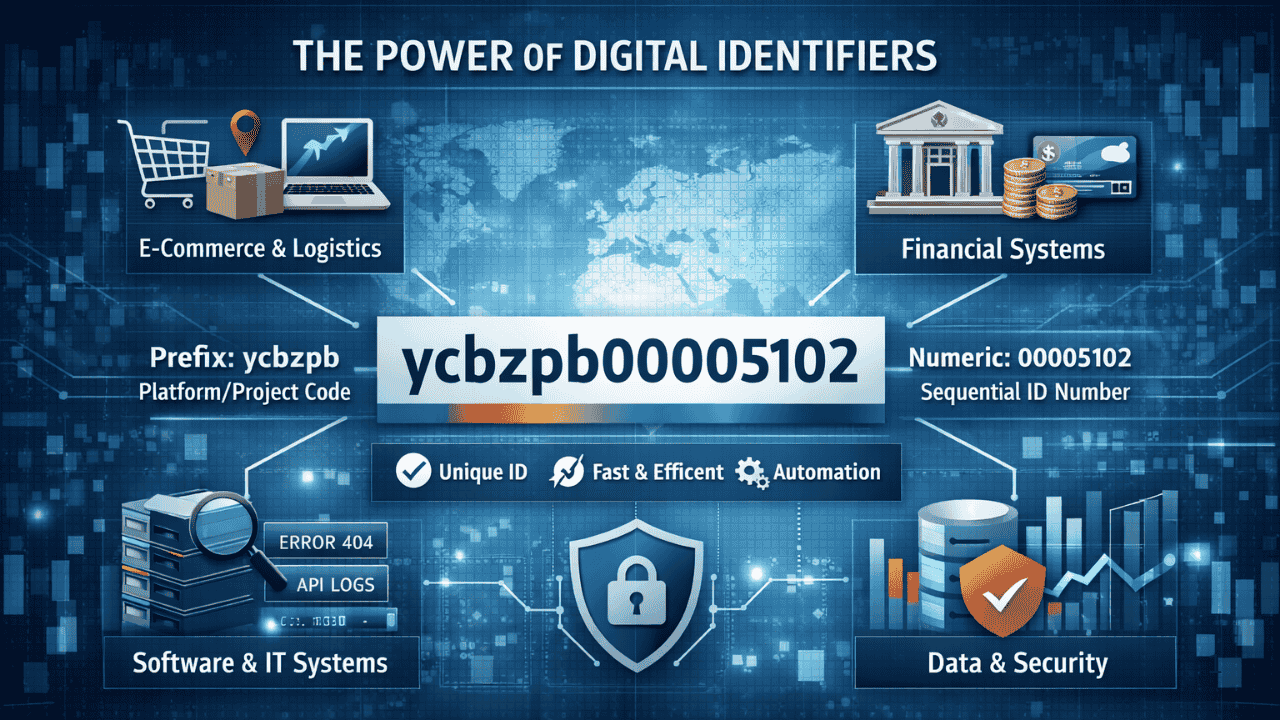
In today’s data-driven world, cryptic strings of letters and numbers are everywhere. From order confirmations and software logs to supply chain tracking systems and cloud platforms, identifiers quietly power the infrastructure of modern technology. One such identifier that has recently attracted curiosity is ycbzpb00005102. At first glance, it looks like a random code. However, identifiers like this are rarely meaningless. They are designed to be precise, machine-readable, and scalable, enabling organizations to track, organize, and protect vast amounts of information. This article explores what codes like ycbzpb00005102 typically represent, how they are structured, where they are used, and why they are increasingly critical in digital ecosystems.
Understanding What ycbzpb00005102 Represents
An identifier such as ycbzpb00005102 is best understood as a structured reference code. It is not a human-friendly label but a machine-friendly one, created to uniquely distinguish one object, event, or record from millions of others.
In practice, such a code could represent:
- A product or inventory item
- A transaction or invoice record
- A database entry
- A user session or authentication token
- A shipment or logistics reference
- An internal software object
The specific meaning depends entirely on the system that generated it. Without access to that system, the identifier remains abstract—but its design still tells us a great deal.
The Structure Behind Codes Like ycbzpb00005102
Identifiers are rarely random. They are typically composed of two main parts:
Alphabetic Prefix
In ycbzpb00005102, the prefix is:
ycbzpb
This segment often represents:
- A company or platform code
- A project or application name
- A category or data type
- A region or system environment
For example, one system might use prefixes to distinguish customer records from product records, while another might use them to identify which internal service created the ID.
Numeric Sequence
The second part:
00005102
This is usually a sequential or semi-sequential number. Padding with leading zeros ensures consistent length, which helps with:
- Database indexing
- Sorting accuracy
- Visual consistency
- Automation and validation
Together, the prefix and numeric sequence create a globally unique or system-unique reference.
Why Identifiers Like ycbzpb00005102 Exist
Modern digital systems process enormous volumes of data. Human-readable names are insufficient for this scale. Identifiers solve several critical problems:
Uniqueness
No two records should share the same ID. This avoids ambiguity and data collisions.
Speed
Databases can retrieve and compare numeric or alphanumeric IDs far faster than long text strings.
Automation
Machines can generate, validate, and process structured identifiers without human intervention.
Security
Opaque identifiers (that do not reveal meaning) reduce the risk of information leakage.
Common Use Cases for Structured Identifiers
E-commerce and Retail
In online stores, every product, order, and return is assigned a unique reference. An identifier like ycbzpb00005102 could represent:
- A specific order
- A warehouse stock unit
- A refund transaction
These IDs enable customer service teams and automated systems to accurately track events.
Logistics and Supply Chain Management
Shipping and logistics systems depend heavily on tracking numbers and internal reference codes. A single package may carry multiple identifiers:
- Warehouse intake ID
- Route assignment ID
- Carrier tracking number
- Delivery confirmation ID
An identifier such as ycbzpb00005102 could exist internally to connect all these stages.
Software Development and System Logs
Developers rely on identifiers to trace behavior across complex systems:
- API request IDs
- Error report references
- User session IDs
- Database object IDs
If a system error occurs, referencing a code like ycbzpb00005102 allows engineers to reconstruct exactly what happened.
Financial Systems
Banking and accounting software uses reference IDs to track:
- Payments
- Transfers
- Invoices
- Audit records
This ensures traceability, compliance, and fraud detection.
Data Warehousing and Analytics
In analytics platforms, identifiers link records across tables and datasets. Without them, large-scale analysis would be unreliable or impossible.
The Role of ycbzpb00005102 in Data Integrity
Data integrity means that information is accurate, consistent, and reliable over its entire lifecycle. Identifiers play a central role in this.
They enable:
- Referential integrity between tables
- Accurate historical tracking
- Error recovery and debugging
- Auditing and compliance reporting
A single code like ycbzpb00005102 might be referenced in dozens of different systems, all pointing to the same real-world entity.
Security Implications of Using Identifiers
Although identifiers are essential, they also introduce security considerations.
Predictability
If IDs are purely sequential, attackers may guess valid ones. This is why many systems mix letters, randomization, or hashing into identifiers.
Exposure
Publishing internal IDs publicly (for example, in URLs or emails) can leak system structure.
Best Practices
To mitigate risks, organizations often:
- Use long, non-guessable identifiers
- Separate public and internal reference numbers
- Apply access controls to ID-based queries
- Rotate or expire sensitive identifiers
If ycbzpb00005102 were part of a secure system, it would likely be protected by additional authentication and authorization layers.
Why People Search for Codes Like ycbzpb00005102
When users encounter unfamiliar identifiers, curiosity and concern naturally arise. Common scenarios include:
- Seeing the code in an email or SMS
- Finding it in a billing statement
- Noticing it in a URL
- Encountering it in application logs
- Discovering it in exported data
People search the code hoping to find:
- Its origin
- Whether it is legitimate
- Whether it indicates a scam or security issue
- What action they should take
In most cases, the code itself is harmless—it is simply a reference key used by a system.
How to Identify the Real Meaning of ycbzpb00005102
If you encounter an identifier and want to know what it refers to, follow these steps:
- Check the context
Where did it appear? Email, website, invoice, software tool? - Review surrounding text
Often, nearby words mention orders, accounts, or transactions. - Look at the domain or application
The platform usually reveals the system that generated the ID. - Search internal systems
If you have access to the software, search for the code directly. - Contact the source
Customer support can often resolve it quickly if you provide the identifier.
The Future of Digital Identifiers
As technology evolves, identifiers will become even more important.
Trends include:
- UUIDs (Universally Unique Identifiers) for global uniqueness
- Blockchain transaction hashes for immutable records
- AI-generated reference keys for distributed systems
- Privacy-preserving identifiers that minimize data leakage
Identifiers like ycbzpb00005102 are part of this broader evolution toward structured, automated, and secure digital infrastructure.
Conclusion
Although ycbzpb00005102 may look mysterious, it represents something deeply familiar in modern technology: a structured digital identifier. Such codes form the invisible backbone of e-commerce, logistics, finance, software development, and data analytics.
You May Like: SparkPressFusion com: A Complete Guide to the Website, Features, Content, and Legitimacy
