
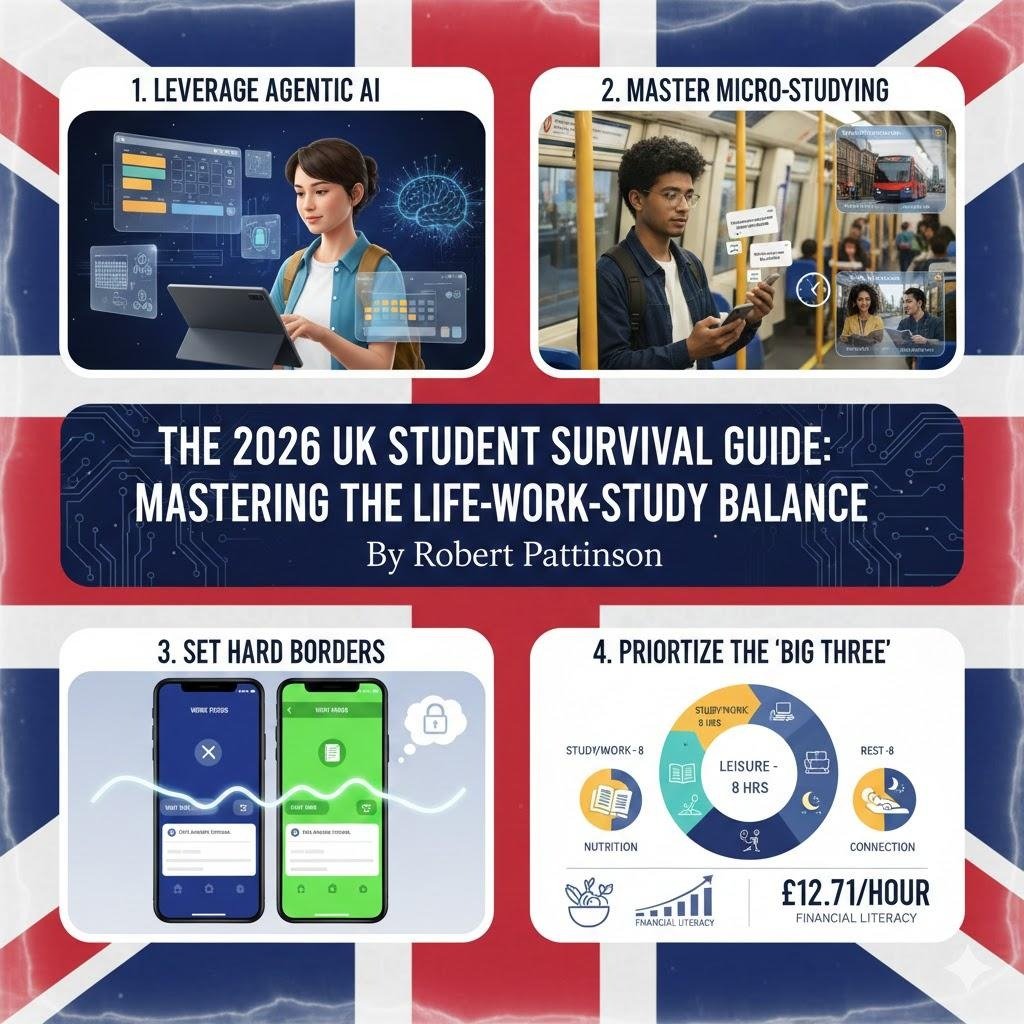
In 2026, the “standard” university experience is a myth. Today’s students—from A-Level pupils to postgraduates—are multitasking like never before. With the rise of “agentic AI,” hybrid learning models, and persistent cost-of-living challenges, the pressure to maintain a student work-life balance in the UK is immense.
If you’re feeling “study-burnout,” you aren’t alone. As an education consultant, I’ve seen that the difference between success and exhaustion is a strategic approach to the “student triad.” Here is how to master your 2026 UK student lifestyle.
1. Leverage the ‘Agentic AI’ Strategy for Productivity
By 2026, AI has shifted from a simple search tool to a “productive partner.” Successful students are now using AI tools for UK university students to act as personal administrative assistants.
- The Strategy: Use “Agentic AI” workflows (like updated Notion AI or Google Gemini) to automate your scheduling.
- The Tip: Sync your retail or hospitality shifts directly into your study calendar. Visualizing your time prevents the “over-commitment trap” many UK students fall into during peak seasons like the January Sales.
2. Master ‘Micro-Studying’ for A-Levels and Degrees
Long, eight-hour library sessions are a thing of the past. In 2026, UK curricula focus heavily on continuous assessment rather than just final exams.
- The Strategy: Use your commute—whether it’s the London Underground or a bus in Manchester—for “micro-studying.” Reviewing digital flashcards for 20 minutes a day is scientifically more effective than a caffeine-fueled all-nighter.
- Expert Support: Even with the best planning, the “academic crunch” is real. When dissertation deadlines or A-Level mocks overlap with work commitments, seeking professional assignment help is a calculated strategy used by high-achievers to maintain their grades while protecting their mental health.
3. Set ‘Hard Borders’ to Prevent Role Blur
The biggest cause of stress for students in 2026 is “role blur”—checking work emails during a lecture or thinking about an essay while on a shift.
The Fix: Create digital boundaries. Use a specific “study-only” browser profile and a “work-only” focus mode on your phone. If you are struggling with specific subject matter, such as data analysis or clinical theory, reaching out for nursing assignment help can provide the clarity you need to work more efficiently within your set study hours.
4. Prioritize the ‘Big Three’ of Wellbeing
The NHS and the National Union of Students (NUS) have highlighted a spike in student fatigue. In 2026, “self-care” is a survival strategy. Follow the 8-8-8 Rule to stay balanced:
| Category | Time Allocation | Focus Area |
| Study/Work | 8 Hours | Lectures, revision, and part-time shifts. |
| Leisure | 8 Hours | Socializing, university societies, and exercise. |
| Rest | 8 Hours | Consistent sleep hygiene and mental downtime. |
Nutrition: With the 2026 focus on sustainability, meal prepping “green” budget meals can save you both money and time.
Connection: Don’t skip the “Life” part. Join a university society or a local UK hobby group to disconnect from the screen.
5. Financial Literacy: Know Your Worth in 2026
With the National Living Wage rising to £12.71 per hour (for those 21+) in April 2026, ensure your part-time work isn’t exploiting your time.
Know the Law: Ensure you are being paid at least the National Minimum Wage for your age group.
The Limit: Leading institutions, such as the University of Manchester, recommend that full-time students work no more than 15 hours per week to avoid academic decline.
Frequently Asked Questions
Q.1 How many hours can a student legally work in the UK?
While “home” students have no legal cap, staying under 15–20 hours is highly recommended. For international students, the 20-hour weekly term-time limit remains strictly enforced by the Home Office.
Q.2 Are AI tools allowed for study in UK universities?
Yes, most UK universities encourage “AI Literacy” for organization and research. However, always check your specific department’s policy on generative AI for assessments to ensure you remain compliant with academic integrity rules.
Q.3 What should I do if my work shifts clash with a major deadline?
First, request a shift swap at least two weeks in advance. If that fails, look into your university’s “Extenuating Circumstances” policy. For many, utilizing expert academic support during these peak weeks is a vital tool to ensure they don’t have to sacrifice their income for their grades.
Conclusion
Achieving a perfect balance in 2026 isn’t about doing everything—it’s about doing the right things at the right time. By utilizing smart tech, setting firm boundaries, and knowing when to ask for a helping hand, you can graduate with both a top-tier degree and your wellbeing intact.
About the Author: Robert Pattinson is a senior education consultant at Myassignmenthelp.com. With over a decade of experience in the UK higher education sector, Robert specializes in student productivity and academic transition.
