
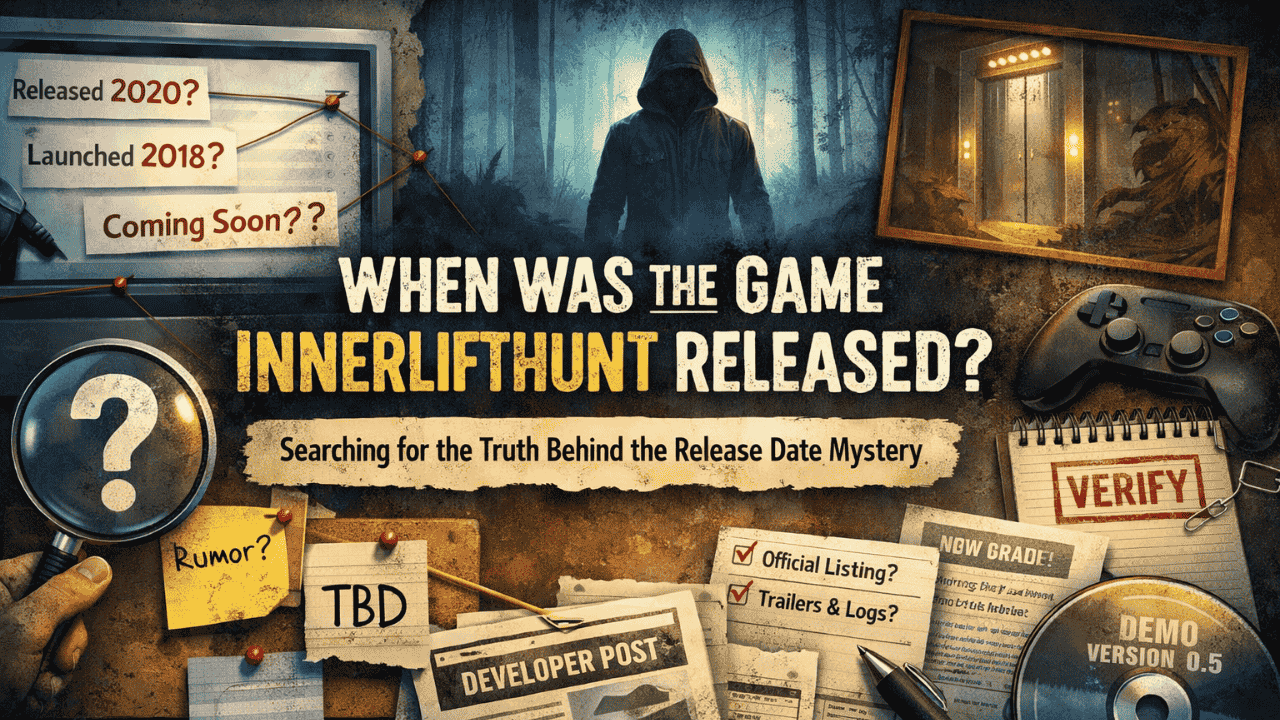
When Was the Game Innerlifthunt Released? You’ve probably noticed something strange: the answers online don’t agree with each other. One site will confidently state one date, another will give a completely different year, and a third might say there’s no confirmed date at all. That can be frustrating—especially if you’re trying to write about the game, cover it on a blog, or simply figure out whether it’s a real published title with an official launch. This article breaks down the release-date mystery in a practical, reader-friendly way. We’ll cover why the confusion exists, how release dates are normally confirmed, what kinds of sources are trustworthy (and which ones usually aren’t), and the best methods to pin down the truth if a game’s release information is unclear or inconsistent.
Why People Keep Asking When Was the Game Innerlifthunt Released?
The short version: because the web is full of claims and light on proof.
When a game has a clear public footprint—like a Steam page, an official trailer, a developer website, or console store listings—its release date is usually easy to confirm. But when those anchors are missing, or when search results are dominated by low-quality pages, uncertainty grows fast. This is especially common with:
- Small indie titles that never hit major storefronts
- Prototypes, demos, or student projects that get mistaken for full releases
- Names that resemble other games (causing “mixed results”)
- SEO pages that publish recycled or speculative information
So if you’re asking when was the game innerlifthunt released, you’re already doing something smart: you’re seeking a reliable answer instead of repeating a random date you saw online
How Game Release Dates Are Normally Confirmed
To understand why Innerlifthunt’s release date is hard to verify, it helps to know how release dates are usually tracked. In most cases, the “official” release date comes from one of the sources below:
1) Official storefront listings
For PC and console games, this is the gold standard. Examples include:
- Steam
- Epic Games Store
- PlayStation Store
- Microsoft Store / Xbox
- Nintendo eShop
- GOG / itch.io (depending on the game)
These store pages typically show a release date or at least a release window (“Q4 2024,” “Coming Soon,” etc.). If the game exists there under the same name, you can treat that date as highly credible.
2) Developer or publisher announcements
This could be:
- A post on the studio website
- A publisher press release
- A pinned social media post (X/Twitter, Facebook, Instagram)
- A trailer description on YouTube with a date
This type of information is also strong—but you should still check whether it matches what stores show (because delays happen).
3) Press coverage from reputable outlets
If a trusted games site reported on the release (and links to sources), that’s helpful—especially if it includes:
- Developer quotes
- Store page links
- Review copies and embargo dates
- Patch notes and launch-day coverage
The keyword is reputable: credible outlets generally cite their sources and correct errors.
4) Patch notes and version history
Sometimes a game’s first public release can be inferred from:
- The earliest public build on itch.io
- The first SteamDB update (for Steam games)
- Public changelogs
- Git release tags (for open-source projects)
This isn’t always definitive, but it’s evidence-based and often more reliable than random blog claims.
Why Innerlifthunt’s Release Date Looks Unclear Online
When you search for when was the game innerlifthunt released, a few patterns commonly appear in results that make the date hard to trust.
Conflicting “release dates” with no citations
Some pages will state a specific day and year—but don’t link to:
- a store page
- a developer announcement
- a trailer
- a press release
- a reputable review site
When a date is presented without a source, it’s often copied from another page, guessed, or generated.
“SEO echo chambers”
Many websites publish similar content:
- near-identical wording
- the same date repeated
- vague statements like “it became popular quickly”
- no author identity or clear references
This creates an illusion of consensus (“multiple sites say it”) when in reality, multiple sites may have copied a single unverified claim.
Name confusion with similar titles
If a game’s name is close to another title, the search engine can blend results, and readers can accidentally adopt the wrong date. If “Innerlifthunt” resembles other names, it may be pulling in unrelated information.
The possibility that it’s not a formally released game
Sometimes a “game” being searched is:
- a concept name
- a project title
- a mod
- a private build
- a rumor
- a domain or blog name mistaken for a game
That doesn’t mean it’s fake—just that the public release record might not exist in normal places.
What Counts as a “Release,” Anyway?
Even if you find a date, you still need to know what that date refers to. “Release” can mean different things:
Full public launch (Version 1.0)
This is the classic definition: the game is publicly available for purchase or download in its entirety.
Early Access release
The game becomes publicly playable, but it’s still in development. Many games “release” twice:
- Early Access launch date
- Full 1.0 launch date
Demo release
A demo can have its own launch date, but it’s not the same as the game release date. People often confuse demo availability with full launch.
Regional release
Some games are released in certain countries first. If Innerlifthunt had a regional rollout (less common for indies), the dates could differ.
Soft launch / limited test
Mobile games sometimes do limited tests in one region before global launch. This also creates multiple “release dates.”
If you’re writing about when was the game innerlifthunt released, it helps to specify what you mean: demo, Early Access, full release, or first public appearance.
How to Verify the Release Date Step-by-Step
If you want an evidence-based answer (and not a copied date), here’s a practical verification workflow you can use.
Look for an official store listing
Search directly on storefronts (not only on Google). If the game exists, the store is likely your best source.
Confirm the developer/publisher identity
Find who actually made the game:
- studio name
- publisher name
- official website
- social accounts
If you can’t identify a developer, treat any release date claim cautiously.
Check the earliest trustworthy timestamp
Look for:
- The earliest trailer upload date
- the earliest devlog entry
- The earliest itch.io upload date
- a first announcement post
This doesn’t prove the release date—but it helps narrow the timeline.
Cross-check multiple independent sources
A date becomes more credible when it is supported by:
- a store page date
- An announcement that links to that store page
- reputable press coverage referencing both
If all sources trace back to vague blog posts, confidence should go down—not up.
Document the evidence in your article
If you’re publishing content, the best practice is to say:
- what you checked
- what you found
- What you could not confirm
- how readers can verify later if new info appears
This approach builds trust and protects your credibility.
If You’re Writing About It: How to Handle Uncertainty Without Sounding Weak
Many writers feel pressure to provide a single, definitive date. But if the public record is unclear, forcing a date can backfire. A better approach is to be transparent and useful:
- State that the release date appears unconfirmed in primary sources.
- Explain why conflicting dates exist.
- Provide the most likely scenarios (Demo vs. Early Access vs. Full Release).
- Tell readers how to verify in the future.
That way, your article still ranks for the keyword when was the game innerlifthunt released while being honest and valuable.
Common Mistakes to Avoid When Answering When Was the Game Innerlifthunt Released
Here are the pitfalls that create misinformation fast:
- Repeating a date from a random blog without checking for a source
- Confusing a similarly named game with Innerlifthunt
- Treating a domain name as proof that a game exists as a released product
- Assuming “first mention online” equals release
- Ignoring the difference between demo, Early Access, and full launch
If you avoid these, your answer will be more accurate than most of what’s currently out there.
Conclusion
So, when was the game innerlifthunt released?
Based on how this query behaves online, the key issue is that there isn’t a widely verifiable, primary-source release date that consistently appears across official storefronts or direct developer/publisher announcements—and that’s why search results show conflicting dates. If a game’s release date is real and official, it typically shows up on major store pages or in clearly attributable announcements. When those aren’t easy to find, the safest and most responsible approach is to treat the release date as unconfirmed until you can tie it to a reliable primary source.
