
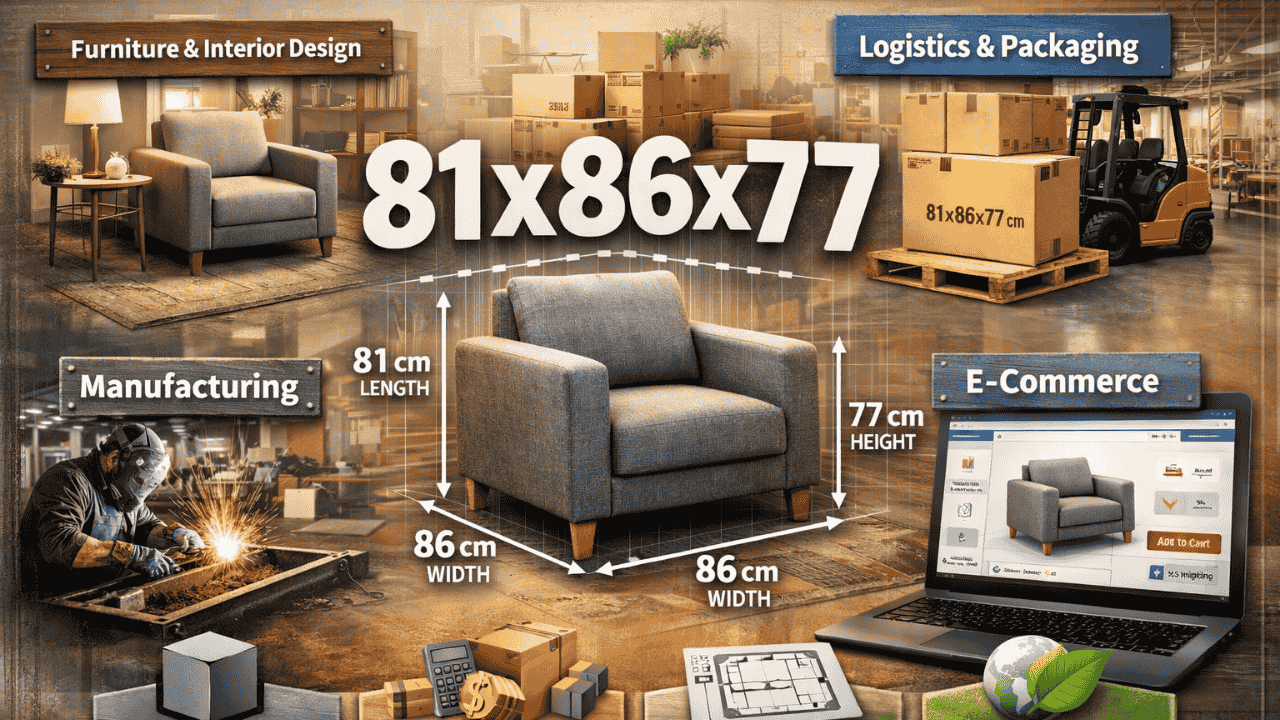
In a world driven by measurements, specifications, and precision, a simple numeric combination like 81x86x77 can hold significant importance. At first glance, it may look like a random sequence of numbers, but in practice, it often represents a three-dimensional measurement used in industries such as furniture design, logistics, interior planning, packaging, and product manufacturing. This article explores what 81x86x77 means, where it is commonly used, why it matters, and how understanding such measurements can help businesses and individuals make better decisions.
What Does 81x86x77 Represent?
The notation 81x86x77 usually refers to three dimensions of an object:
- Length
- Width
- Height (or depth)
In most commercial and industrial contexts, these measurements are expressed in centimeters (cm), though they may also be expressed in inches or millimeters, depending on the region or industry.
So when you see 81x86x77, it typically means:
An object that is 81 units long, 86 units wide, and 77 units high (or deep).
This format is widely used because it clearly and efficiently communicates spatial size.
Why Dimension Formats Like 81x86x77 Are Important
Measurements are more than just numbers. They influence:
- Product compatibility
- Shipping costs
- Storage planning
- Interior layout
- Manufacturing efficiency
- Customer satisfaction
Misunderstanding dimensions can lead to products that don’t fit through doors, excessive shipping fees, wasted storage space, or poor user experiences.
Using a precise dimension, such as 81x86x77, helps avoid these issues by providing an exact physical reference.
Common Industries That Use 81x86x77 Measurements
Furniture Manufacturing and Retail
One of the most common uses of 81x86x77 is in furniture descriptions, especially for:
- Armchairs
- Accent chairs
- Compact sofas
- Lounge seating
- Outdoor chairs
Furniture brands frequently include these measurements to help customers visualize how a product will fit in their living space.
For example, an armchair sized 81x86x77 offers:
- Moderate width for comfort
- Adequate depth for sitting posture
- Balanced height for ergonomic back support
These dimensions often strike a balance between comfort and space efficiency.
Logistics and Packaging
In shipping and warehousing, 81x86x77 is often used as a packaging or box dimension.
Logistics companies calculate:
- Shipping volume
- Container optimization
- Pallet arrangements
- Freight pricing
A box measuring 81x86x77 cm has a volume of approximately:
0.536 cubic meters
That figure directly affects:
- How many items fit into a truck or container
- Whether air or sea freight is cost-effective
- How warehouse shelves should be arranged
Thus, 81x86x77 becomes a critical data point in operational planning.
Interior Design and Space Planning
Interior designers rely heavily on accurate measurements.
A piece of furniture with dimensions 81x86x77:
- Fits comfortably in apartments
- Works well in reading corners
- Matches compact living rooms
- Integrates into balconies or patios
Designers use these numbers to:
- Avoid overcrowding
- Maintain walking clearance
- Balance visual proportions
- Create functional layouts
Without exact dimensions, design becomes guesswork.
E-commerce and Online Product Listings
In online retail, customers cannot physically touch products. Measurements like 81x86x77 become their primary reference for size.
Including these dimensions:
- Reduces return rates
- Improves buyer confidence
- Enhances product transparency
- Helps SEO and search filtering
Shoppers often search directly for size-specific products, making dimension-based keywords valuable for online visibility.
Practical Benefits of Knowing 81x86x77 Before Buying
Avoiding Fit Issues
Knowing that a product is 81x86x77 allows buyers to:
- Measure door frames
- Check stairwell width
- Evaluate room space
- Plan furniture arrangement
This prevents costly mistakes.
Budgeting Shipping Costs
Large dimensions often equal higher shipping fees. With 81x86x77, buyers and sellers can estimate:
- Volumetric weight
- Freight class
- Packaging materials
- Insurance costs
This helps with budgeting and pricing strategies.
Improving Product Comparisons
When comparing products, dimensions matter more than photos.
Two chairs may look identical online, but one could be:
- 75x80x70
- Another 81x86x77
That difference could mean better comfort, a larger seating area, or different room compatibility.
Technical Interpretation of 81x86x77 in Volume Calculations
To understand the physical space occupied:
If measured in centimeters:
81 × 86 × 77 = 536,382 cm³
Converted to cubic meters:
536,382 ÷ 1,000,000 ≈ 0.536 m³
This figure is essential for:
- Freight cost formulas
- Warehouse storage calculations
- Container capacity planning
Even a small increase in each dimension can significantly increase volume.
How Manufacturers Use 81x86x77 During Production
During manufacturing, dimensions like 81x86x77 guide:
- Material cutting
- Mold creation
- Frame welding
- Foam shaping
- Fabric sizing
- Quality control
Production tolerances may be as tight as ±5 mm to ensure consistency.
Standardized dimensions allow manufacturers to:
- Reduce waste
- Automate assembly
- Maintain product uniformity
- Improve scalability
Marketing Value of the Keyword 81x86x77
From a digital marketing perspective, 81x86x77 serves as a long-tail keyword.
It attracts:
- Buyers with specific size requirements
- B2B logistics planners
- Furniture retailers
- Warehouse managers
Such targeted searches often convert better because the intent is clear.
Potential Variations and Units of Measurement
While centimeters are common, 81x86x77 could also be interpreted as:
- Inches (very large object)
- Millimeters (very small object)
Context matters.
Always confirm:
- Unit of measurement
- Dimension order (L×W×H or W×D×H)
- Whether the packaging size or the product size is listed
Misinterpretation can lead to serious errors.
Environmental and Sustainability Considerations
Larger dimensions increase:
- Packaging materials
- Carbon emissions during transport
- Storage energy usage
By optimizing products around dimensions like 81x86x77, companies can:
- Reduce unused space
- Improve container loading efficiency
- Lower shipping frequency
- Reduce environmental impact
Even small dimension optimizations can save thousands of tons of CO₂ annually in large-scale logistics operations.
The Psychological Effect of Dimensions in Consumer Behavior
Size influences perception.
An item labeled 81x86x77 may be perceived as:
- More substantial
- More comfortable
- Higher value
Customers often associate larger dimensions with better quality, even when materials are identical.
Thus, size becomes a subtle marketing tool.
Challenges When Working With Fixed Dimensions
Despite its advantages, fixed measurements like 81x86x77 can create challenges:
- Limited customization
- Regional space differences
- Shipping constraints
- Compatibility issues with modular systems
Companies often offer multiple size variants to address this.
Future Trends in Dimension Standardization
As global commerce expands, standardized dimension reporting will become even more important.
Expect:
- AI-driven space optimization
- Automated dimension verification
- 3D scanning integration
- Smart packaging systems
Numbers like 81x86x77 will increasingly be processed automatically by software rather than manually by humans.
Conclusion
The dimensions 81x86x77 may appear to be a simple numerical sequence, but in practice they represent a powerful tool for decision-making across furniture design, logistics, manufacturing, interior planning, and e-commerce. These three numbers define not only physical size, but also cost efficiency, usability, customer satisfaction, and environmental impact.
