
Introduction
In the high-stakes worlds of aerospace and medical technology, procuring custom titanium alloy parts is plagued by two persistent and costly challenges: ambiguous cost estimates and unpredictable delivery schedules. This uncertainty leads to budget overruns and critical delays in product development and time-to-market, jeopardizing entire programs. The root cause lies in the inherent difficulty of machining titanium — its propensity for thermal distortion and rapid tool wear — combined with traditional manufacturing models that lack transparent process management and data-driven predictive capabilities, leaving both supplier and client in a costly guessing game.
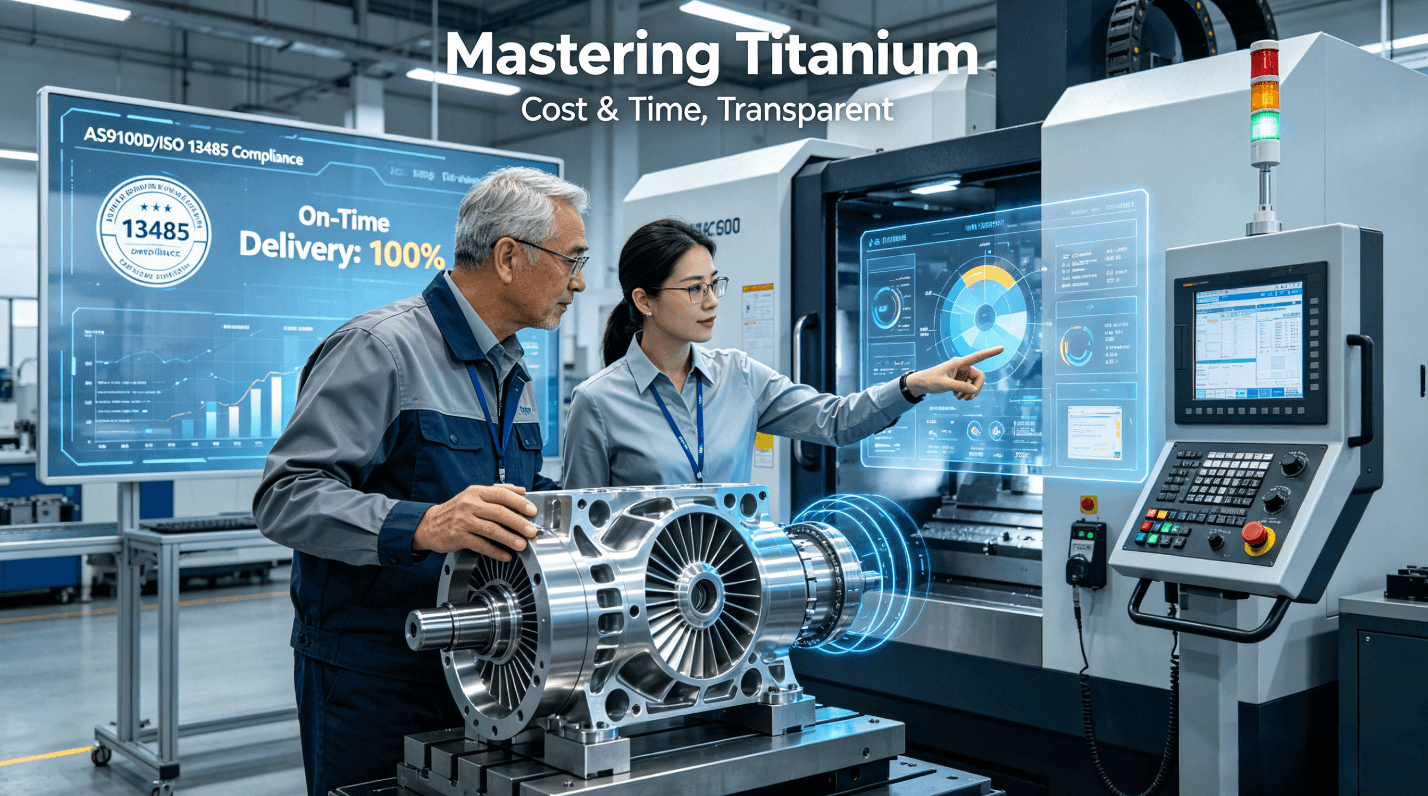
This article explores a modern manufacturing paradigm that transforms “unpredictable” into “deterministic.” By integrating advanced 5-axis machining technology, fully digitized production management systems, and engineering-grade transparent collaboration, it is possible to achieve both absolute cost clarity and guaranteed on-time delivery. The following sections will deconstruct this approach, detailing the mechanisms for transparent pricing, robust delivery assurance, and the technical mastery required to tame aerospace-grade titanium, turning high-risk procurement into a predictable, value-driven partnership.
Why Do Traditional Titanium Machining Quotes Feel Like a Blind Box?
The traditional quote for a titanium component is often a frustrating exercise in obscurity. It typically presents a single, lump-sum figure that masks the true drivers of cost, making comparative analysis impossible and hiding potential risks. This opacity stems from a pricing model based on rough estimates and averaged historical data, rather than a transparent, feature-by-feature engineering analysis of the specific part at hand. Moving to a transparent CNC pricing model is the foundational step in building trust and aligning expectations for custom titanium parts.
- Deconstructing the “Black Box” of Cost: A traditional quote rarely breaks down the hours spent on CAM programming for complex toolpaths, the distinct time allocated for roughing versus high-precision finishing, or the cost of specialized tooling and high-rigidity fixtures required for titanium. It often uses generic material costs, ignoring the premium for certified aerospace-grade stock and the critical metric of material utilization rate. A transparent quote itemizes these elements, transforming the document from a simple price tag into an auditable engineering and process plan that justifies every dollar.
- The Value of an Engineering-Centric Quote: When a quote specifies “3.5 hours for semi-finishing deep pockets via trochoidal milling for heat control,” it does more than state a time — it demonstrates a deep process understanding. It shows awareness of the need to manage heat in titanium. Listing certified material grades and detailing post-processing costs (like CMM inspection and surface integrity checks) upfront eliminates surprises. This engineering-centric approach, as practiced by leaders in the field like LS Manufacturing, builds confidence by proving the supplier has thought through the manufacturing challenges and is investing in the right solutions from the start.
- Building Partnership on a Foundation of Data: Ultimately, transparency is about shared understanding and risk mitigation. A detailed, data-backed quote facilitates a technical dialogue. It allows the client to see where costs are driven by design complexity and where value engineering could be applied. It shifts the relationship from an adversarial negotiation over a mysterious number to a collaborative effort to optimize the manufacturing process for both performance and cost. This foundational trust is essential for the long-term, high-value partnerships required in critical industries.
How to Systematically Guarantee On-Time Delivery for High-Value Titanium Parts?
Promising on-time delivery is easy; systematically guaranteeing it requires an integrated, resilient system. For titanium machining services, this guarantee is built on three interdependent pillars: a buffered and certified supply chain, a digital twin-driven production schedule locked in before work begins, and predictive operational management that prevents stoppages. Together, these elements transform delivery from a hopeful estimate into a predictable, managed outcome.
1. Supply Chain Resilience: Eliminating Material Bottlenecks
The first delay often occurs before machining even starts: waiting for certified raw material. A reliable partner maintains an inventory of certified aerospace-grade titanium (e.g., Ti-6Al-4V) to buffer against market fluctuations and mill lead times. This ensures that production can commence immediately upon order release, establishing a solid foundation for the project timeline and protecting the schedule from the most common external variable.
2. Digital Twin Scheduling: Locking in the Plan
Once an order is confirmed, the part’s digital twin — including the complete CAM program — is imported into a Manufacturing Execution System (MES). This allows for the simulation and locking of the entire production process, from saw cutting to final inspection, onto specific 5-axis CNC machines. This creates an immutable production schedule that is immune to internal contention or ad-hoc planning, providing a fixed timeline from day one.
3. Predictive Operations: Preventing Internal Delays
Even with a perfect plan, unplanned downtime destroys schedules. A systematic approach uses tool life prediction models for titanium to automatically generate replenishment orders, ensuring critical consumables are always in stock. Furthermore, in-process verification checkpoints (like first-article inspection with on-machine probing) are planned as non-negotiable milestones. This proactive quality integration avoids the catastrophic last-minute discovery of non-conformance, which is a primary cause of missed on-time delivery CNC commitments.
How Does 5-Axis Machining Conquer Titanium’s Deformation and Precision Challenges?
Machining titanium is a battle against physics — specifically, against intense heat generation and demanding strength. 5-axis machining technology is the strategic weapon of choice, not merely for geometric freedom, but for its inherent advantages in managing the thermal and mechanical loads that cause distortion and tool failure. Mastering this process requires a systematic, engineering-driven protocol that addresses each challenge with a specific, validated countermeasure.
- Strategic Heat Management Through Toolpath and Coolant: Heat is the primary enemy. Uncontrolled, it softens the tool, work-hardens the material, and causes thermal distortion. The 5-axis advantage enables optimized toolpaths like trochoidal milling, which use the full flute length of the tool, distribute wear evenly, and allow for consistent, high-pressure coolant delivery directly to the cutting edge. The dynamic orientation of the 5-axis head ensures the coolant reaches deep cavities and undercuts, which are inaccessible in 3-axis setups, providing continuous thermal management.
- Combating Tool Deflection and Chatter for Superior Finishes: Titanium’s strength causes significant cutting forces, leading to tool deflection and chatter, which ruin surface finish and dimensional accuracy. 5-axis machining allows the use of shorter, more rigid tooling by optimally orienting the workpiece, dramatically increasing system stiffness. Furthermore, advanced finite element analysis (FEA) is used in the planning stage to simulate cutting forces and predict potential deflection, allowing for pre-emptive adjustments to the toolpath or holding strategy before any metal is cut.
- The Closed-Loop of In-Process Verification: The ultimate assurance of precision is real-time validation. On-machine probing integrated into the 5-axis cell allows for in-process measurement of critical features. If a deviation is detected — whether from tool wear, residual stress relief, or thermal drift — the machine controller can automatically apply a compensation offset for subsequent operations. This closed-loop control transforms the machine from a passive executor of code into an active participant in maintaining quality, ensuring the final part meets the stringent tolerances required for aerospace titanium machining. To delve deeper into the systematic strategies for managing thermal distortion and controlling precision, a detailed technical analysis is available in this resource on 5-axis titanium machining services.
From Design to Certification: What Are the Key Processes for a High-Quality Titanium Part?
Delivering a flight-worthy or implantable titanium component requires more than precise cutting; it demands a verifiable, controlled ecosystem that spans the entire product lifecycle. This journey from digital design to certified part is governed by a framework of rigorous standards, multi-stage validation, and immutable traceability. It transforms manufacturing from a production activity into a quality assurance discipline integral to precision manufacturing services.
1. Foundation: Standards-Based Design and Planning
The process begins with a design review grounded in the requirements of ISO 9001 and AS9100D. This ensures the design is not only functional but also manufacturable within the constraints of titanium and 5-axis processes. A comprehensive Process Failure Mode and Effects Analysis (PFMEA) is conducted to identify and mitigate risks in the manufacturing plan. This upfront, preventive engineering is what separates a qualified supplier from a job shop, setting the stage for a successful first article.
2. Execution: Multi-Stage Inspection and Control
Quality is built in, not inspected in. During production, in-process inspection using on-machine probes provides the first layer of control. Post-machining, a Coordinate Measuring Machine (CMM) performs a full dimensional analysis against the CAD model, generating a detailed deviation report. For critical features or surfaces, advanced techniques like white light scanning or surface roughness analysis may be employed. Each inspection is a planned checkpoint, not an optional activity.
3. Closure: Certification, Traceability, and Special Processes
The final deliverable is more than a part; it is a certification package. This includes the First Article Inspection Report (FAIR), material certifications traceable to the mill heat number, and records of all process parameters. For aerospace, compliance with NADCAP for special processes (like non-destructive testing) is often required. This package creates an unbroken digital thread, providing full traceability from raw material to finished component. It is this documented, auditable proof of conformance and control that qualifies a part for mission-critical use, fulfilling the promise of true 5-axis CNC machining excellence.
Real-World Case: How Was a Critical Titanium Engine Bracket Project Rescued?
Theory is proven in practice under pressure. A compelling case involves a leading aerospace engine OEM facing a crisis: a Ti-6Al-4V engine mount bracket failed high-cycle fatigue testing, and the incumbent supplier could not deliver redesigned parts within the critical 3-week window. The resolution of this crisis demonstrates the power of integrated engineering, rapid prototyping, and disciplined execution, turning a potential program derailment into a validation of superior capability.
1. The Crisis: Redesign Under Extreme Time Pressure
The failure analysis pointed to a stress concentration. The client needed a topologically optimized redesign, new prototypes, and validation — all within an impossible-seeming timeline to prevent a multi-week delay in their testing schedule. The challenge was not just to make a part, but to re-engineer it for dramatically improved performance and manufacture it with extreme speed and certainty, a task for which conventional approaches were wholly inadequate.
2. The Integrated Solution: Co-Engineering and Advanced Processes
Within 72 hours, a collaborative engineering team performed finite element analysis (FEA) to redesign the bracket, optimizing material distribution. The manufacturing solution leveraged high-speed hard milling on a high-rigidity 5-axis machine to handle the complex new geometry efficiently. A cryogenic stress-relief process was integrated post-roughing to stabilize the part. Crucially, on-machine probing was used throughout for in-process verification, ensuring the new design intent was achieved perfectly on the first attempt. The success of this project hinged on the application of advanced 5-axis CNC machining services, combined with topological optimization and cryogenic stress relief.
3. The Outcome: Performance Leap and Timeline Salvation
The result was delivery of five certified brackets in 18 days — 40% faster than the client’s urgent requirement. More importantly, the new parts exhibited a fatigue life over 200% greater than the original specification. This allowed the client’s prototype testing to succeed in a single attempt, saving an estimated 8 weeks on their critical path. This case exemplifies how deep technical expertise, rapid response protocols, and seamless integration between design and manufacturing can transform a supply chain crisis into a decisive competitive advantage.
Conclusion
In summary, conquering the challenges of high-end titanium part manufacturing has evolved beyond seeking the workshop with the most machines. The solution lies in partnering with a provider that embodies systemic engineering thinking, end-to-end digital process control, and absolute collaborative transparency. The true value delivered is the elimination of technical, cost, and schedule risks at their source. This transforms complex, high-stakes projects from gambles into predictable, managed outcomes, allowing innovators to focus on design and market success, secure in the knowledge that their most critical components are in expert hands.
FAQs
Q1: What is the typical lead time for 5-axis titanium part machining?
A: Lead time depends on part complexity. Simple parts typically take 2-3 weeks, moderately complex parts 4-6 weeks, and highly complex parts 6-8 weeks from drawing freeze. A precise delivery plan is provided after a full engineering review of your specific project.
Q2: What precision can you guarantee for titanium alloy parts?
A: For common alloys like Ti-6Al-4V, we typically guarantee dimensional tolerances of ±0.05mm, form and position tolerances of 0.03-0.05mm, and a surface roughness of Ra 0.8-1.6µm. Specific, tighter tolerances are evaluated and confirmed during the project feasibility stage.
Q3: How long is a quote valid, and what triggers a price change?
A: A quote based on stable, finalized design drawings is valid for 30 days. The price is only adjusted if the client formally requests and confirms an Engineering Change Notice (ECN) in writing, which modifies the design, material, or specifications.
Q4: How is the confidentiality of my designs and data protected?
A: We operate under strict Non-Disclosure Agreements (NDAs). All project documentation is stored on encrypted servers, and access to production areas is restricted. Upon project completion, we can securely return or destroy all client-provided data as requested.
Q5: What happens if a part is found to be non-conforming after delivery?
A: We perform rigorous outgoing inspection. If a non-conformance is verified and root cause analysis confirms it was due to our manufacturing responsibility, we cover all costs for rework, replacement, and associated logistics to make the situation right.
Author Bio
The author is a seasoned expert in advanced manufacturing solutions with over 15 years of industry experience, specializing in supply chain optimization for precision components within the aerospace and medical sectors. Working closely with the LS Manufacturing team, the author assists engineers and procurement specialists in gaining a deeper understanding of the management logic and value-realization pathways underpinning complex manufacturing technologies. If you would like to receive a complimentary and detailed “Technical-Commercial Assessment Report” for your next batch of titanium alloy components, simply upload your engineering drawings to receive a comprehensive briefing — covering manufacturability analysis, a transparent breakdown of costs, and a preliminary project implementation timeline.
