
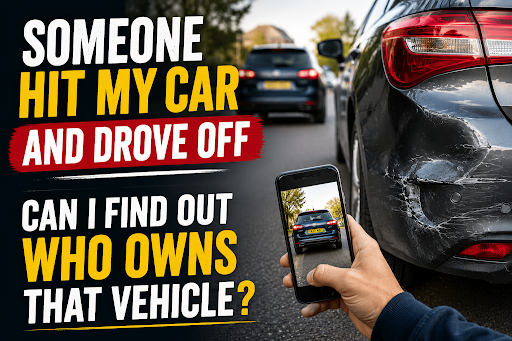
It happens more than most people think. You come back to a parked car and find a dent, a scrape, or a broken wing mirror. Sometimes there is a note. Usually there is not. All you have is a registration number you managed to write down, or caught on a dashcam, or spotted on a security camera.
The immediate instinct is to find out who owns the car. And the immediate frustration is discovering that in the UK, it is not as straightforward as typing a plate number into a website.
This piece explains what the law actually says, what you can and cannot find out from a registration number, what keeper history data tells you, and what the right steps are depending on your situation.
Can You Find Out Who Owns a Car From Its Number Plate in the UK
The short answer is no, not directly and not without a legal reason.
The DVLA holds the registered keeper information for every vehicle in the UK. That includes the keeper’s name, address, and contact details. Under UK data protection law and GDPR, that information is not accessible to members of the public through a standard search. You cannot look someone up by their number plate the way you might search a phone book.
The DVLA will release registered keeper details only to people or organisations with what they call a reasonable cause. This includes:
• Insurance companies investigating a claim
• Solicitors handling a legal dispute
• Local authorities dealing with parking or road safety matters
• Individuals with a specific and demonstrable need such as a blocked driveway or a hit and run incident
If you fall into that last category, there is a formal process. You fill in the DVLA’s V888 form, explain your reasonable cause, and submit it with any supporting evidence. The DVLA then decides whether to release the information. It is not guaranteed, and it takes time.
For most everyday situations, there is a faster and more practical route that tells you a great deal about a vehicle without needing personal keeper data at all.
What Is Keeper History and What Does It Tell You
Every time a UK vehicle changes hands, the DVLA updates its records. The registered keeper changes, the V5C logbook is reissued, and the date of that transfer is logged. This data forms the vehicle’s keeper history, and unlike personal contact details, a version of this information is legally accessible to anyone with a legitimate interest in a vehicle.
For a full breakdown of what is legally possible, read the CarAnalytics guide to finding a car owner by number plate. In terms of what the data itself shows you, a keeper history report covers:
• Number of previous keepers. How many registered owners the vehicle has had since it was first registered.
• Keeper change dates. When each transfer of ownership took place, giving you a timeline of how the car has moved between owners.
• V5C logbook count. How many times the logbook has been issued or reissued. Multiple reissues in a short period can indicate problems.
• Time since last V5C issue. Useful for cross referencing against what a seller tells you about when they bought the car.
• Vehicle registration details. Make, model, engine, fuel type, and spec as registered with the DVLA.
• MOT history. Test dates, pass and fail results, mileage recorded at each test, and any advisory notices.
What it will not show is the current or previous keeper’s name, address, or any personal contact information. That boundary exists for good reason, and legitimate vehicle history services operate within it.
Why the Number of Previous Keepers Matters More Than Most Buyers Realise
When someone is buying a used car, keeper history tends to get glossed over. The focus goes on mileage, service records, and the MOT. But the number of previous owners and the pattern of ownership changes can tell you as much as any of those.
A car with one or two careful keepers over eight or ten years suggests stability. A car with five or six keepers in three years raises a different set of questions entirely. Why did it change hands so many times? Was there a recurring mechanical fault? Was it involved in an incident? Was it passed between traders to obscure its history?
None of those possibilities is guaranteed by a high keeper count. But all of them become worth investigating.
There are also more specific patterns to watch for:
• A V5C issued very recently on an older car. This could mean a legitimate transfer, or it could indicate a title wash, where a car’s history is obscured through a series of quick ownership changes.
• Multiple keeper changes within a single year. Particularly on a car being sold privately, this is unusual and warrants explanation.
• A mismatch between the seller’s claimed ownership period and the V5C date. If someone says they have owned the car for four years but the logbook was issued eighteen months ago, that gap needs explaining.
What to Do If Someone Hit Your Parked Car and Left
This is one of the most common reasons people search for how to find a vehicle owner by number plate. And it is also one of the situations where the formal DVLA process applies.
Here is the practical sequence:
• Document everything immediately. Photographs of the damage, the scene, any tyre marks, and crucially the registration number of the other vehicle if you have it. Note the date and time.
• Report it to the police. In the UK, leaving the scene of an accident without leaving details is a criminal offence under the Road Traffic Act. Report the incident and get a reference number. The police can access DVLA keeper data directly and will do so if they open an investigation.
• Report to your insurance company. Even if you plan to pursue the other driver directly. Your insurer needs to know, and they have their own processes for tracing registered keepers through approved channels.
• Apply to the DVLA using the V888 form. If police and insurance channels are too slow and you need to pursue the matter yourself, the V888 form is the legal route to request keeper information from the DVLA. You will need to demonstrate reasonable cause.
Running a keeper history check in the meantime gives you useful background on the vehicle, even if it cannot give you the driver’s name. It confirms the car exists in DVLA records, gives you a registration history, and can support your case when speaking to your insurer or the police.
What to Do If a Car Is Persistently Blocking Your Driveway
This is the other situation people most commonly encounter. A car keeps parking across your driveway, you have left notes, it has not stopped, and now you want to find out who owns it.
The same rules apply. You cannot access the registered keeper’s personal details without going through the DVLA. But you can take steps that actually work:
• Contact the local council. Many councils have enforcement powers for vehicles blocking private driveways. They can sometimes trace the owner through official channels.
• Contact the police non emergency line. If the obstruction is serious or persistent, the police can advise and may be able to act.
• Apply to the DVLA via V888. With photographic evidence of dates and times the car has blocked your driveway, you have a reasonable cause for a DVLA request.
• Run a keeper check. While you cannot get a name, knowing the vehicle’s full registration history and whether it has any flags on it can be useful context for any formal complaint.
Checking Ownership History Before Buying a Used Car
For buyers, the keeper history check serves a completely different purpose. You are not trying to trace a specific person. You are trying to verify that the seller’s account of the car’s history is consistent with the records.
This is where taking the time to find a car owner by reg number using CarAnalytics becomes one of the most valuable things you can do before committing to a purchase.
The check tells you how many owners the car has had and when each change happened. If the seller says they bought it two years ago from a one previous owner and the records show six keepers, you have an immediate discrepancy to raise before any money changes hands.
It also tells you whether the V5C has been issued recently, how many times it has been reissued, and whether the mileage timeline across MOT records is consistent with normal use.
In combination with checks for outstanding finance, insurance write off status, and stolen markers, a keeper history check forms the foundation of proper due diligence on any used car purchase. CarAnalytics full reports cover all of this, starting from £4.99 for a five check bundle, with a £10,000 data guarantee backed into every paid report.
What You Can and Cannot Find Out From a UK Number Plate
To summarise clearly, because this is the question most people arrive with:
• You can find: Number of previous keepers, keeper change dates, V5C logbook count and issue dates, MOT history and mileage records, vehicle specification, tax status, outstanding finance, write off history, stolen status, and salvage records.
• You cannot find: The registered keeper’s name, home address, phone number, or any personal contact information. This data is protected under UK law and is only accessible to the DVLA and approved bodies for specific legal purposes.
For most practical purposes, the data you can access legally tells you more than enough to make a confident decision, whether you are buying a car, dealing with a parking dispute, or following up after an incident.
The Right Way to Check a Vehicle in the UK
The process is simpler than most people expect once you know what to look for and where to look.
If you have a registration number and a question about the vehicle behind it, start with a keeper history check. It takes less than a minute, costs nothing for a basic overview, and gives you a grounded picture of who has owned the vehicle, for how long, and whether anything in that record contradicts what you have been told.
If you need the registered keeper’s personal details for a specific legal reason, the V888 route through the DVLA is the correct process. It is slower and not guaranteed, but it exists for exactly these situations.
The two approaches are not in competition. They serve different needs. For most people, most of the time, the vehicle history route is faster, clearer, and answers the questions that actually matter.
