
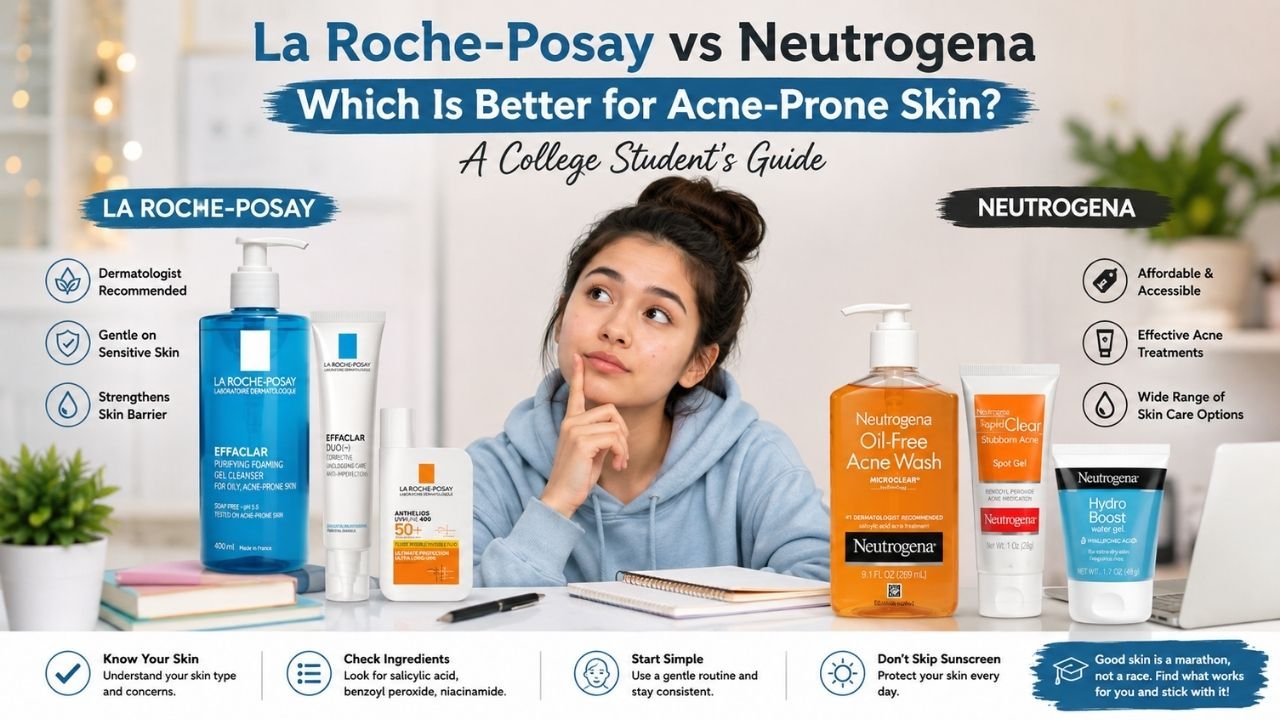
College life can be exciting, but it can also bring changes that affect your skin. Stress, irregular sleep, changing diets, busy schedules, and limited budgets can all make skincare more challenging. For students dealing with breakouts, choosing the right skincare products can feel even more confusing.
A common question is: I am a college student. Are La Roche-Posay products better for acne-prone skin than Neutrogena? Both La Roche-Posay and Neutrogena are well-known skincare brands with products designed for oily, acne-prone, and sensitive skin. However, deciding which brand is better depends on your individual skin type, the ingredients you need, and how much you want to spend.
La Roche-Posay is often associated with gentle, dermatologist-focused skincare, while Neutrogena is widely recognized for affordable and accessible skincare products. Neither brand is automatically better for everyone. The right product is the one that provides useful acne-fighting ingredients without unnecessarily irritating your skin.
Why Acne Can Be Common During College
College students can experience acne for many different reasons. Stress is one common factor. During exams, assignments, social events, and changes in daily routines, stress levels can increase. Hormonal changes, insufficient sleep, and inconsistent skincare habits may also contribute to breakouts.
Students may also spend long hours wearing makeup, exercising, or commuting. Sweat and oil can accumulate on the skin if the face is not cleansed appropriately.
However, acne is not simply caused by having a “dirty” face. Overwashing or aggressively scrubbing the skin can actually irritate and make a skincare routine harder to tolerate.
A simple routine that includes cleansing, acne treatment when appropriate, moisturizing, and daytime sun protection can be easier to maintain during a busy college schedule.
La Roche-Posay and Neutrogena: A Basic Comparison
La Roche-Posay and Neutrogena approach skincare somewhat differently, although both offer products for acne-prone skin.
La Roche-Posay is particularly popular among people who want formulas designed with sensitive skin in mind. Its product range includes cleansers, moisturizers, sunscreens, and acne-focused products.
Neutrogena has a broad selection of affordable skincare products and has long offered formulas containing ingredients used for acne management. Its accessibility can make it especially attractive to students.
The important point is that comparing the brands alone does not tell you which product will work best. A salicylic acid cleanser from one brand should be compared with another based on ingredients, formulation, skin tolerance, price, and intended use.
Are La Roche-Posay Products Better for Acne-Prone Skin?
La Roche-Posay can be an excellent option for acne-prone skin, particularly for students with sensitive or easily irritated skin.
Some La Roche-Posay products focus on helping cleanse excess oil and support the skin barrier. This can be useful because acne treatments may sometimes leave the skin feeling dry or irritated.
However, “better” does not necessarily mean “more effective for every type of acne.” A product’s active ingredients and formulation matter more than the brand’s reputation.
If a La Roche-Posay product contains an ingredient appropriate for your acne concerns and your skin tolerates it well, it may be a good choice. But if an affordable Neutrogena product provides an appropriate acne-fighting ingredient and works well for you, there may be no reason to spend more.
Is Neutrogena Good for Acne-Prone Skin?
Neutrogena can also be a practical choice for acne-prone skin. One of its biggest advantages for college students is accessibility and price.
Students often have to balance skincare expenses with tuition, textbooks, food, transportation, and other everyday costs. A simple, affordable skincare routine is more realistic than an expensive one with numerous products.
Neutrogena offers products designed for different skin types and concerns. Depending on the specific formula, products may contain ingredients such as salicylic acid or benzoyl peroxide.
As with La Roche-Posay, students should look beyond the brand name and check the active ingredients and directions before purchasing an acne product.
Salicylic Acid and Acne-Prone Skin
Salicylic acid is a popular acne-care ingredient because it can help exfoliate the skin and unclog pores. It is commonly used in products intended for oily skin, blackheads, and whiteheads.
For a college student with occasional clogged pores or mild breakouts, a salicylic acid cleanser or treatment may be a convenient addition to a basic routine.
However, using too many exfoliating products at the same time can lead to irritation. If your skin becomes excessively dry, red, tight, or uncomfortable, reducing the number of active products may be helpful.
The goal is not to use the strongest routine possible. The goal is to find a routine that you can use consistently without damaging your skin barrier.
Benzoyl Peroxide for Breakouts
Benzoyl peroxide is another well-established acne-fighting ingredient. It can be particularly useful for inflammatory pimples.
Both La Roche-Posay and Neutrogena have offered acne products featuring ingredients used for treating breakouts. When comparing products, students should look at the concentration, formulation, directions, and their own skin sensitivity.
Benzoyl peroxide can cause dryness or irritation in some people. It can also bleach fabrics, so students should be careful with towels, pillowcases, and clothing when using it.
If you have persistent or severe acne, an over-the-counter product may not be enough, and professional advice can be useful.
Which Brand Is Better for Sensitive Acne-Prone Skin?
This is where La Roche-Posay may have an advantage for some students.
People with acne can also have sensitive skin, and aggressive acne treatments may cause excessive dryness. La Roche-Posay has a strong reputation for products that support sensitive skin, although individual formulas still need to be evaluated.
A sensitive-skinned student should look for a gentle cleanser and a non-irritating moisturizer, rather than assuming that every acne product is inherently gentle.
Neutrogena also has products suitable for different skin types, including sensitive skin, so it would be inaccurate to say that all La Roche-Posay products are gentler than all Neutrogena products.
Always evaluate the specific product.
Which Brand Is More Affordable for College Students?
For many students, Neutrogena is likely to be the easier choice when budget is the main concern.
La Roche-Posay products can cost more depending on the product and retailer. That does not mean they are poor value, but a higher price can matter when you are building a complete routine.
College students do not necessarily need an expensive skincare collection. A basic routine can often be built around a gentle cleanser, an appropriate acne treatment, moisturizer, and sunscreen.
Spending more money on skincare does not guarantee better results.
What Should a College Student’s Acne Routine Look Like?
A simple routine is often easier to maintain than a complicated one.
Morning Routine
Start with a gentle cleanser or rinse, depending on your skin type. Follow with moisturizer if your skin needs it. Finish with broad-spectrum sunscreen during the day.
If you use an acne treatment in the morning, follow the product directions carefully.
Evening Routine
Cleanse your face to remove makeup, sunscreen, oil, and daily buildup. Apply your acne treatment as directed. Finish with moisturizer.
Students should avoid adding several new active ingredients simultaneously. If something causes significant irritation, it becomes difficult to determine which product is responsible.
Should You Choose La Roche-Posay or Neutrogena?
The answer depends on your priorities.
Choose La Roche-Posay if:
- Your skin is acne-prone and sensitive.
- You are willing to spend more on skincare.
- You prefer a skincare range that is strongly focused on sensitive-skin needs.
- You want products that can fit into a barrier-conscious routine.
Consider Neutrogena if:
- You have a limited college budget.
- You want widely available skincare products.
- You prefer affordable acne-care options.
- You have found a particular Neutrogena formula that works well for your skin.
Neither list means one brand is universally superior. Your skin’s response is ultimately more important than the label on the bottle.
Can You Use Products From Both Brands?
Yes, you do not have to choose one brand exclusively.
For example, a student could use a cleanser from one brand and a moisturizer or sunscreen from another. Skincare routines do not need to be built around a single manufacturer.
The key is to avoid unnecessarily combining too many strong acne treatments. Introducing products gradually makes it easier to identify irritation and determine what is actually helping.
A mixed-brand routine may also be more affordable because you can choose products based on their individual strengths and prices.
Common Skincare Mistakes College Students Should Avoid
One of the biggest mistakes is constantly changing products. Acne treatment can require time, and switching products every few days can make it difficult to determine whether something works.
Another mistake is over-cleansing. Washing repeatedly or scrubbing aggressively can irritate the skin.
Students should also avoid picking at pimples whenever possible. Picking can increase inflammation and may contribute to marks or scarring.
Finally, do not build a routine around social-media trends alone. A product’s online popularity does not necessarily mean it is appropriate for your skin.
How Long Should You Give an Acne Product a Chance?
Patience is important. Acne does not normally disappear overnight.
Many acne treatments need several weeks of consistent use before their benefits can be properly evaluated. It is therefore better to follow the product’s instructions consistently rather than add multiple treatments, as results are not immediate.
If acne is painful, severe, persistent, or causing significant scarring, seeing a dermatologist or other qualified healthcare professional is a better approach than continually experimenting with new products.
FAQs
Is La Roche-Posay better than Neutrogena for acne?
Not necessarily. Both brands offer products for acne-prone skin. The best option depends on the specific product, active ingredients, skin type, sensitivity, and budget.
Is La Roche-Posay good for sensitive acne-prone skin?
Some La Roche-Posay products can be suitable for sensitive acne-prone skin. However, every product should be evaluated individually because formulations and active ingredients differ.
Is Neutrogena cheaper than La Roche-Posay?
Neutrogena often provides more budget-friendly options, which can make it attractive to college students. Prices vary by product and retailer.
What acne ingredient should college students look for?
Common evidence-based ingredients include salicylic acid and benzoyl peroxide. Adapalene is another important over-the-counter acne treatment in many markets. The appropriate option depends on the type and severity of acne, as well as your skin’s tolerance.
Can I use La Roche-Posay and Neutrogena together?
Yes. There is no general requirement to use products from only one brand. Choose individual products based on your skincare needs and avoid unnecessarily combining multiple irritating active ingredients.
Conclusion
The question I am a college student. Are La Roche-Posay products better for acne-prone skin than Neutrogena? does not have a universal yes-or-no answer.
La Roche-Posay may be a particularly appealing choice for students with sensitive, acne-prone skin who are willing to spend more on skincare. Neutrogena can be an excellent alternative for students seeking accessible, budget-conscious products.
The most important thing is to compare individual products rather than brands. Look at active ingredients, consider your skin type, avoid overly complicated routines, and give acne treatments enough time to work.
For a college student, the best skincare routine is usually one that is effective, affordable, gentle enough to tolerate, and simple enough to follow consistently. A more expensive product is not automatically better, and an affordable product is not automatically inferior. Your skin’s needs should be the deciding factor.
You May Like: Pantene Menopause Shampoo Reviews: Honest Insights, Ingredients, Benefits, and Real Results
