
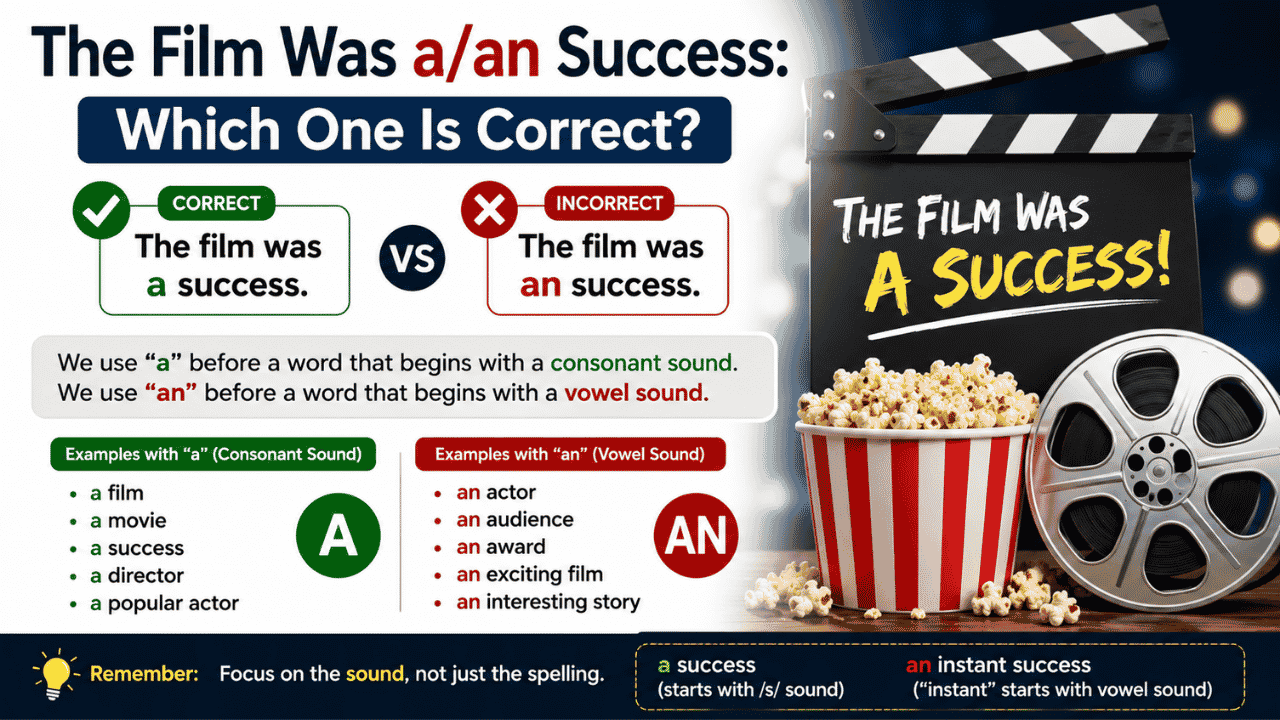
When learning English grammar, choosing between “a” and “an” can sometimes be confusing. One common question that students and English learners ask is: “The film was a/an success” — should we use “a” or “an”? The correct answer is “a.” Therefore, the grammatically correct sentence is “The film was a success.” This simple grammar question is important because the words “a” and “an” are indefinite articles used before singular countable nouns. Although the rule may seem easy at first, learners sometimes choose the wrong article because they focus on the spelling of a word instead of its pronunciation. In this article, we will explain why “The film was a success” is correct, why “The film was an success” is incorrect, how to use “a” and “an” properly, and how to create similar sentences. We will also explore related expressions such as “a huge success,” “a commercial success,” “a critical success,” and “an instant success.”
Whether you are a student, writer, blogger, or someone trying to improve your English, this guide will help you understand the correct usage clearly.
The Film Was a/an Success: The Correct Answer
The correct sentence is:
The film was a success.
The incorrect version is:
The film was an success.
The reason is straightforward. The noun “success” begins with the consonant sound /s/. In English, we normally use “a” before words that begin with a consonant sound.
Therefore:
- a success — correct
- an success — incorrect
The sentence “The film was a success” means that the film performed well or achieved a positive result. Depending on the context, it could mean that audiences enjoyed the film, critics praised it, it earned significant money at the box office, or it became popular.
For example:
The film was a success with audiences.
The film was a major success at the box office.
The film was a critical success.
The film was a commercial success.
All of these sentences are grammatically correct.
Why Do We Use “A” Before Success?
The main reason we use “a” before “success” is pronunciation.
The indefinite articles “a” and “an” are selected based primarily on the sound that follows them. The word “success” starts with the consonant sound /s/, so we use “a.”
The basic rule is:
- Use “a” before a consonant sound.
- Use “an” before a vowel sound.
Examples of “a” include:
- a film
- a movie
- a success
- a story
- a book
- a director
- a popular actor
Examples of “an” include:
- an actor
- an audience
- an award
- an excellent film
- an interesting story
- an exciting movie
The important point is that the rule depends on the sound, not simply the first written letter.
Because “success” starts with the /s/ sound, the correct expression is “a success.”
What Does “The Film Was a Success” Mean?
The phrase “The film was a success” is used to describe a movie that achieved a favourable outcome.
The exact meaning of “success” depends on the situation.
For example, a film can be successful because it earns a lot of money. In this case, it may be described as a commercial success or box-office success.
A film can also be successful because professional reviewers praise it. This is called a critical success.
Sometimes a film may not earn a huge amount of money but still become popular among viewers. In such a case, people may describe it as a success because of its cultural impact or audience reception.
Consider these examples:
The film was a success because audiences loved its story.
The film was a success at the international box office.
Despite its small budget, the film was a success.
The film was a success among younger viewers.
The film was a success and received several awards.
In each sentence, “a success” functions as a noun phrase that describes the positive outcome of the film.
A Success vs An Success
One of the most common mistakes in this sentence is writing “an success.” This is incorrect in standard English.
The word “an” is generally used before vowel sounds.
For example:
- an actor
- an audience
- an award
- an exciting film
- an excellent performance
The word “success,” however, begins with a consonant sound.
Therefore:
The film was a success. ✓
Not:
The film was an success. ✗
This mistake may happen because learners remember that “an” comes before vowels and then incorrectly apply the rule without considering pronunciation.
The first sound in “success” is /s/, which is a consonant sound. That is why “a” is the correct article.
Understanding the Difference Between “A” and “An”
To fully understand the phrase “The film was a/an success,” it is useful to review the difference between “a” and “an.”
Both are indefinite articles. They are used when referring to one person, place, thing, or idea that is not specifically identified.
We use “a” before a consonant sound.
Examples:
- a film
- a movie
- a director
- a successful actor
- a story
- a success
We use “an” before a vowel sound.
Examples:
- an actor
- an actress
- an award
- an audience
- an exciting film
- an interesting story
Notice that the sound is more important than the spelling.
For example, we say:
an hour
The word “hour” begins with the vowel sound /aʊ/ because the “h” is silent.
However, we say:
a university
Although “university” begins with the letter “u,” it begins with the /juː/ sound, which is a consonant sound similar to “y.”
Therefore, the same principle explains why we say “a success.”
Examples of “The Film Was a Success”
Here are several examples showing how the phrase can be used naturally.
Example 1: General Success
The film was a success and quickly became popular with audiences.
This sentence simply states that the movie achieved a positive result.
Example 2: Financial Success
The film was a success at the box office and earned millions of dollars worldwide.
Here, “success” refers mainly to financial performance.
Example 3: Critical Success
The film was a critical success and received positive reviews from critics.
In this case, the movie was praised by professional reviewers.
Example 4: Audience Success
The film was a success among audiences, who praised its emotional story.
This sentence focuses on the reaction of viewers.
Example 5: Unexpected Success
The film was a surprise success despite having a relatively small production budget.
This means the movie performed better than people expected.
These examples demonstrate that “a success” can be followed by additional information explaining why or how the film was successful.
Common Expressions Related to Film Success
There are many ways to describe a successful film in English. Learning these phrases can improve your vocabulary and help you write more naturally.
A Great Success
The film was a great success.
This means the movie achieved a very positive result.
A Huge Success
The film was a huge success around the world.
This suggests that the movie was extremely successful.
A Major Success
The film became a major success after its release.
This indicates that the film achieved significant popularity or recognition.
A Commercial Success
The film was a commercial success.
This usually means the movie performed well financially.
A Critical Success
The film was a critical success.
This means professional critics responded positively to it.
A Box-Office Success
The film became a box-office success.
This phrase generally refers to strong financial performance in theatres.
An Instant Success
The film was an instant success.
Notice the use of “an” here. The word “instant” begins with a vowel sound, so “an” is correct.
This is a useful comparison:
The film was a success.
The film was an instant success.
In the first sentence, “success” begins with a consonant sound, so we use “a.” In the second sentence, the article comes immediately before “instant,” which begins with a vowel sound, so we use “an.”
The Film Was a Success vs The Film Was Successful
Another common question is whether to say “The film was a success” or “The film was successful.”
Both are correct, but they use different grammatical structures.
The film was a success.
Here, “success” is a noun.
The film was successful.
Here, “successful” is an adjective.
The meanings are very similar.
For example:
The film was a success with audiences.
The film was successful with audiences.
Both sentences communicate the idea that the movie performed well.
However, the noun form “a success” often sounds natural when discussing the result or outcome of something.
For example:
The new movie was a huge success.
The adjective form is also common:
The new movie was hugely successful.
Choosing between these forms depends on the structure and style of your sentence.
Common Mistakes to Avoid
When using the phrase “the film was a/an success,” English learners may make several mistakes.
Mistake 1: Using “An Success”
Incorrect:
The film was an success.
Correct:
The film was a success.
The word “success” starts with a consonant sound, so “a” is required.
Mistake 2: Confusing “Success” and “Successful”
Incorrect:
The film was a successful.
Correct:
The film was successful.
Or:
The film was a success.
“Successful” is an adjective and does not normally follow “a” in this structure.
Mistake 3: Forgetting the Article
Incorrect:
The film was success.
Correct:
The film was a success.
When “success” is used as a singular countable noun in this meaning, it generally needs an article or another determiner.
Mistake 4: Using “An” Based Only on Spelling
Some learners think that “an” should be used whenever a word contains or seems to have a vowel. However, the choice between “a” and “an” depends on the sound immediately following the article.
That is why we say:
a success
but:
an instant success
The sound after the article determines the correct choice.
How to Use the Keyword “The Film Was a/an Success” Correctly
The keyword “the film was a/an success” is commonly searched by people who are unsure which article should be used in a grammar exercise.
If you are answering a multiple-choice or fill-in-the-blank question, the correct answer is:
The film was a success.
The completed sentence should read naturally and follow standard English grammar rules.
For example:
Question: The film was a/an success.
Answer: The film was a success.
The final sentence is:
The film was a success.
This is the clearest and most direct answer.
Why This Grammar Rule Matters
Using the correct article may seem like a small detail, but articles are an important part of English grammar. Incorrect article usage can make a sentence sound unnatural or grammatically incorrect.
For students, understanding “a” and “an” is especially important when writing essays, answering grammar questions, completing examinations, or communicating in English.
The phrase “The film was a success” provides an easy example because the correct article can be determined by the pronunciation of “success.”
Once you understand this pattern, you can apply the same rule to many other words.
For example:
- a success
- a story
- a movie
- a director
- an actor
- an audience
- an award
- an exciting performance
Practising these examples can help learners become more confident in their English writing and speaking.
Quick Grammar Summary
If you are looking for a short answer to the question “The film was a/an success,” remember these points:
- The correct article is “a.”
- The correct sentence is “The film was a success.”
- “Success” begins with the consonant sound /s/.
- We use “a” before consonant sounds.
- We use “an” before vowel sounds.
- “An success” is grammatically incorrect.
- “A success” is a noun phrase.
- “Successful” is an adjective.
- “An instant success” is correct because “instant” begins with a vowel sound.
This simple rule can help you avoid one of the most common article mistakes in English.
Frequently Asked Questions
Is “The film was a success” correct?
Yes. “The film was a success” is grammatically correct and natural English.
Is “The film was an success” correct?
No. “The film was an success” is incorrect because “success” begins with a consonant sound. The correct phrase is “a success.”
Why do we say “a success”?
We say “a success” because the word “success” begins with the consonant sound /s/. The indefinite article “a” is used before consonant sounds.
Can I say “The film was successful”?
Yes. “The film was successful” is also correct. In this sentence, “successful” is an adjective rather than a noun.
What is the difference between “a success” and “a successful film”?
“A success” is a noun phrase, while “successful” is an adjective. For example, “The film was a success” and “The film was successful” have similar meanings but different grammatical structures.
Conclusion
The correct answer to the grammar question “The film was a/an success” is “a.” The correct sentence is “The film was a success.”
The reason is that “success” begins with the consonant sound /s/, so the indefinite article “a” should be used. The phrase describes a film that achieved a positive result, whether through strong audience reception, critical praise, financial performance, or general popularity.
