
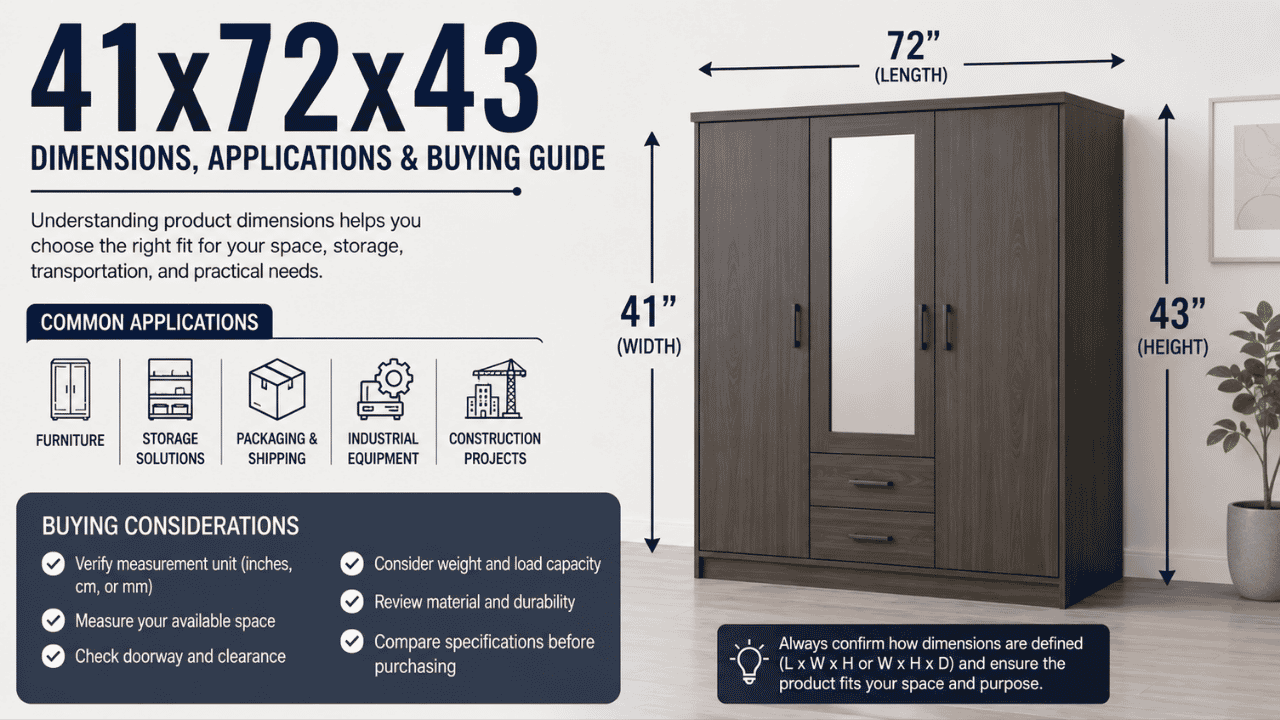
The 41x72x43 may appear simple at first glance, but dimension-based specifications play a crucial role across numerous industries. Whether used for furniture, storage units, shipping containers, industrial equipment, packaging solutions, or custom-built products, measurements such as 41x72x43 help define size, capacity, functionality, and compatibility.
Consumers, manufacturers, retailers, and logistics professionals frequently rely on dimensional specifications to make informed decisions. Understanding what 41x72x43 represents can help buyers accurately evaluate products, determine installation requirements, estimate transportation needs, and ensure proper space utilization.
In many cases, dimensions like 41x72x43 refer to length, width, and height measurements. The exact unit may vary by industry, with inches, centimeters, or millimeters being the most common. Regardless of the measurement unit, understanding the significance of dimensions is essential for both personal and commercial applications.
This comprehensive guide explores the meaning of 41x72x43, its common uses and practical applications, the benefits of dimensional specifications, industry relevance, measurement considerations, and tips for choosing products based on dimensional requirements.
What Does 41x72x43 Mean?
The 41x72x43 typically represents three measurements arranged in a specific order:
- Length
- Width
- Height
Depending on the product or industry, the order may also be:
- Width × Height × Depth
- Length × Width × Depth
- Height × Width × Length
For example:
- 41 inches × 72 inches × 43 inches
- 41 centimeters × 72 centimeters × 43 centimeters
- 41 millimeters × 72 millimeters × 43 millimeters
The exact interpretation depends on the context in which the dimensions are provided.
Manufacturers usually specify dimensions to ensure buyers understand a product’s physical size before purchase.
Why Dimensions Like 41x72x43 Matter
Dimensions are important because they provide critical information regarding:
Space Planning
Knowing a product’s dimensions helps determine whether it will fit within a designated space.
Examples include:
- Furniture placement
- Storage installations
- Equipment positioning
- Packaging arrangements
Transportation Requirements
Dimensions influence shipping costs and transportation methods.
Larger products often require:
- Specialized handling
- Additional packaging
- Freight shipping services
Storage Efficiency
Businesses use dimensions to maximize warehouse space and improve inventory management.
Product Compatibility
Dimensional specifications help ensure compatibility with:
- Existing furniture
- Storage systems
- Machinery
- Building layouts
Common Applications of 41x72x43 Dimensions
Furniture Industry
Many furniture products are categorized by dimensions.
Potential examples include:
- Cabinets
- Wardrobes
- Shelving units
- Display cases
- Storage benches
A furniture item measuring 41 x 72 x 43 may be designed for residential or commercial use.
Storage Solutions
Storage products frequently use dimension-based descriptions.
Examples include:
- Storage boxes
- Industrial shelving
- Warehouse containers
- Utility cabinets
Proper dimensions help users maximize storage capacity while maintaining accessibility.
Packaging and Shipping
In logistics, dimensions are essential.
Packaging measurements influence:
- Shipping rates
- Loading efficiency
- Container utilization
- Product protection
A package labeled 41x72x43 provides handlers with essential sizing information.
Industrial Equipment
Manufacturing environments often use dimensional specifications for:
- Machinery components
- Equipment housings
- Tool cabinets
- Production units
Accurate dimensions help engineers integrate equipment into existing systems.
Construction Projects
Builders rely on dimensional data when selecting materials and components.
Possible applications include:
- Custom cabinetry
- Framing components
- Storage systems
- Built-in fixtures
Understanding Measurement Units
One important consideration when evaluating 41x72x43 is identifying the measurement unit.
Inches
Inches are commonly used in:
- United States
- Canada (some industries)
- Furniture manufacturing
- Home improvement products
A dimension of 41 x 72 x 43 inches indicates a relatively large item.
Centimeters
Centimeters are widely used internationally.
Common applications include:
- Consumer products
- Furniture
- Packaging
- Home décor
41x72x43 centimeters would indicate a medium-sized object.
Millimeters
Millimeters are typically used for:
- Engineering
- Manufacturing
- Precision components
41x72x43 millimeters would indicate a much smaller item.
Always verify the unit before making purchasing decisions.
Benefits of Using Standardized Dimensions
Improved Accuracy
Standardized measurements eliminate confusion between buyers and sellers.
Easier Comparisons
Consumers can compare products more effectively when dimensions are clearly listed.
Reduced Returns
Incorrect sizing is a major reason for product returns.
Accurate dimensions help minimize these issues.
Better Planning
Knowing exact measurements assists with:
- Space allocation
- Installation planning
- Transportation logistics
How to Measure Products Correctly
If you need to verify whether a product truly measures 41x72x43, follow these steps.
Measure Length
Use a measuring tape to determine the longest side.
Measure Width
Measure the side perpendicular to the length.
Measure Height
Determine the vertical dimension from bottom to top.
Record Measurements Consistently
Always use the same unit throughout the measurement process.
Double-Check Results
Repeat measurements to ensure accuracy.
Factors to Consider Before Purchasing a 41x72x43 Product
Available Space
Measure the intended location before purchasing.
Ensure there is sufficient room for:
- Placement
- Movement
- Maintenance access
Doorway Clearance
Many buyers forget to check:
- Door widths
- Hallways
- Staircases
- Elevators
A product measuring 41x72x43 may be difficult to move through restricted spaces.
Weight
Dimensions do not indicate weight.
Always verify:
- Product weight
- Load capacity
- Floor support requirements
Material Construction
The material influences:
- Durability
- Appearance
- Maintenance needs
Common materials include:
- Wood
- Metal
- Plastic
- Composite materials
Industry Importance of Dimensional Specifications
Retail Industry
Retailers use dimensions to:
- Manage inventory
- Organize displays
- Calculate shipping costs
Manufacturing Industry
Manufacturers rely on precise dimensions to:
- Maintain quality standards
- Ensure compatibility
- Reduce production errors
Logistics Industry
Shipping companies use dimensions to:
- Calculate freight charges
- Optimize vehicle loading
- Improve efficiency
Construction Industry
Builders use dimensional specifications to:
- Plan installations
- Coordinate materials
- Avoid costly mistakes
Space Optimization Using 41x72x43 Measurements
Proper planning can maximize the usefulness of products with these dimensions.
Residential Spaces
Applications include:
- Bedroom storage
- Living room organization
- Garage storage solutions
Commercial Spaces
Businesses may use dimension-specific products for:
- Inventory storage
- Office organization
- Retail displays
Industrial Facilities
Factories and warehouses often depend on dimensional planning for:
- Equipment placement
- Workflow optimization
- Safety compliance
Common Mistakes When Evaluating Dimensions
Ignoring Measurement Units
Confusing inches with centimeters can lead to significant sizing errors.
Overlooking Clearance Space
Always account for:
- Opening doors
- Access panels
- User movement
Assuming Standardization
Not all manufacturers measure products the same way.
Verify how dimensions are defined.
Failing to Measure Installation Areas
Always compare product dimensions with available space before purchasing.
Future Trends in Dimension-Based Product Selection
As technology advances, dimensional specifications are becoming even more important.
Digital Product Visualization
Online retailers increasingly provide:
- 3D product views
- Augmented reality previews
- Interactive measurement tools
Smart Space Planning
Software tools help consumers determine whether products fit specific spaces.
Automated Warehousing
Modern warehouses use precise dimensions for:
- Robotics
- Inventory management
- Storage optimization
Enhanced E-Commerce Information
Consumers now expect detailed product specifications before making purchases.
Tips for Choosing Products Based on Dimensions
To ensure a successful purchase:
- Verify all measurements.
- Confirm the unit of measurement.
- Measure available space.
- Consider transportation requirements.
- Review manufacturer specifications.
- Allow extra clearance space.
- Check weight and load limits.
- Compare multiple products.
These practices help avoid sizing issues and improve satisfaction.
Conclusion
The 41x72x43 dimensional specification can apply to numerous products and industries. Whether associated with furniture, storage solutions, industrial equipment, packaging, or construction materials, dimensions play a critical role in purchasing decisions, logistics planning, and space management. Understanding measurements such as 41x72x43 helps consumers and businesses make informed choices, improve efficiency, and avoid costly mistakes. By verifying measurement units, planning available space, and carefully evaluating product requirements, users can ensure that dimension-based products meet their needs effectively and provide long-term value.
You May Like: Layout of Nichols House JHY: Design, Floor Plan, Architecture, and Interior Organization
