
The OCR A Level grade boundaries 2017 remain an important reference point for students, teachers, parents, and education researchers across the UK. The June 2017 exam series was particularly significant because it marked one of the first full sittings of reformed A Levels under the new linear system. As a result, understanding OCR grade boundaries from 2017 helps contextualise grade standards, exam difficulty, and long-term trends in A Level assessment. This article provides a comprehensive, SEO-friendly guide to OCR A Level grade boundaries in 2017, including what they are, how they were set, subject examples, links to official data, and why they still matter today.
What Are OCR A Level Grade Boundaries?
Grade boundaries are the minimum values required to achieve each grade (A*, A, B, C, D, E) in an exam. For OCR A Levels, grade boundaries are set after exams are marked, not before. This allows OCR to adjust for variations in paper difficulty and maintain consistent national standards.
In 2017, OCR published grade boundaries for:
- New (reformed) A Levels
- Legacy AS and A Levels
- Unit-level and qualification-level results
- Raw marks and UMS (Uniform Mark Scale), where applicable
When people search for OCR A Level grade boundaries 2017, they are usually looking for these official thresholds published by OCR after the June 2017 exam session.
Why OCR A Level Grade Boundaries 2017 Are Important
The 2017 OCR A Level grade boundaries are especially significant for several reasons:
First Major Year of A Level Reform
Many subjects, particularly Biology, Chemistry, Physics, and Mathematics, were assessed under the new linear A Level structure. This meant:
- No modular retakes
- Exams taken at the end of two years
- Increased emphasis on problem-solving and application
Benchmark for Exam Difficulty
Teachers and examiners often compare later years’ grade boundaries with those of 2017 to judge whether papers have become harder or easier.
Appeals and Historical Analysis
Grade boundaries from 2017 are still referenced for:
- Grade appeals
- University admissions comparisons
- Education research and trend analysis
OCR A Level Grade Boundaries 2017: Official Sources
OCR released multiple official documents for the June 2017 series. These remain the only authoritative sources for grade boundary data.
Key OCR Documents (June 2017)
- New A Level Grade Boundaries – June 2017
Covers reformed A Levels with raw mark thresholds per subject and paper. - Legacy AS and A Level Grade Boundaries – June 2017
Includes older specifications using UMS. - Specification-Level UMS Grade Boundaries
Shows how raw marks are converted into UMS for final grades.
These PDFs are archived in the OCR Grade Boundaries Archive, which remains accessible online.
OCR A Level Grade Boundaries 2017: Subject Examples
While OCR does not provide a single summary table across all subjects, data from the official PDFs allows us to highlight key examples from popular A Level subjects.
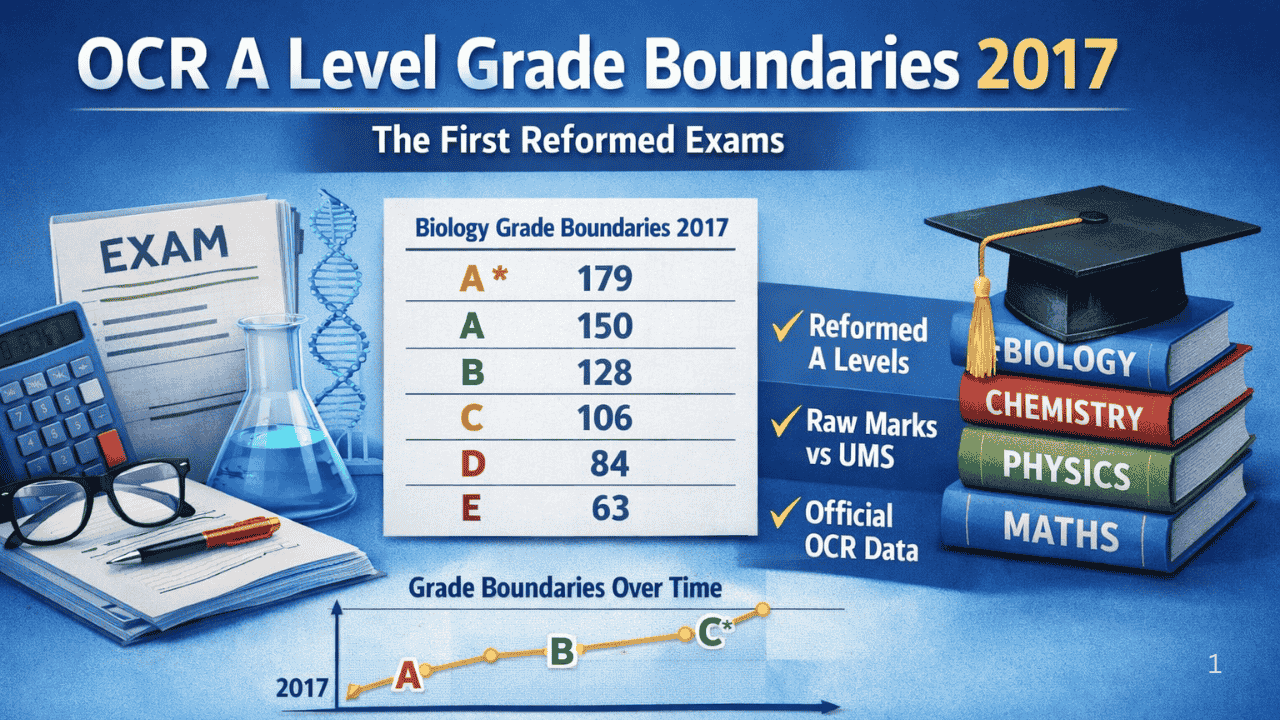
OCR A Level Biology Grade Boundaries 2017 (OCR A)
For the full A Level qualification (maximum 270 raw marks):
| A* | ~179 |
| A | ~150 |
| B | ~128 |
| C | ~106 |
| D | ~84 |
| E | ~63 |
These boundaries illustrate how demanding the new specification was in its first full assessment year.
OCR A Level Chemistry Grade Boundaries 2017
Chemistry grade boundaries in 2017 showed a noticeable emphasis on higher-order thinking and mathematical skills.
Typical qualification-level patterns:
- A*: approximately 75–80% of total raw marks
- A: approximately 70–75%
- B: approximately 60–65%
- C: approximately 50–55%
Exact boundaries varied slightly across papers and specifications (OCR A vs OCR B).
OCR A Level Physics Grade Boundaries 2017
Physics was widely regarded as challenging in 2017. OCR grade boundaries reflected this difficulty:
- Lower absolute raw marks are required for higher grades
- Strong weighting of extended problem-solving questions
- Practical skills assessed through written exams
This made the OCR A Level Physics grade boundaries 2017 a frequent point of discussion among teachers.
OCR A Level Mathematics Grade Boundaries 2017
OCR Mathematics was among the first fully linear maths A Levels assessed in 2017.
Key features:
- Three equally weighted exam papers
- Emphasis on reasoning and problem-solving
- Grade boundaries set to stabilise outcomes during reform
Overall, A and A* boundaries were considered demanding but fair given the paper difficulty.
How OCR Set Grade Boundaries in 2017
OCR follows a structured awarding process:
- Scripts are marked by trained examiners
- Senior examiners review performance data
- Statistical evidence is analysed (national outcomes, prior attainment)
- Judgement-based decisions are applied to maintain standards
- Final grade boundaries are agreed upon and published
Importantly, OCR does not aim to fix the percentage of students achieving each grade. Instead, grade boundaries shift each year to reflect exam difficulty.
OCR A Level Grade Boundaries 2017 vs Other Years
When compared to later years:
- 2018–2019: Boundaries stabilised as teachers and students adjusted to reforms
- 2020–2021: Exams cancelled (teacher-assessed grades)
- 2022–2024: Gradual return to pre-pandemic grading standards
This makes the OCR A Level grade boundaries 2017 a crucial baseline year for long-term comparisons.
Raw Marksvs UMS in 2017
Another reason the 2017 data is complex is the coexistence of raw marks and UMS:
- New A Levels: Raw marks only
- Legacy qualifications: Raw marks converted to UMS
UMS allowed consistency across different exam sessions, but it was phased out as reformed A Levels were introduced.
Where to Find OCR A Level Grade Boundaries 2017
To access the full data:
- Visit the OCR Grade Boundaries Archive
- Select June 2017
- Download the relevant PDF for:
- New A Levels
- Legacy AS/A Levels
- UMS conversions
These documents provide subject-by-subject, paper-by-paper grade thresholds.
Common Questions About OCR A Level Grade Boundaries 2017
Are OCR grade boundaries the same every year?
No. Grade boundaries change annually depending on exam difficulty.
Were OCR A Level grade boundaries high in 2017?
They were considered challenging, particularly in sciences and maths, due to the introduction of reformed specifications.
Can I still use OCR grade boundaries 2017 for revision?
Yes. They are useful for:
Understanding exam standards
Comparing paper difficulty
Historical analysis
However, they should not be used to predict current boundaries.
Final Thoughts on OCR A Level Grade Boundaries 2017
The OCR A Level grade boundaries 2017 represent a pivotal moment in UK education. As one of the first full assessments of reformed A Levels, they set the tone for grading standards that followed.
For students, teachers, and researchers, these grade boundaries remain an essential reference point for understanding how OCR maintained fairness, consistency, and academic rigour during a major transition period.
