
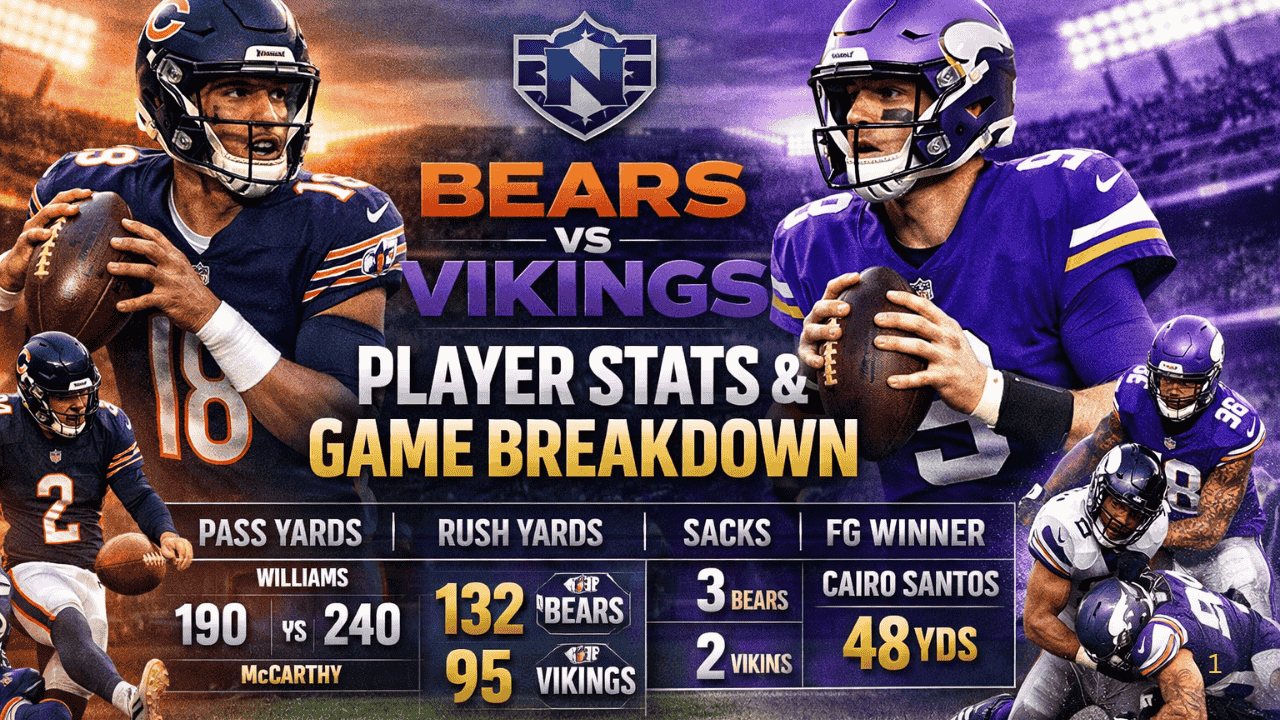
The rivalry between the Chicago Bears and the Minnesota Vikings is one of the most competitive and historic matchups in the NFC North. Every time these two teams meet, fans and analysts closely examine the chicago bears vs minnesota vikings match player stats to understand how individual performances shape the outcome. From quarterback efficiency to defensive stops, from rushing dominance to special-teams heroics, player statistics in this matchup often tell a deeper story than the final score. This article provides a complete statistical and tactical breakdown of recent meetings, highlighting standout players, team metrics, and what the numbers reveal about this intense division rivalry.
Rivalry Context and Why Player Stats Matter
The Bears–Vikings rivalry dates back decades, with both franchises frequently battling for playoff position within the NFC North. Because these games are often tightly contested, individual player contributions—a key interception, a third-down conversion, or a late field goal—regularly decide the winner.
When reviewing chicago bears vs minnesota vikings match player stats, analysts typically focus on:
- Quarterback completion rate and yards per attempt
- Rushing yards and yards after contact
- Receiving yards and red-zone targets
- Defensive sacks, tackles for loss, and turnovers
- Time of possession and third-down efficiency
- Kicking accuracy in clutch moments
These metrics consistently explain why momentum swings from one side to the other.
Quarterback Comparison and Passing Efficiency
A major storyline in recent matchups has been the quarterback duel between Caleb Williams and J.J. McCarthy.
Passing Snapshot (Recent Meetings)
| Caleb Williams | 16/32 | ~190+ | 1 | 0–1 | ~6.0 |
| J.J. McCarthy | 22/30 | ~240+ | 2 | 0 | ~8.0 |
What the stats show:
- Williams often manages the game with controlled drives and safe throws.
- McCarthy tends to stretch the field with higher yards per attempt.
- Vikings benefit when McCarthy converts deep third-down passes.
- Bears benefit when Williams sustains long drives and limits turnovers.
Quarterback stats in this rivalry often correlate directly with time of possession and defensive fatigue.
Rushing Attack and Ground Control
Establishing the run is critical in Bears–Vikings games. The Bears traditionally lean on a physical rushing style, while the Vikings mix inside runs with outside zone plays.
| Total Rush Yards | 120–150 | 90–120 |
| Yards per Carry | 4.2 | 3.8 |
| First Downs via Run | 8 | 5 |
Insights:
- When Chicago crosses 130 rushing yards, they usually control tempo.
- Minnesota’s run game is more situational, opening play-action for McCarthy.
- Short-yardage conversions heavily favor the Bears when their line wins at the point of attack.
These trends frequently appear in chicago bears vs minnesota vikings match player stats after the final whistle.
Receiving Leaders and Target Distribution
Passing success is amplified by receiver performance, especially on third downs and in the red zone.
| WR1 | 70–95 | 90–120 |
| WR2 | 40–60 | 50–70 |
| TE | 30–45 | 35–50 |
Patterns:
- Vikings WR1 often leads all receivers in yards during these matchups.
- Bears spread targets more evenly, reducing predictability.
- Tight ends on both teams are key red-zone targets.
Yards after catch (YAC) frequently separates the two offenses in tight games.
Defensive Impact: Sacks, Turnovers, and Pressure
Defense often decides this rivalry. A single turnover can flip momentum late in the game.
| Sacks | 3 | 2 |
| Interceptions | 1 | 0 |
| QB Hits | 7 | 5 |
| Tackles for Loss | 6 | 4 |
What stands out:
- Bears generate more interior pressure, collapsing the pocket.
- Vikings rely on edge rush to force hurried throws.
- Interceptions by Chicago frequently occur in the second half.
When reviewing chicago bears vs minnesota vikings match player stats, defensive pressure metrics often explain stalled drives more than offensive mistakes.
Time of Possession and Third-Down Efficiency
Possession time is a hidden stat that reveals control.
| Time of Possession | 11:59 PM | 11:01 PM |
| Third-Down Conversions | 8/14 | 5/13 |
Long, methodical Bears drives limit Vikings possessions and reduce scoring chances.
Special Teams and the Game-Winning Moment
Clutch kicking has defined at least one recent meeting, highlighted by Cairo Santos converting a late long-range field goal.
| Cairo Santos | 4/4 | 48 yd | Walk-off winner |
| Vikings K | 2/3 | 42 yd | Missed mid-range |
Special teams often become the deciding factor when offenses are evenly matched.
Penalties and Discipline
| Penalties | 6 | 2 |
| Penalty Yards | 40 | 15 |
Despite more penalties, Chicago has still won by maintaining composure in crucial moments.
What the Stats Reveal About Team Identity
Bears Identity
- Ball control offense
- Defensive interior pressure
- Reliable kicking
- Long drives and clock management
Vikings Identity
- Explosive passing plays
- Efficient third-down passing
- Edge pass rush
- Faster scoring drives
These identities repeatedly show up in chicago bears vs minnesota vikings match player stats across multiple seasons.
Historical Head-to-Head Trends
All-time meetings favor Minnesota slightly, but recent seasons show highly competitive, one-score games. The average margin of victory in recent matchups is often under 5 points, reinforcing how critical individual stats become.
Conclusion
Analyzing chicago bears vs minnesota vikings match player stats provides far more insight than the scoreboard alone. Quarterback efficiency, rushing balance, receiver execution, defensive pressure, and special-teams precision all intertwine to determine outcomes in this storied NFC North rivalry.
You May Like: Dodgers vs Chicago Cubs Match Player Stats: Complete Breakdown, Analysis, and Key Performances
