
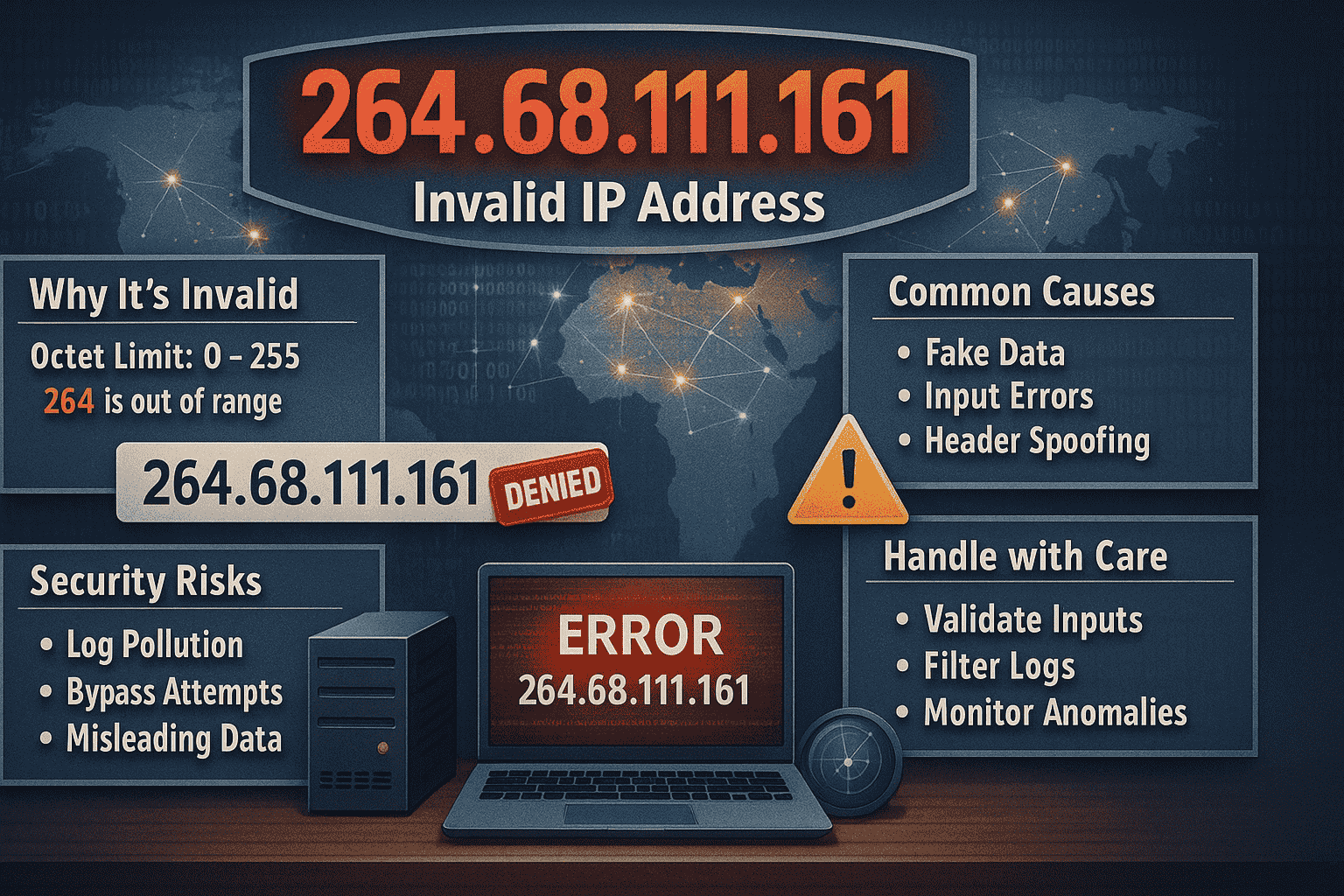
In the digital age, IP addresses are the backbone of internet communication. Every website visit, email sent, or application request relies on these numerical identifiers to route data correctly across global networks. Occasionally, however, unusual strings such as 264.68.111.161 appear in logs, analytics tools, or security reports. At first glance, it looks like a standard IPv4 address—but a closer look reveals that it is not valid. This article explores 264.68.111.161 in depth: what it is, why it appears, how it affects systems, and what developers, administrators, and security professionals should do when they encounter it.
What Is an IP Address?
An IP (Internet Protocol) address is a unique numerical identifier assigned to devices on a network. It allows systems to locate and communicate with one another efficiently.
IPv4 Basics
IPv4 addresses consist of four numbers separated by dots, for example:
192.168.1.1
Each number (called an octet) must be between 0 and 255. This limitation exists because each octet represents an 8-bit binary number.
Why 264.68.111.161 Is Different
In the case of 264.68.111.161, the first octet is 264, which exceeds the maximum allowable value of 255. This immediately disqualifies it as a valid IPv4 address.
Why 264.68.111.161 Is Not a Valid IP Address
To understand why 264.68.111.161 is invalid, it helps to look at how IP addresses are mathematically defined.
The Octet Rule
Each octet in an IPv4 address represents 8 bits, which can only produce values from 0 to 255. Any number outside this range cannot be processed by networking hardware or software.
Because 264 > 255, the address:
- Cannot be assigned to a device
- Cannot be routed on the internet
- Cannot be geolocated reliably
This makes 264.68.111.161 technically impossible as a real network endpoint.
Why Does 264.68.111.161 Appear in Logs and Data?
Despite being invalid, 264.68.111.161 frequently appears in real-world systems. This can be confusing, especially for those unfamiliar with networking rules.
Common Reasons for Appearance
Placeholder or Example Data
Developers sometimes use fake IP addresses during:
- Documentation writing
- Testing environments
- Training materials
An address like 264.68.111.161 may be chosen intentionally to avoid pointing to a real system.
User Input or Header Injection
In web applications, IP addresses are often read from HTTP headers such as:
- X-Forwarded-For
- Forwarded
These headers are user-controlled unless sanitized. Attackers or bots may insert invalid values like 264.68.111.161 to:
- Bypass filters
- Test validation weaknesses
- Obfuscate real origins
Logging or Parsing Errors
Sometimes, software bugs cause numbers to be concatenated incorrectly or parsed out of range, producing values such as 264.68.111.161.
Security Implications of 264.68.111.161
From a cybersecurity perspective, invalid IP addresses should never be ignored.
Potential Risks
- Log pollution: Invalid IPs make analysis more difficult and reduce the signal-to-noise ratio.
- Bypass attempts: Poor validation may allow attackers to exploit trust in IP-based controls.
- Broken analytics: Geolocation and traffic analysis tools may fail or produce misleading results.
If 264.68.111.161 appears frequently, it may indicate automated scanning or malicious probing activity.
How Systems Typically Handle Invalid IPs
Modern systems respond differently depending on configuration.
Common Behaviors
- Rejected outright: Well-configured validators discard invalid IPs immediately.
- Stored as strings: Some systems store them as raw text without validation.
- Default fallback: Applications may replace them with 0.0.0.0 or unknown.
The best practice is always strict validation before processing or trusting IP address data.
How to Detect and Validate IP Addresses Properly
To avoid issues caused by invalid entries like 264.68.111.161, validation should occur at multiple layers.
Validation Best Practices
- Use standard libraries instead of custom regex
- Validate both IPv4 and IPv6 explicitly
- Treat headers as untrusted input
- Log invalid values separately for investigation
Example (Conceptual)
Any proper IP validation logic will immediately flag 264.68.111.161 as invalid due to its out-of-range octet.
SEO, Data Analysis, and 264.68.111.161
Interestingly, invalid IPs also show up in SEO tools, analytics platforms, and server dashboards.
Impact on Analytics
- Traffic may be misclassified
- Location-based reports may break
- Bot detection may become less accurate
Filtering out values like 264.68.111.161 ensures cleaner datasets and more reliable insights.
Lessons Developers Can Learn from 264.68.111.161
Although 264.68.111.161 is not a real IP address, it serves as a valuable teaching example.
Key Takeaways
- Never assume data is valid
- Always validate network identifiers
- Treat client-supplied headers with caution
- Separate “invalid” from “unknown”
By addressing these points, systems become more robust, secure, and maintainable.
Conclusion
The 264.68.111.161 address may appear to be a valid IPv4 address, but it is fundamentally invalid because it violates basic networking rules. Its appearance in logs, applications, and reports is not uncommon—and often signals placeholder data, malformed input, or untrusted headers.
You May Like: 185.63.253.2pp: What It Is, Why It Appears, and How to Analyze It Safely
