
Air Traffic Controller UK Salary, you are likely considering this high-responsibility career or simply curious about how much professionals in this field earn. Air traffic controllers (ATCs) play a critical role in maintaining safe and efficient air travel across the United Kingdom. Because of the skill, training, and concentration required, salaries are typically well above the national average. In this in-depth guide, we will explore average earnings, starting salaries, senior-level pay, regional differences, training income, benefits, and the factors that influence total compensation. By the end, you will have a complete understanding of what to expect financially from a career as an air traffic controller in the UK.
What Is the Average Air Traffic Controller UK Salary?
The average air traffic controller UK salary generally falls between £48,000 and £55,000 per year. However, this figure varies depending on experience, employer, and location.
Most industry data sources place the median salary around:
- £50,000 per year is the national average
- Equivalent to roughly £4,100 per month before tax
This is significantly higher than the UK’s overall average full-time salary, reflecting the technical expertise and the responsibility required to manage aircraft movements safely.
It’s important to understand that “average” figures often include controllers at various career stages. A newly qualified controller will earn less than a senior professional working at a major international airport.
Starting Salary for Trainee Air Traffic Controllers
When discussing air traffic controller UK salary, it is essential to consider the training phase.
Trainee Salary
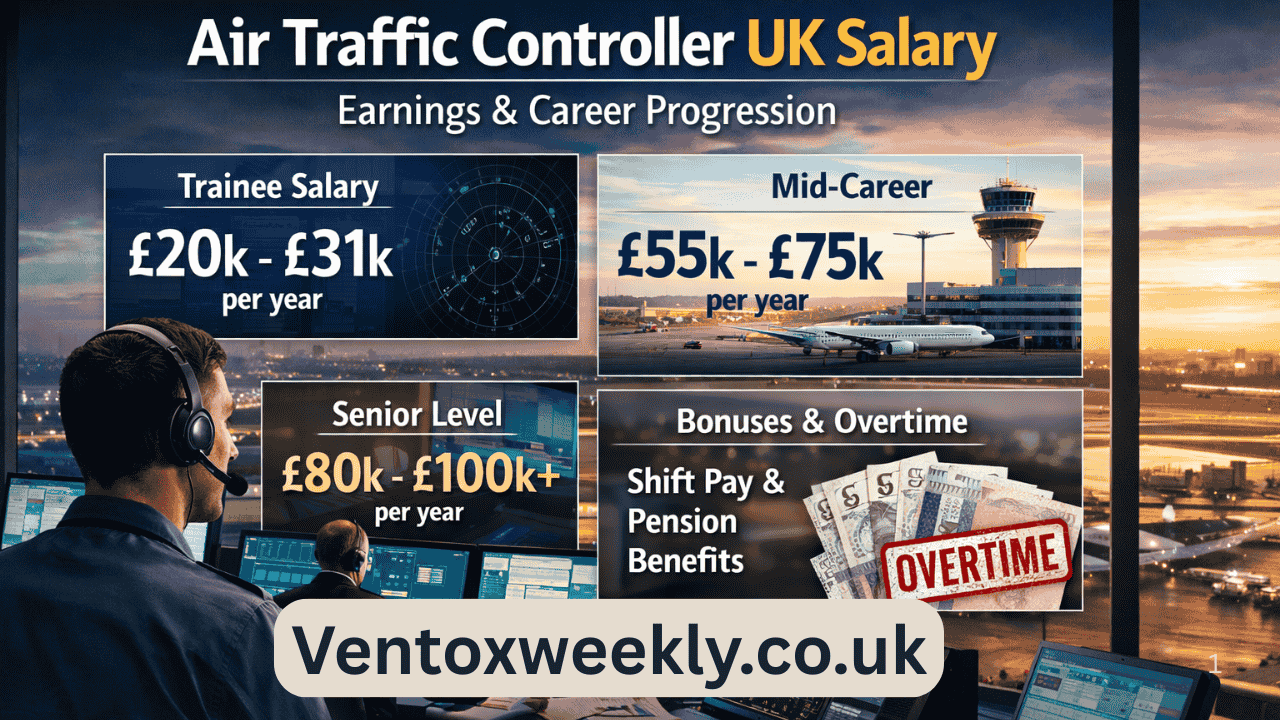
During training, candidates typically earn between:
- £20,000 and £31,000 per year
This depends on the training programme and employer. In the UK, most civilian controllers are trained through NATS (National Air Traffic Services) or airport-specific providers.
Although trainee salaries are lower than qualified rates, they are still competitive compared to many graduate roles. Training usually lasts 2 to 3 years and combines classroom instruction with on-the-job training.
Newly Qualified Salary
Once fully validated and licensed, newly qualified air traffic controllers can expect earnings of:
- £37,000 to £45,000 per year
From this point onward, pay progression can accelerate depending on performance and operational complexity.
Mid-Career Earnings
After several years of experience, the air traffic controller UK salary increases substantially.
Controllers with 5–10 years of experience often earn:
- £55,000 to £75,000 per year
Those working in busier airspace sectors, such as London Terminal Control or major airports like Heathrow and Gatwick, may earn at the higher end of this range.
Pay at this stage reflects:
- Advanced licensing endorsements
- Responsibility for high-traffic airspace
- Shift leadership roles
- Increased operational complexity
Mid-career controllers often see steady salary growth through incremental pay scales.
Senior and High-Earning Air Traffic Controllers
Senior-level professionals represent the top tier of air traffic controller UK salary figures.
Highly experienced controllers, supervisors, and operational managers can earn:
- £80,000 to £100,000+ per year
In some cases, particularly in complex airspace control centres, earnings may exceed £120,000 annually when overtime and allowances are included.
Senior roles may include:
- Watch Manager
- Supervisor
- Operations Manager
- Specialist radar controller roles
At this level, total compensation may also include significant pension contributions and bonuses.
Location and Its Impact on Salary
Location is one of the biggest influences on air traffic controller UK salary.
Higher-Paying Areas
- London (Heathrow, Gatwick, London City)
- Swanwick Control Centre
- Manchester Airport
- Major international hubs
Controllers working in high-density airspace often receive higher base pay due to the complexity and pressure of operations.
Smaller Regional Airports
Controllers at smaller regional airports typically earn slightly less than their counterparts at major hubs. However, salaries are still competitive compared to many other professions.
Shift Work and Overtime Pay
Air traffic control is a 24/7 operation. As a result, shift work significantly affects total earnings.
Most controllers work rotating shifts that include:
- Nights
- Weekends
- Public holidays
Additional compensation often includes:
- Shift allowances
- Night premiums
- Overtime pay
These extras can add several thousand pounds to total income each year. In some cases, overtime can push annual earnings well above base salary figures.
Pension and Benefits
When evaluating air traffic controller UK salary, it’s important to consider total compensation, not just base pay.
Air traffic controllers in the UK typically receive:
- Generous employer pension contributions
- Paid annual leave (often 25+ days)
- Structured career progression
- Medical support
- Strong job security
The pension scheme in particular is considered one of the more attractive elements of the profession.
Factors That Influence Air Traffic Controller UK Salary
Several variables impact how much a controller earns:
Experience Level
The more experience and endorsements a controller holds, the higher the salary.
Airspace Complexity
Controllers managing dense, international airspace earn more than those handling lighter regional traffic.
Employer
The primary employer in the UK is NATS, but some airports operate independent control services. Military controllers follow different pay structures.
Qualifications and Ratings
Additional ratings and sector validations increase earning potential.
Performance and Promotions
Supervisory or management promotions significantly increase salary.
Comparison to Other Aviation Careers
When comparing air traffic controller UK salary to other aviation roles:
| Commercial Pilot | £60,000–£100,000+ |
| Aircraft Engineer | £40,000–£65,000 |
| Cabin Crew | £20,000–£35,000 |
| Air Traffic Controller | £48,000–£100,000+ |
While pilots may earn more at senior levels, air traffic controllers benefit from:
- No travel requirements
- Stable working location
- Strong pensions
- Predictable income growth
Is the Salary Worth the Responsibility?
Air traffic control is widely regarded as one of the most demanding civilian jobs. Controllers must:
- Maintain intense concentration
- Make rapid decisions
- Communicate clearly under pressure
- Manage aircraft separation safely
Because of this high responsibility, the air traffic controller UK salary is structured to reflect both skill and stress levels.
The job is not for everyone. The selection process is highly competitive and entails testing, medical assessments, and extensive training.
However, for those suited to the role, it offers:
- Excellent long-term earnings
- Career stability
- Professional respect
- Clear progression pathways
Career Progression and Long-Term Earnings
One of the strongest aspects of the air traffic controller UK salary structure is predictable progression.
Typical career stages include:
- Trainee
- Junior Controller
- Fully Validated Controller
- Senior Controller
- Supervisor
- Management
Over a 20–30 year career, total lifetime earnings can be substantial, especially when pension contributions are factored in.
Tax Considerations
Given that many experienced controllers earn £50,000+, they may fall into:
- Higher rate tax brackets (40% on income above threshold)
Even after tax, however, take-home pay remains attractive compared to many other UK professions.
For example:
- £60,000 annual salary may result in roughly £3,500–£3,800 monthly take-home pay after deductions (depending on pension contributions and tax code).
Future Outlook for Air Traffic Controller Salaries
The aviation industry continues to grow following recovery from global travel disruptions. Demand for skilled controllers remains steady.
Factors supporting future salary stability include:
- High training barriers
- Limited qualified workforce supply
- Critical safety role
- Increasing airspace congestion
As a result, the air traffic controller UK salary is expected to remain competitive for years to come.
Conclusion
The air traffic controller UK salary reflects the skills, responsibilities, and pressure associated with managing the nation’s airspace. Starting salaries during training range from £20,000 to £31,000, while newly qualified controllers typically earn £37,000 to £45,000. With experience, earnings rise significantly, with mid-career professionals earning £55,000 to £75,000 and senior controllers reaching £80,000 to £100,000 or more.
You May Like: Latest Jobs News by NewsArena.tech: Your Trusted Source to Career Opportunities in 2025
