
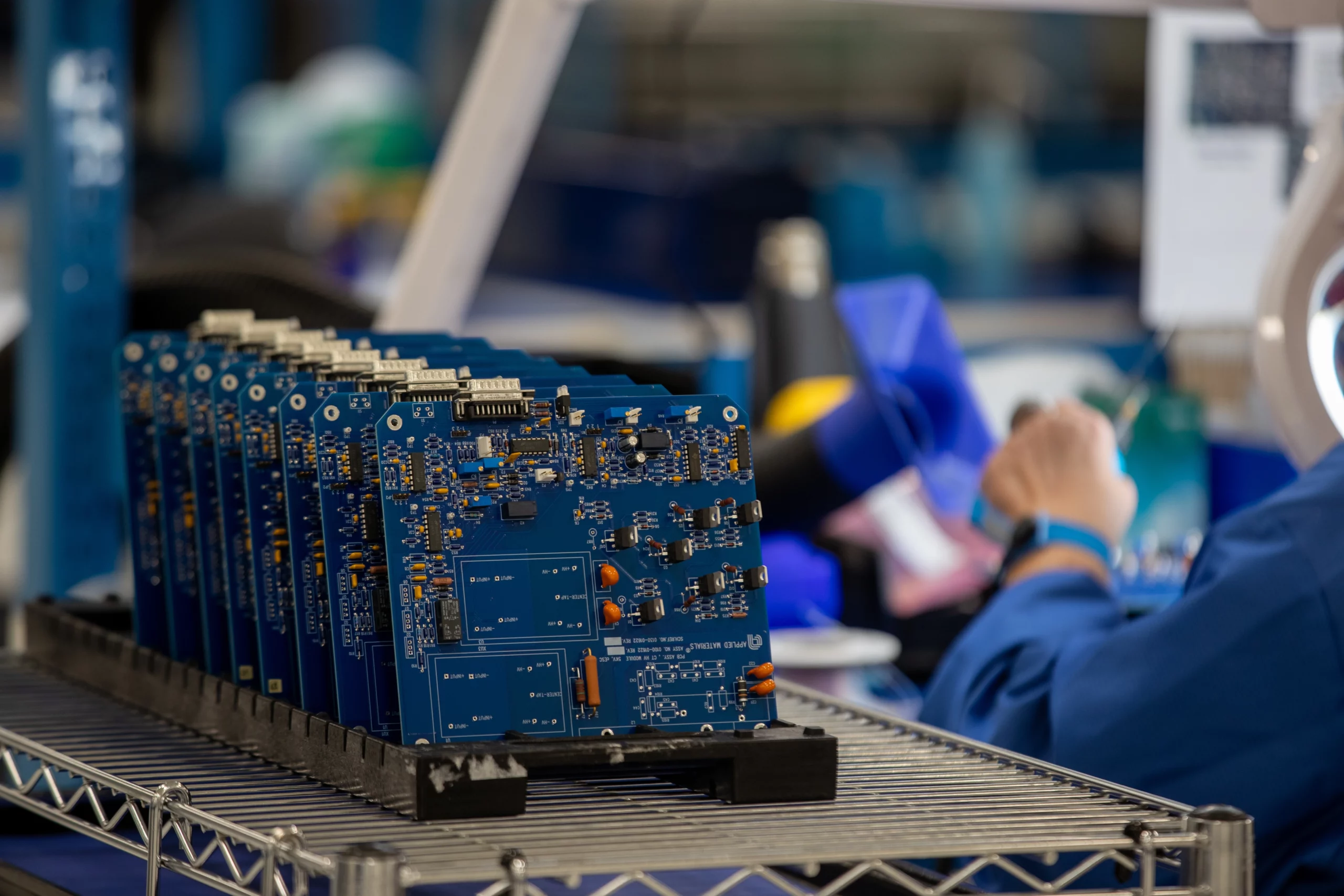
When one of my friends (who’s in grad school) needed to pay off his student loans, he ended up taking a job at an avionics firm to pay them off. A while back he explained what he did for a living to a group of us at dinner and said, for example, “I spend most of my time buying parts. This week, it’s been a lot of resistors.” The table fell silent for a moment or two after that and then someone said, “Oh,” and we moved on to talk about something else to talk about at dinner. The way he explained that work was completely accurate, and that the weight behind that sentence, the sheer consequence of getting those resistors right, is exactly why the electronics procurement in aerospace is one of the most demanding disciplines for modern manufacturing. Most people have no idea that work exists. The ones who do know that work exists think about little else.
I wasn’t trying to downplay my friend’s job or diminish her respect for it. What I was trying to get across was that her job consists mostly of small details such as choosing the right resistor. And yes, there are many different types of resistors. But the types of resistors used in avionics equipment made by my friend’s company are different from those used in most other types of equipment. In fact, the differences between the types of resistors used in avionics are of a life and death nature. Most people are completely unaware of the intricacies of procurement of electronic components for the aerospace industry. And even those who are aware of the difficulties of procurement of components for the aerospace industry are likely to have no idea of the specifics of the challenges that my friend faces every day.
The stakes are genuinely different here
Most industries are able to absorb the occasional failure of components; items can be returned to a supplier under warranty or repaired under an out-of-warranty service. Not so in aerospace and defense. Failure of a component at 35,000 feet, during satellite deployment, or within the guidance system of a missile already in flight will be catastrophic and most likely be unrecoverable.
Parts that fail on the flight deck at 35,000 feet or on deployment of a space system have no recovery whatsoever. Thus, the business of procurement in the aerospace industry is not that of supplying parts, it is safety. Treating the procurement of parts for aerospace as just another aspect of buying parts for other industries will result in disaster.
Most industries can easily deal with components for consumer products, which can be returned for repair or replacement if they fail. Other components for production equipment can also be repaired. But a single component failure in an aerospace system can have catastrophic consequences. There is no way to retrieve a failed piece of equipment floating at 35,000 feet. There is no way to retrieve a failed piece of equipment that has been deployed miles into space. And there is no way to retrieve a failed piece of equipment that is part of a guidance system that has passed the point of no return. Therefore all components for an aerospace system must be sourced with extreme care. Procurement for the aerospace industry is not like procurement for other industries. Procurement for the aerospace industry is a safety critical function.
When one considers the lives of people, the success of a mission, and the cost of billions of dollars worth of hardware the potential consequences of procurement decisions change dramatically.
Traceability isn’t a checkbox. It’s a chain of accountability.
Understanding the potential problems of any part used in aerospace applications can be solved by tracing back the part’s history. Where was the part made? Who was handling the part? What was the part’s lot number? How was the part stored before it was put into service? And was the part ever returned to the manufacturer for any sort of rework or repair? Even after a part has been removed from service it is important to understand its history for many different reasons. The reasons for a part’s failure can be traced back and used to fix similar failures in the future.
The problem of counterfeit parts is becoming more frequent and a real worry to the supply of aerospace electronic components. These parts are often designed to look identical to genuine parts, will test to be within specifications and often fail in a most catastrophic manner. Counterfeit parts have been found in military avionics, in commercial aircraft, in space and other types of systems. The risk of counterfeit parts is something that everyone in the industry is worried about and is why procurement of aerospace components must be done in a very rigorous manner with all due diligence taken to confirm that all components are from a verified and approved supplier.
- Certificates of conformance from authorized distributors
- Full traceability back to the original manufacturer
- Third-party inspection and testing where appropriate
- Documentation that survives the component’s entire service life
Documentation required for aerospace components has to stand the test of time – up to 20 to 40 years after the component has been embedded in a system. Paperwork management is typically not the most exciting part of procurement but it is an important function nonetheless.
6. The Obsolescence Problem
Here’s where things get really interesting.
While the components used in commercial electronics can change in a short amount of time, in aerospace it can happen in as little as 3 years. A chip that is being used today will become obsolete in 3 years for example when a smaller, lower cost alternative has been qualified by a defense laboratory. So the aerospace procurement team has to be able to source parts for the long-term, and to identify problems with potential obsolescence years before they actually become a problem.
In aerospace the buying for these systems is for 20+ years. Hence, the procurement team needs to be able to obtain all the documentation for the components required for the end system for the entire lifespan of the system. However, the documentation for commercial off-the-shelf items (COTS) is generally only valid for the warranty period of the item. The procurement team for these types of systems need to be able to source long life, qualified, best in class items that will not cause problems down the road.
There are companies who are Distributors of components for Aerospace electronic systems. These companies have experts in sourcing components for such applications and have a broad network of contacts within the industry, including other distributors, manufacturers and sources worldwide. This allows them to source the best component for their customer. They are also familiar with the Military Specifications that govern the design and procurement of components for these systems. They can assist in the Qualification of an alternative component and work with the Engineering teams of their customers to select and Qualify the best component for the application. Many of these Distributors also have Design Verification and Test Planning resources in-house, so they can assist in the testing of complex systems as well. Because of the complexity of sourcing and Qualifying components for Aerospace systems, sourcing through a qualified Distributor can save a lot of time and money for the customer.
(Another thing to remember is that qualifying an alternative component can take months to complete and requires the involvement of design engineers, purchasing agents, test engineers, and production engineers. It’s not something that can be done overnight, which is why a qualified purchasing agent will qualify parts ahead of time to avoid these last minute headaches.)
The Aerospace Market Is Highly Regulated
Rules for Aerospace Procurement of High Reliability Electronic Components for Space and other High Reliability Systems abound. Most are documented and follow the standard model for a number of industries – AS9100 (Quality Management), MIL-SPEC (Military Specifications), ITAR (International Traffic in Arms Regulations), and DO-254 (Design Assurance for Aerospace and Defense Electronic Systems) are but a few of the many rules that are currently intended to ensure that all parties involved in procurement of high reliability electronic components for the aerospace industry can remain honest in their dealings with each other. In practice, many of these rules will affect the world of procurement in a unique fashion and the mindset of the procurement personnel must include the realization that the work of the procurement personnel is not separate from that of the engineers of the organization. In fact, in the best of cases, the work of the two groups is combined as a single function – that of ensuring that the correct components are procured for the application at hand and that all steps are taken to ensure that the end product will be of high quality and meet all of the required specifications.
Parts can affect the certification of end products. Certain importation of parts can cause an ITAR violation and can have severe legal consequences. Therefore, the compliance burden cannot be given to the engineering to handle over a Friday afternoon.
| Standard | What it covers | Procurement impact |
| AS9100 | Quality management for aerospace | Suppliers must be AS9100-certified or formally approved |
| MIL-SPEC | Military performance requirements | Parts must meet specific grade and testing standards |
| ITAR | Export control for defense-related technology | Sourcing and handling require meticulous documentation |
| DO-254 | Airborne hardware design assurance | Components need full traceability and supporting design evidence |
As can be seen from the following diagram, there are whole careers built around each of the major rules / sets of rules (AS9100, MIL-SPEC, ITAR, DO-254 etc) and only a deep knowledge of one of them is needed for a reliable career in the aerospace industry.
Reliability isn’t a feature. It’s the floor.
Marketing around the high quality of products designed to last, such as high end consumer electronic products, focuses on their high reliability and the long period of time during which the product will function well. For parts used in aerospace products such as space vehicles or aircraft, the requirement for high reliability is extreme and is the minimum required for flight. Therefore for aerospace electronic systems procuring the proper parts, knowledge of the part’s environmental test levels and how to qualify a part for use in systems designed for use in a variety of environments is needed. Parts are typically procured from distributors of electronics parts however for the proper aerospace electronic system parts a specialized distributor must be located that can properly source high reliability components for use in aerospace products.
When sourcing parts for aerospace systems, procurement teams must understand the environment in which parts will operate. They must work with distributors who have the same level of expertise as the engineers who qualified the parts for use in a particular system. This means that parts cannot be sourced from general electronics distributors that only sell commercial-grade products. These types of products are not qualified for or designed to operate in the same environment as military-grade parts.
My comparison earlier of aerospace procurement to a load-bearing wall in a house of cards is a good one. The analogy would be more accurate however to consider the procurement organization as the load-bearing foundation of the house of cards that is the aerospace engineering program. The structure is built upon the decisions and actions of the procurement team. If the foundation fails then the entire structure will fail, even if the rest of the structure looks fine for a time.
They understand that the foundation of the structure is critical to its successful completion and that sourcing and procurement need to be treated as an integral part of the engineering function. It is not viewed grudgingly, but as a necessary ingredient in the development of the aerospace systems and products that are the lifeblood of their organization. My friend with the resistors? She’s one of the most important people in that building. It just doesn’t make for good dinner party conversation.
My friend with the resistors? She’s one of the most important people in that building. It just doesn’t make for good dinner party conversation.
