
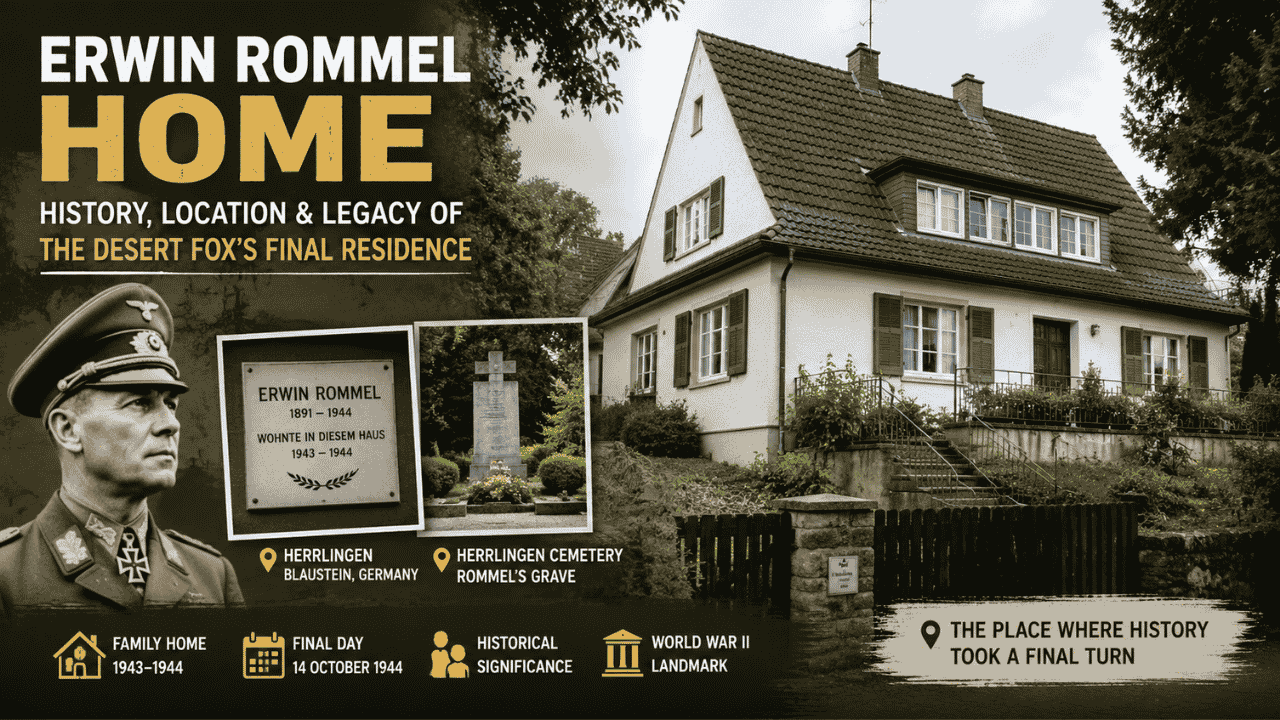
The Erwin Rommel home remains one of the most historically significant residences associated with World War II. Although Field Marshal Erwin Rommel—famously known as the “Desert Fox”—spent much of his military career on battlefields across Europe and North Africa, his final home in Herrlingen, Germany, has become an important landmark for historians and visitors alike. More than just a family residence, the house witnessed the final chapter of Rommel’s life, including the events that led to his forced suicide in October 1944. Today, many history enthusiasts search for information about the Erwin Rommel home to understand where he lived, what happened there during the final months of World War II, and whether the property can still be visited. This comprehensive guide explores the home’s location, architectural features, historical significance, family life, connection to the July 20 Plot, nearby memorials, and its place in modern historical tourism.
Erwin Rommel Home Overview
The Erwin Rommel home is located in Herrlingen, a district of Blaustein in Baden-Württemberg, southern Germany. Nestled in a quiet hillside neighbourhood near Ulm, the residence was intended as a peaceful family home rather than a military headquarters.
Rommel and his family moved into the property in 1943 after years of military assignments throughout Europe and North Africa. Although he spent only about a year living there, the home became permanently linked with one of the most dramatic events of World War II—his forced death under orders from Adolf Hitler’s regime.
Today, the house stands as an important historical site, attracting military historians and visitors interested in Germany’s wartime history.
Where Is the Erwin Rommel Home Located?
The home is situated in:
- Herrlingen
- Blaustein
- Baden-Württemberg
- Germany
Herrlingen lies approximately 10 kilometres west of Ulm, a historic city in southern Germany.
The residence is located on a peaceful residential street, overlooking wooded hills and valleys. During World War II, this location offered a safer environment than larger German cities, which increasingly became targets of Allied bombing campaigns.
Its relatively secluded setting also provided Rommel with privacy while recovering from severe injuries sustained during the Normandy campaign.
Why Did Rommel Move to Herrlingen?
By late 1943, Germany faced increasing Allied air raids.
Rommel’s family needed a secure location away from major industrial centres. Herrlingen offered several advantages:
- Quiet countryside
- Reduced bombing risk
- Beautiful natural surroundings
- Easy railway access
- Close proximity to military transportation routes
The move allowed his wife, Lucie Rommel, and their son, Manfred, to enjoy a safer environment while Rommel continued serving in high-ranking military positions.
Who Lived in the Erwin Rommel Home?
The household primarily consisted of:
Erwin Rommel
Field Marshal Erwin Rommel was among Germany’s most respected military commanders. His leadership during the North African Campaign earned him international recognition and the nickname “Desert Fox.”
Lucie Rommel
Lucie Rommel managed the household throughout her husband’s frequent military deployments. She remained with him during his recovery following injuries suffered in France.
Manfred Rommel
Their only son, Manfred Rommel, later became the long-serving mayor of Stuttgart. He frequently wrote about his father’s final days and helped preserve aspects of the family’s history.
Architecture of the Erwin Rommel Home
Unlike the grand residences often associated with senior military leaders, the Erwin Rommel home was relatively modest.
The house reflected traditional German residential architecture rather than military prestige.
Key architectural features included:
- Sloped roof
- White exterior walls
- Large windows
- Garden area
- Stone pathways
- Multi-level hillside construction
- Comfortable family rooms
- Private study
The design emphasised practical family living instead of luxury.
Its peaceful surroundings contrasted sharply with the violent events unfolding across Europe during World War II.
Life Inside the Erwin Rommel Home
Because Rommel spent much of the war commanding military operations, he had relatively little opportunity to enjoy domestic life.
When at home, he valued:
- Reading military reports
- Spending time with his wife
- Walking nearby trails
- Meeting close friends
- Recovering from physical exhaustion
Following the Normandy campaign, doctors recommended rest after he suffered serious injuries in July 1944 when Allied aircraft attacked his staff car.
During his recovery, much of his time was spent inside the Herrlingen residence.
The Normandy Injury That Changed Everything
On 17 July 1944, Rommel’s staff car came under attack by Allied fighter aircraft near Livarot in Normandy.
The attack resulted in:
- Skull fractures
- Facial injuries
- Severe concussion
- Temporary loss of consciousness
Doctors believed his recovery would require months.
Consequently, he returned to the Erwin Rommel home, where he recuperated as Germany’s military situation continued to deteriorate.
The July 20 Plot and Rommel
One of the most controversial aspects of Rommel’s legacy involves the failed assassination attempt against Adolf Hitler on 20 July 1944.
Although historians continue debating the extent of Rommel’s involvement, evidence suggests:
- He opposed some of Hitler’s military decisions.
- He favoured negotiating peace with the Allies.
- Some conspirators believed Rommel could support a post-Hitler government.
However, there is no conclusive evidence that Rommel directly participated in the assassination attempt itself.
Following the plot’s failure, Nazi investigators connected several conspirators to Rommel through conversations and correspondence.
This association ultimately sealed his fate.
The Final Day at the Erwin Rommel Home
The Erwin Rommel home became internationally famous because of the events of 14 October 1944.
That morning, Generals Wilhelm Burgdorf and Ernst Maisel arrived at the residence.
They delivered Hitler’s ultimatum.
Rommel faced two choices:
Option One
Stand trial before the People’s Court.
Possible consequences included:
- Public humiliation
- Execution
- Punishment of his family
- Confiscation of property
Option Two
Take poison quietly.
In return:
- His family would remain unharmed.
- He would receive a state funeral.
- His reputation would be publicly preserved.
After discussing the situation with Lucie and Manfred, Rommel chose the second option.
He left the house wearing his field marshal’s uniform.
Shortly afterwards, inside a waiting staff car, he swallowed a cyanide capsule and died within minutes.
The German government falsely announced that he had died from injuries sustained during the Normandy campaign.
What Happened to the Home After Rommel’s Death?
Following World War II, the house remained standing.
Unlike many wartime buildings, it survived extensive destruction.
Ownership changed over the decades, and the residence eventually became private property.
Today:
- The structure still exists.
- It remains historically significant.
- It is not generally open to the public for interior tours.
- Visitors can view the exterior respectfully.
The home’s historical value lies not in its size or architecture but in the events that occurred there during the closing months of World War II.
Can You Visit the Erwin Rommel Home Today?
Yes—but with limitations.
Because the property is privately owned, tourists cannot freely explore the interior.
Visitors usually:
- View the exterior from public roads.
- Visit nearby memorials.
- Explore Herrlingen Cemetery.
- Learn more at local historical museums.
Anyone planning a visit should respect residents’ privacy and local regulations.
Nearby Historical Attractions
Several important historical sites are located near the Erwin Rommel home.
Herrlingen Cemetery
Rommel was buried in the local cemetery.
His grave remains one of Germany’s most visited World War II military graves.
Thousands of visitors arrive each year to pay respects or study history.
Memorial Site
Near the location where Rommel died, a memorial commemorates the final events of October 1944.
Historical markers explain the circumstances surrounding his death and place them within the broader context of the war.
Museum Lebenslinien
Previously known as the Rommel Museum, it now presents the broader history of Herrlingen and its notable residents. Exhibits provide historical context about Rommel’s life, the local community, and the Second World War.
Historical Significance of the Erwin Rommel Home
The Erwin Rommel home symbolises more than one man’s residence.
It represents:
- Military leadership
- Moral dilemmas during dictatorship
- Family sacrifice
- The collapse of Nazi Germany
- The personal cost of war
Historians continue studying Rommel’s complex legacy.
Some view him primarily as a brilliant military strategist.
Others examine his role within Nazi Germany and debate the extent of his resistance to Hitler.
The home serves as a tangible reminder of these difficult historical questions.
Interesting Facts About the Erwin Rommel Home
Here are several lesser-known facts:
- Rommel lived there for only about one year.
- The house was intended primarily for family life.
- He spent much of his recovery from Normandy injuries there.
- Hitler’s emissaries delivered the fatal ultimatum at the residence.
- Rommel’s farewell to his wife and son took place at home.
- The house survived World War II largely intact.
- It remains one of Germany’s best-known residences associated with World War II.
Why People Continue Searching for Erwin Rommel Home
Interest in the Erwin Rommel home continues because it combines military history, architecture, biography, and the dramatic circumstances of Rommel’s death.
Common reasons people search for the topic include:
- Learning where Rommel lived.
- Understanding the events leading to his death.
- Planning historical travel in Germany.
- Exploring World War II landmarks.
- Researching the life of the Desert Fox.
- Studying Germany’s wartime history.
Unlike famous castles or palaces, the house offers a deeply personal perspective on one of World War II’s most discussed military figures.
Frequently Asked Questions
Where is the Erwin Rommel home?
The home is located in Herrlingen, now part of Blaustein in Baden-Württemberg, Germany.
Does the Erwin Rommel home still exist?
Yes. The residence still stands and remains a recognised historical landmark, although it is privately owned.
Why is the Erwin Rommel home famous?
It is famous because it was Rommel’s final residence and the place from which he departed on 14 October 1944 before taking cyanide under orders from the Nazi leadership.
Can tourists visit inside the house?
Generally, no. The property is private, though visitors can view the exterior from public areas and visit nearby historical sites.
Is Rommel buried near his home?
Yes. Rommel is buried in Herrlingen Cemetery, only a short distance from his former residence.
Conclusion
The Erwin Rommel home is far more than a historic building—it is a place where military history, personal tragedy, and the final days of one of Germany’s most famous field marshals intersect. Located in the peaceful village of Herrlingen, the modest residence served as Rommel’s family home during the last year of his life and became the setting for the events that ended his career and ultimately his life. While the house itself remains privately owned, its historical importance continues to attract researchers, historians, and travellers from around the world. Together with nearby memorials, the cemetery, and local museums, the Erwin Rommel home provides valuable insight into the complexities of World War II and the enduring legacy of the man known as the Desert Fox.
You May Like: William John March: Biography, History, and the People Behind the Name
