
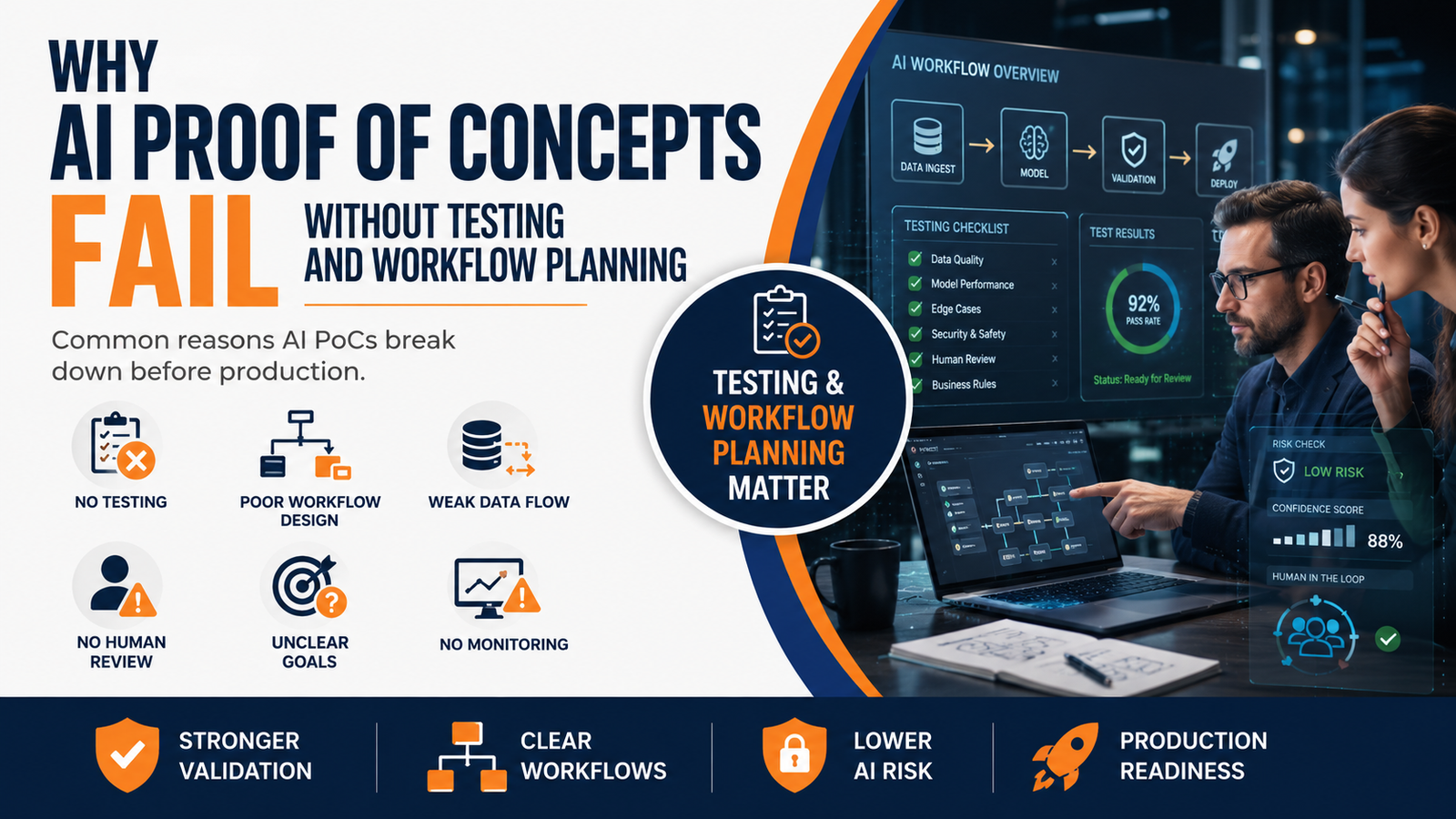
Why AI PoCs Look Promising but Still Fail
Many AI projects start with excitement. A team builds an AI PoC, runs a polished demo, and sees the model answer questions, summarize documents, or automate a simple task. On the surface, everything looks ready. But when the same PoC enters a real business environment, the problems begin.
The issue is rarely the model alone. Most AI proof of concepts fail because teams skip the practical foundation.
- They do not complete an AI readiness assessment.
- They do not map agentic workflows clearly.
- They do not test edge cases, integrations, or user behavior.
- They ignore governance, data quality, and adoption planning.
A good AI PoC should prove more than technical possibility. It should prove that AI can work inside real workflows, with real users, real data, and real business constraints.
What Is an AI Proof of Concept?
An AI proof of concept is a small validation project used to test whether an AI idea can solve a specific business problem. It may involve an AI agent platform, an AI agent builder, a chatbot, a document processing model, or a custom automation workflow.
For example, a company may ask how to create an AI agent that can answer support tickets, summarize invoices, or route leads to the right sales team. Generative AI consulting teams often begin with a PoC to check feasibility before larger investment.
A strong AI PoC usually validates:
- Whether the AI can access the right data.
- Whether outputs are accurate enough.
- Whether the workflow saves time.
- Whether users trust the system.
- Whether the solution can scale safely.
The goal is not to build everything at once. The goal is to learn quickly, reduce risk, and decide whether the idea deserves a pilot or full deployment.
AI PoC vs AI Pilot vs Full Deployment
An AI PoC, AI pilot, and full deployment are often confused, but they serve different purposes. A PoC proves whether an idea is possible. A pilot tests the idea in a controlled real-world environment. Full deployment makes the AI part of daily operations.
- AI PoC: Small experiment with limited users, data, and scope.
- AI pilot: Controlled rollout with real users and measurable outcomes.
- Full deployment: Production-ready system with governance, monitoring, testing, support, and scaling.
The mistake happens when businesses treat a PoC like a finished product. A working demo does not mean the system is ready for live users, sensitive data, compliance checks, or business-critical decisions.
Why Businesses Run AI PoCs
Businesses run AI PoCs because they want faster, smarter, and more efficient operations. They may want to automate support, process documents, improve decision support, optimize workflows, or increase team productivity.
Common PoC goals include:
- Reducing manual repetitive tasks.
- Improving response accuracy.
- Speeding up internal approvals.
- Automating document classification.
- Supporting employees with AI recommendations.
- Connecting AI to CRM, ERP, or ticketing systems.
These goals are valid, but they need business discipline. A PoC should not only show that AI can respond. It should show whether the response is useful, safe, measurable, and connected to the way people actually work.
The Main Reason AI PoCs Fail: No AI Readiness Assessment
The biggest reason AI PoCs fail is simple: teams start building before asking whether the business is ready. An AI readiness assessment helps identify whether the company has the right problem, data, process, people, and governance structure.
Without this step, even the best AI tool can fail.
- The data may be messy or incomplete.
- The process may not be documented.
- Teams may disagree on ownership.
- Compliance requirements may be unclear.
- Users may not trust the output.
AI governance consulting and AI governance solutions are becoming more important because companies now understand that AI risk is not only technical. It is operational, legal, reputational, and human.
Teams Start with the Tool Instead of the Problem
Many teams begin by choosing a model, platform, or vendor. They explore an AI agent platform, compare an AI agent builder, or follow consulting industry news about the latest agentic AI workflows. But they have not clearly defined the business problem.
This creates weak PoCs because nobody knows what success means.
A better starting point is to ask:
- What exact problem are we solving?
- Who owns the workflow?
- What decision will AI support or automate?
- What data does the AI need?
- What accuracy level is acceptable?
- What happens when the AI is wrong?
When the tool comes before the problem, the PoC becomes a technology showcase. When the problem comes first, the PoC becomes a business validation exercise.
Missing Business, Data, and Process Readiness
AI depends on context. If business rules are unclear, data is scattered, or processes are inconsistent, the AI will struggle. A model cannot fix a broken workflow by itself.
Readiness gaps often include:
- Poor data quality.
- Duplicate or outdated records.
- Missing role-based permissions.
- No process documentation.
- Weak stakeholder alignment.
- No compliance owner.
- No testing baseline.
This is where AI governance contextual intelligence matters. AI should understand not only text or data, but also the business context around that data. Without context, the output may look fluent but still be wrong, risky, or unusable.
Poor Workflow Planning Breaks AI PoCs
Workflow planning is where many AI PoCs collapse. Teams often design the AI response but forget the process around that response. Real businesses are not simple chat windows. They include approvals, exceptions, user roles, system permissions, audit trails, and escalation paths.
Agentic workflows must be designed with structure. Whether the company is building agentic workflow automation, AI agentic workflows, or agentic AI workflows, the system needs clear boundaries.
A successful workflow answers:
- Where does the request begin?
- Which system provides the data?
- What should the AI do independently?
- When should a human approve?
- Where is the final output stored?
- How are errors reported?
AI should reduce process friction, not create more confusion.
AI Cannot Succeed Without a Clear Workflow Map
A clear workflow map shows how work moves from input to outcome. It includes users, systems, approvals, data sources, exceptions, and final decisions.
For example, an AI invoice assistant may need to:
- Read the invoice.
- Match it with purchase orders.
- Check vendor rules.
- Flag mismatches.
- Send exceptions to finance.
- Update the ERP after approval.
Without workflow planning, the AI may extract data correctly but still fail operationally. It may not know who should approve a mismatch, where to send an exception, or how to handle missing vendor information.
This is why Microsoft workflow tools, CRM systems, ERP platforms, and automation platforms must be considered early, not after the PoC is built.
Agentic Workflows Need Boundaries and Human Oversight
Agentic workflows are powerful because they allow AI to take multiple steps, use tools, and make recommendations. But autonomy without boundaries is risky.
A reliable agentic workflow should define:
- What the AI can do alone.
- What requires approval.
- Which actions are blocked.
- What fallback logic applies.
- When a human must take over.
- How the system records decisions.
For example, an AI support agent may suggest a refund, but a human may need to approve refunds above a certain amount. An AI sales assistant may qualify leads, but it should not change CRM deal stages without clear rules.
Human oversight is not a weakness. It is what makes AI safe enough for business use.
Workflow Gaps Create Adoption Problems
Users reject AI when it creates extra work. If the AI gives unclear outputs, breaks familiar processes, or requires users to double-check everything, adoption drops quickly.
Workflow gaps usually appear as:
- Confusing recommendations.
- Missing context.
- Extra manual copy-paste work.
- Poor handoff between AI and humans.
- No clear owner for errors.
- Outputs that do not match business formats.
This is why workflow planning should happen before development. The best AI PoCs make daily work easier. They fit into existing habits while improving speed, consistency, and accuracy.
Lack of Testing Makes AI PoCs Unreliable
AI PoCs often fail because teams test them like demos instead of systems. A few successful examples do not prove reliability. AI must be tested against real users, messy inputs, edge cases, business rules, integrations, security limits, and changing data.
This is where structured QA becomes essential. Companies exploring what are the tools for software testing should understand that traditional testing tools still matter, but AI also needs LLM evaluation.
Testing should cover:
- Output accuracy.
- Prompt consistency.
- Hallucination risk.
- Integration behavior.
- Access control.
- Regression impact.
- User acceptance.
- Failure handling.
For AI connected to real systems, testing is not optional. It protects the business from wrong decisions, broken workflows, and unreliable automation.
AI Outputs Need More Than Demo Testing
Demo testing usually uses clean inputs and expected questions. Real users behave differently. They ask incomplete questions, upload messy files, use different wording, and expect accurate results every time.
AI output testing should check:
- Common user requests.
- Rare but important edge cases.
- Confusing or incomplete inputs.
- Multi-step business rules.
- Wrong or conflicting data.
- Permission-restricted information.
A PoC that works in one meeting may fail across hundreds of real scenarios. Reliable AI needs repeatable evaluation, not one successful presentation.
LLM Evaluation Is Critical for Generative AI PoCs
LLM evaluation checks whether generative AI outputs are accurate, safe, consistent, and useful. It goes beyond asking, “Does the answer look good?”
A strong LLM evaluation plan should include:
- Hallucination testing.
- Accuracy checks.
- Bias testing.
- Prompt consistency.
- Response quality scoring.
- Groundedness checks.
- Failure response testing.
- Human review for sensitive tasks.
This is especially important for customer support, healthcare, finance, legal, insurance, and HR workflows. In these areas, a confident but wrong answer can damage trust quickly.
LLM evaluation turns AI from a creative experiment into a measurable business system.
Functional, Integration, and Regression Testing Still Matter
Even if the AI model works, the connected system can fail. AI PoCs often rely on APIs, databases, CRM platforms, ERP tools, knowledge bases, authentication layers, and third-party services.
Testing should verify:
- API responses.
- Data sync.
- User permissions.
- CRM and ERP updates.
- Role-based access.
- Audit logs.
- Error messages.
- Regression after workflow changes.
This is where experienced QA partners such as Frugal Testing can help businesses validate AI-enabled systems before they reach production. AI does not remove the need for software testing tools. It makes testing more important.
Common Testing Mistakes That Cause AI PoCs to Fail
Testing mistakes are common because AI feels different from traditional software. Teams assume that if the model can reason, it can handle variation automatically. That assumption is dangerous.
Modern testing tools and AI testing platforms can support evaluation, but the strategy matters more than the tool. Teams may explore Applitools for visual validation, Momentic for AI-driven testing, or other software testing tools, but they still need a clear test plan.
Common mistakes include:
- Testing only ideal prompts.
- Ignoring negative scenarios.
- Skipping integration testing.
- Not measuring quality over time.
- Trusting model output without review.
AI PoCs fail when testing is treated as a final checkbox instead of a design requirement.
Testing Only Happy Paths
Happy-path testing checks whether the system works when everything goes right. This is useful, but it is not enough.
For example, a document AI PoC may work when the invoice is clean, complete, and formatted correctly. But what happens when the file is blurry, the tax number is missing, or the vendor name is slightly different?
Teams should test:
- Clean data.
- Messy data.
- Missing fields.
- Unexpected formats.
- User mistakes.
- System downtime.
- Conflicting instructions.
Real-world testing reveals whether the AI can support actual operations, not just a controlled demo.
Ignoring Edge Cases and Negative Scenarios
Edge cases often decide whether an AI PoC can scale. These are the unusual but realistic situations that break weak systems.
Examples include:
- Incomplete customer records.
- Wrong user inputs.
- Missing permissions.
- Duplicate entries.
- Conflicting business rules.
- Unsupported languages.
- Outdated knowledge base content.
- Requests outside the AI’s scope.
Negative testing is equally important. The AI should know when not to answer, when to escalate, and when to ask for more information. A safe refusal is better than a confident mistake.
Not Measuring Output Quality Over Time
AI quality can change as prompts, data, models, and workflows evolve. A PoC may perform well in week one and decline later when new data sources, users, or tasks are added.
Teams should monitor:
- Accuracy trends.
- Hallucination rates.
- User corrections.
- Escalation frequency.
- Response acceptance.
- Failed automation attempts.
- Regression after prompt changes.
Continuous measurement helps teams improve the AI system before users lose trust. AI performance should be treated like product quality, not a one-time approval.
Governance and Risk Planning Are Often Ignored
Governance is often added too late. Teams focus on speed, demos, and automation, then realize they have not defined accountability, security, compliance, or decision ownership.
AI governance solutions help answer important questions:
- Who owns the AI system?
- Who approves high-risk outputs?
- What data can the AI access?
- How are decisions logged?
- What happens when AI causes an error?
- Which compliance rules apply?
AI governance consulting is especially useful when AI touches customer data, financial records, healthcare information, HR decisions, or regulated workflows.
Who Owns the AI Decision?
AI may recommend an action, but the business still owns the result. That ownership must be clear before deployment.
For example:
- A sales AI may recommend lead priority.
- A finance AI may flag invoice risk.
- A support AI may suggest compensation.
- A legal AI may summarize contract exposure.
In each case, someone must be accountable. The business needs approval authority, review rules, escalation paths, and audit records. Without ownership, teams may blame the model, the vendor, or the user when something goes wrong.
Governance makes responsibility visible.
Security, Compliance, and Data Access Risks
AI PoCs often use sensitive data before access controls are fully designed. This creates risk.
Teams should plan for:
- Role-based permissions.
- Sensitive data masking.
- Secure API access.
- Audit logs.
- Data retention rules.
- Compliance requirements.
- Vendor risk reviews.
- User consent where needed.
A PoC should never become a shortcut around security. Even a small experiment can expose customer data, employee information, or confidential business records if access is not controlled properly.
How to Build a Successful AI PoC with Testing and Workflow Planning
A successful AI PoC starts with business clarity, not technology excitement. The goal is to prove that AI can solve a real problem safely, reliably, and measurably.
Companies offering agentic process automation, custom generative AI development services, AI ML development services, or ai/ml development services should guide clients through both development and validation.
A practical AI PoC framework includes:
- Business problem definition.
- Workflow mapping.
- Data readiness review.
- Testing plan.
- Governance model.
- Human oversight.
- Pilot roadmap.
AI works best when it is designed as part of a business system.
Step 1: Define the Business Problem and Success Metrics
Start with a measurable problem. Avoid vague goals like “use AI to improve productivity.” Instead, define what should improve and how it will be measured.
Useful success metrics include:
- Time saved per task.
- Error reduction.
- Response accuracy.
- Automation rate.
- Cost reduction.
- User adoption.
- Escalation reduction.
- Customer satisfaction improvement.
For example, a support AI PoC may aim to reduce first-response time by 40 percent while maintaining response accuracy above a defined threshold. Clear metrics prevent subjective decisions later.
Step 2: Map the Workflow Before Building the AI
Workflow mapping should happen before prompts, integrations, or UI design. It shows how the AI will fit into actual operations.
Map the following:
- Inputs.
- Users.
- Systems.
- Data sources.
- Approval steps.
- Exceptions.
- Security roles.
- Final outcomes.
This helps teams identify gaps early. For instance, if an AI assistant needs CRM data, ticket history, and billing information, the PoC must include access planning, permission checks, and integration testing from the start.
Step 3: Create a Testing Plan from Day One
Testing should not wait until the PoC is finished. It should shape the build.
An AI testing plan should include:
- Functional testing.
- LLM evaluation.
- Integration testing.
- Security testing.
- Regression testing.
- User acceptance testing.
- Monitoring after launch.
For AI systems, testing is not only about bugs. It is about trust, reliability, consistency, and safe behavior under uncertainty.
Step 4: Start Small, Then Scale Carefully
A PoC should prove feasibility first. It should not attempt to automate an entire department in one step.
A better path is:
- Start with one workflow.
- Validate with limited users.
- Measure results.
- Fix quality gaps.
- Expand into a pilot.
- Add governance and monitoring.
- Scale to production carefully.
This is where an experienced AI development agency such as Buildnextech can help teams move from PoC to production with architecture, workflow automation, governance, and deployment planning.
When Should You Work with an AI Development or Consulting Partner?
Not every company needs outside help for every AI experiment. But many businesses benefit from expert support when the PoC involves sensitive data, complex workflows, production integrations, or high-risk decisions.
A partner can help with:
- AI readiness assessment.
- Workflow design.
- Model selection.
- LLM evaluation.
- Governance planning.
- Testing strategy.
- Deployment architecture.
- Post-launch monitoring.
This is why businesses often compare an AI development agency, top AI consulting firms, and generative AI consulting services before scaling AI investments.
When Internal Teams Lack AI Testing Experience
Internal teams may understand their business well but lack AI testing experience. AI projects need a mix of development, QA, workflow design, governance, and deployment planning.
The right partner brings structure. They help define what to test, how to measure outputs, how to reduce hallucination risk, and how to connect AI safely with business systems.
This support matters most when the AI PoC affects customers, revenue, compliance, or employee decisions.
When the PoC Needs to Become Production-Ready
A PoC becomes serious when leaders ask, “Can we use this in the business?” At that point, the work shifts from experimentation to production planning.
Production-ready AI needs:
- Scalable architecture.
- Secure integrations.
- Testing coverage.
- Human oversight.
- Monitoring.
- Governance.
- Support processes.
- Clear ownership.
A consulting partner can help turn a promising AI demo into a reliable operating system, not just a clever prototype.
Conclusion: AI PoCs Fail When They Are Treated Like Experiments, Not Systems
AI PoCs fail when companies treat them as isolated experiments. A good model is not enough. The real test is whether AI can work inside business workflows with reliable outputs, secure data access, clear governance, and measurable value.
Successful AI proof of concepts need:
- AI readiness assessment.
- Clear agentic workflows.
- LLM evaluation.
- Workflow planning.
- Human oversight.
- Functional and integration testing.
- Governance from the beginning.
AI can transform business operations, but only when teams design it as a system. Testing and workflow planning are not extra steps. They are what turn an AI PoC into something the business can trust, scale, and use every day.
