
Introduction
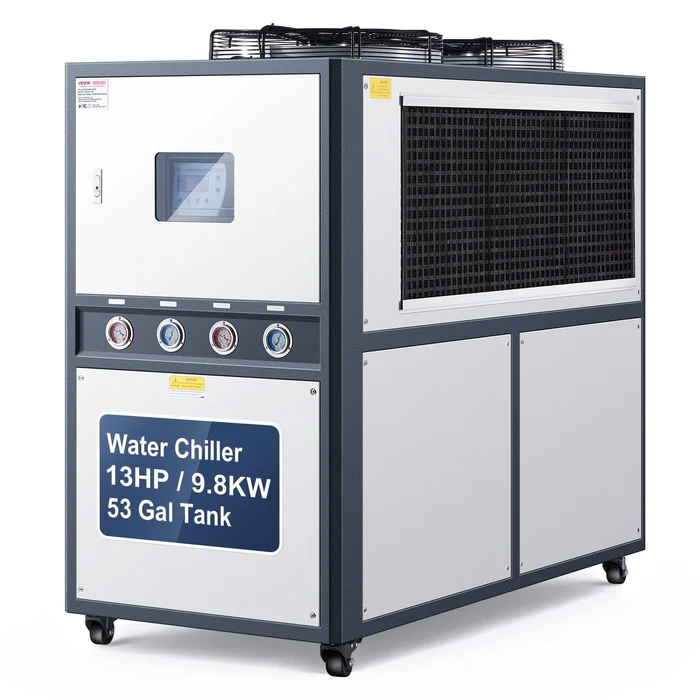
Many American manufacturing and processing operations generate heat that must be removed to keep equipment and products within their working temperature. Injection molding machines, machine tools, lasers, and food and beverage processes all rely on steady cooling. An air-cooled water chiller meets this need by removing heat from a process and rejecting it to the surrounding air, without the cooling tower that a water-cooled system requires. Plants, workshops, and production lines use these units to hold a stable temperature and protect both output quality and equipment life.
What a Water Chiller Does
A water chiller cools a fluid, usually water or a water-and-glycol mix, and circulates it through the equipment or process that needs cooling. The fluid absorbs heat from the process, returns warmer to the chiller, gives up that heat, and is sent back cold in a continuous loop. By holding the supply fluid at a set temperature, it keeps the process from overheating.
The Refrigeration Cycle
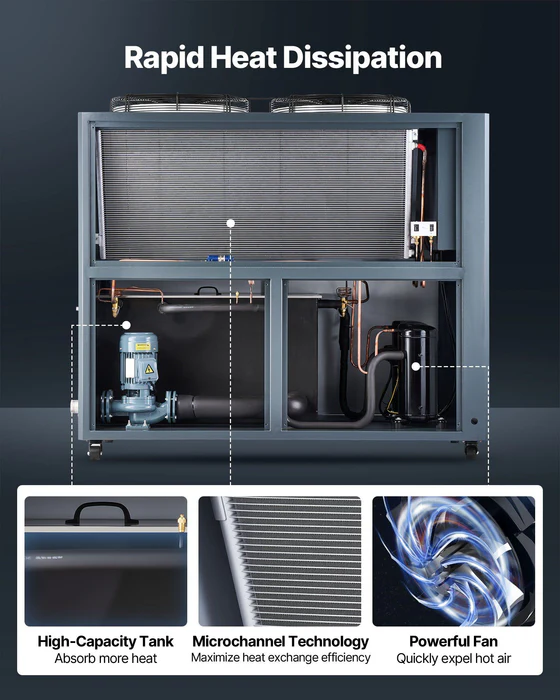
At the heart of the unit is a refrigeration cycle similar to that of an air conditioner. A compressor raises the pressure and temperature of a refrigerant, which then passes through a condenser where it releases heat and turns to liquid. The liquid refrigerant expands through a valve, cooling sharply, and flows through an evaporator where it absorbs heat from the process water. The refrigerant returns to the compressor as a gas, and the cycle repeats.
Air-Cooled Versus Water-Cooled
Chillers reject their collected heat in one of two ways. An air-cooled unit uses a condenser with fans that blow ambient air across the coils, carrying the heat away. A water-cooled unit instead passes the heat to a separate water loop and a cooling tower. Air-cooled designs are simpler to install because they need no tower or water supply, though they depend on the surrounding air temperature and add heat to nearby space.
Main Components
Several parts work together in an air-cooled unit. The compressor drives the refrigeration cycle, while the condenser coil and its fans reject heat to the air. The evaporator transfers heat out of the process fluid, a pump circulates that fluid, and a tank or reservoir holds a buffer of it. Controls and sensors regulate the set temperature and protect the system.
Sizing and Capacity
A chiller must be sized to the heat load it has to remove, usually expressed in tons or horsepower. An undersized chiller cannot hold the set temperature under full load, while a heavily oversized one cycles inefficiently and costs more than needed. Estimating the process heat load, the required fluid temperature, and the ambient conditions is the basis for choosing capacity.
Common Applications
Process chillers serve a wide range of industries:
· Plastic injection molding and extrusion
· Machine tools and metalworking
· Lasers, welding, and electronics
· Food, beverage, and brewing processes
· Medical, laboratory, and analytical equipment
Placement and Ventilation
An air-cooled chiller depends on a steady supply of cool air, so placement matters. The unit needs clearance around the condenser for airflow and a location where it can draw cool air and exhaust warm air without recirculating it. High ambient temperatures reduce its capacity, and a dusty or blocked condenser forces the system to work harder.
Coolant and Freeze Protection
The circulating fluid is often plain water, but where temperatures can drop below freezing, a glycol mixture is added to protect against freeze damage. Glycol lowers the freezing point but also changes how the fluid carries heat, which must be considered in sizing. Keeping the fluid clean and treated helps prevent scale and corrosion over time.
Safety and Maintenance
The points below are general guidance and do not replace the manufacturer’s instructions or local regulations:
· Have refrigerant servicing performed by a qualified technician
· Keep the condenser coil clean and clear for airflow
· Ensure the correct electrical supply and grounding
· Monitor fluid level, temperature, and quality
· Maintain clearance around the unit for ventilation
Advantages and Limitations
Advantages:
· Removes process heat to hold a steady temperature
· No cooling tower or external water loop required
· Simpler to install than a water-cooled system
· Self-contained and relatively easy to relocate
Limitations:
· Capacity falls as ambient air temperature rises
· Rejects heat into the surrounding space indoors
· Refrigerant work requires a qualified technician
· Condenser needs clearance and regular cleaning
Industry Outlook
As manufacturers seek reliable temperature control and easier installation, demand for industrial cooling equipment such as air-cooled chillers continues across plastics, machining, and food sectors. Makers are improving compressor efficiency, controls, and quieter condenser fans. Buyers should match the cooling capacity, fluid temperature, and ambient rating to their process and environment, since a chiller sized for a single machine will not cool a whole line, and a unit must suit the temperatures of the space where it runs.
