
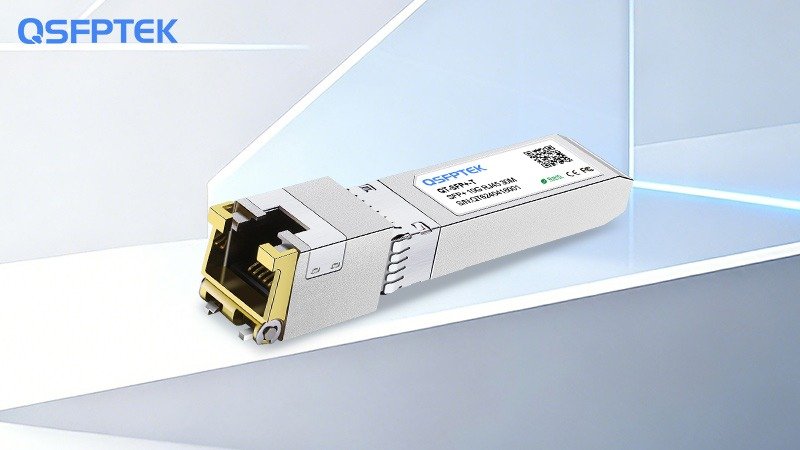
As 10G networking becomes increasingly common in enterprise environments, data centers, and even advanced home labs, the choice of interconnect technology has become more important than ever. Among the available options, 10GBASE-T SFP+ modules have emerged as a flexible solution that allows Ethernet transmission over traditional copper cabling. At the same time, fiber optics remains the gold standard for high-speed, low-latency communication. This raises a practical question: is it worth choosing copper-based 10GBASE-T SFP+ modules over fiber solutions, or does fiber still hold a clear advantage?
In many deployment scenarios, 10G SFP+ modules serve as the foundation for high-speed connectivity, offering different media options such as DAC, AOC, fiber optics, and copper RJ45. The 10GBASE-T variant is particularly appealing because it enables network upgrades without requiring a complete overhaul of existing cabling infrastructure. For organizations that already rely on Cat6a or Cat7 cabling, this can significantly reduce deployment complexity and cost.
However, the decision is not as straightforward as it may seem. While 10GBASE-T SFP+ modules offer convenience and compatibility, fiber-based 10G SFP+ modules provide superior performance in terms of latency, power consumption, and transmission distance. Understanding the trade-offs between these two approaches is essential for selecting the right solution for your specific network requirements.
Understanding 10GBASE-T SFP+ and Fiber Optic Modules
What Is 10GBASE-T SFP+?
10GBASE-T SFP+ modules are designed to transmit 10 Gigabit Ethernet signals over twisted-pair copper cables terminated with RJ45 connectors. Typically supporting distances of up to 30 meters in SFP+ form factor implementations, these modules are ideal for short-reach connections within racks or between nearby network devices. Their key advantage lies in their compatibility with widely deployed copper cabling, making them a practical option for incremental upgrades.
How Do Fiber Optic SFP+ Modules Work?
Fiber optic SFP+ modules, on the other hand, use light to transmit data through optical fibers. Depending on the type of module—such as SR (short-range) or LR (long-range)—they can support distances ranging from a few hundred meters to several kilometers. Fiber solutions are known for their high bandwidth, low signal loss, and immunity to electromagnetic interference, making them a preferred choice in performance-critical environments.
Key Differences Between Copper and Fiber
Transmission Distance and Scalability
One of the most noticeable differences between 10GBASE-T SFP+ and fiber optics is transmission distance. While copper-based modules are typically limited to around 30 meters in SFP+ form factor, fiber optic modules can easily extend beyond 300 meters and even reach tens of kilometers. This makes fiber the clear winner for scalable network designs, especially in large data centers or campus environments.
Latency and Performance
Latency is another critical factor in high-speed networking. Fiber optic solutions generally offer lower latency compared to 10GBASE-T, as copper-based transmission involves more complex signal processing and encoding. In latency-sensitive applications such as financial trading, real-time analytics, or high-performance computing, even small delays can have a significant impact. Therefore, fiber is often the preferred choice in these scenarios.
Power Consumption and Heat
10GBASE-T SFP+ modules are known for their relatively high power consumption, often consuming significantly more power than fiber optic counterparts. This increased power usage also leads to higher heat generation, which can affect the overall thermal management of network equipment. In high-density environments, this can become a limiting factor, making fiber a more energy-efficient option.
Cost and Deployment Flexibility
From a cost perspective, the comparison is more nuanced. Copper cabling is generally less expensive than fiber, and many buildings are already equipped with copper infrastructure. This gives 10GBASE-T SFP+ modules a clear advantage in scenarios where reusing existing cabling is possible. However, fiber prices have decreased over time, and the total cost of ownership may favor fiber in larger or long-term deployments due to its efficiency and scalability.
When 10GBASE-T SFP+ Is Worth It
Leveraging Existing Copper Infrastructure
One of the strongest use cases for 10GBASE-T SFP+ modules is in environments where copper cabling is already in place. Upgrading to 10G without replacing cables can significantly reduce installation time and cost. This is particularly relevant for enterprise networks and office buildings that have been wired with Cat6a or Cat7 cables.
Short-Reach Connections
For short-distance connections—such as within a rack or between adjacent racks—10GBASE-T SFP+ modules can be a practical and convenient solution. The 30-meter limitation is rarely an issue in these scenarios, and the ability to use standard RJ45 connectors simplifies deployment and maintenance.
Compatibility and Ease of Use
Another advantage of 10GBASE-T is its compatibility with existing Ethernet standards. Network administrators familiar with traditional RJ45 connections may find copper-based solutions easier to deploy and troubleshoot compared to fiber optics, which often require more specialized knowledge and handling.
When Fiber Optics Is the Better Choice
High-Performance and Low-Latency Environments
In applications where performance is critical, fiber optics clearly stands out. Lower latency, higher reliability, and better signal integrity make fiber the preferred option for data centers, cloud computing environments, and high-frequency trading systems.
Long-Distance Connectivity
Whenever the required transmission distance exceeds the limitations of copper, fiber becomes the only viable option. Whether connecting different floors in a building or linking multiple data centers, fiber provides the necessary reach without compromising performance.
Energy Efficiency and High-Density Deployments
In modern data centers where power efficiency and thermal management are key concerns, fiber optics offers significant advantages. Lower power consumption translates to reduced cooling requirements and improved overall efficiency, which can have a substantial impact at scale.
Conclusion
So, is 10GBASE-T SFP+ worth it compared to fiber optics? The answer depends largely on your specific use case. If you need a cost-effective, flexible solution for short-distance connections and want to leverage existing copper infrastructure, 10GBASE-T SFP+ modules can be an excellent choice. However, if your priorities include maximum performance, long-distance connectivity, and energy efficiency, fiber optics remains the superior option. Rather than viewing one as universally better than the other, it is more useful to see them as complementary technologies, each suited to different networking scenarios.
