
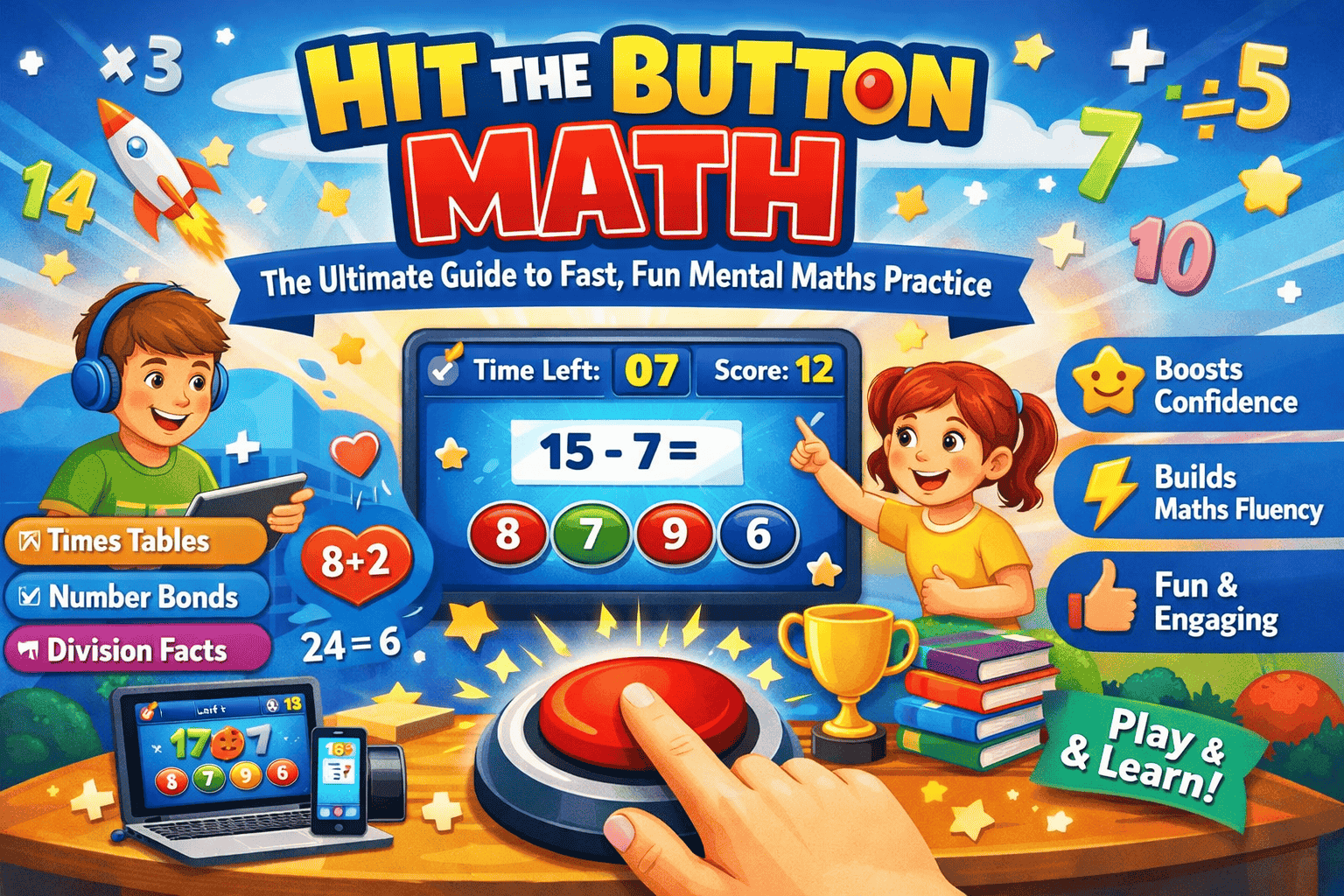
Hit the Button Math has become one of the most popular tools for helping children build confidence and speed in mental mathematics. Loved by teachers, parents, and students alike, this quick-fire maths game turns core arithmetic skills into an engaging challenge that feels more like play than practice. In this in-depth guide, you’ll learn what Hit the Button Math is, how it works, why it’s so effective, and how to use it at home or in the classroom. Whether you’re a parent supporting homework, a teacher planning maths lessons, or simply searching for the best mental maths resources online, this article covers everything you need to know.
What Is Hit the Button Math?
Hit the Button is a fast-paced mental maths game developed by Topmarks. It is designed primarily for primary school children and focuses on strengthening core arithmetic skills through repetition, speed, and accuracy.
The game presents learners with a series of maths questions to answer as quickly as possible. Each correct answer scores a point, encouraging children to improve their personal best and build confidence with numbers.
Hit the Button Math is widely used in:
- Primary schools
- Homeschooling environments
- After-school practice
- Maths intervention sessions
Why Hit the Button Math Is So Popular
The popularity of Hit the Button Math isn’t accidental. It combines educational value with strong game mechanics that motivate learners.
Key Reasons for Its Success
- Instant engagement: Simple rules and quick rounds keep children focused.
- Time pressure: Encourages rapid recall of maths facts.
- Clear goals: Beat the clock and improve your score.
- Age-appropriate design: Bright, clean layout suitable for young learners.
Unlike worksheets, Hit the Button Math makes repetition enjoyable rather than boring.
Maths Topics Covered in Hit the Button Math
One of the biggest strengths of Hit the Button Math is its support for a wide range of skills. These topics align closely with primary school maths curricula.
Times Tables
Children can practise:
- 2, 3, 4, 5, and 10 times tables
- More challenging tables like 6, 7, 8, 9, and 12
- Mixed multiplication facts
Regular times tables practice using Hit the Button Math significantly improves recall speed.
Division Facts
Division is often harder for children, but Hit the Button Math helps reinforce:
- Division is the inverse of multiplication
- Fact families
- Fluency with common divisors
Number Bonds
Number bonds are essential for early maths development. The game includes:
- Bonds to 10
- Bonds to 20
- Bonds to 100 (for more advanced learners)
Doubling and Halving
Doubling and halving help children develop number sense and mental calculation strategies, especially for later multiplication and fractions.
Multiples and Square Numbers
Older primary students can practise:
- Recognising multiples
- Identifying square numbers
- Building early algebraic thinking skills
How Hit the Button Math Works
Hit the Button Math is designed to be intuitive, even for young children.
Gameplay Overview
- Choose a maths topic (for example, times tables).
- Select a difficulty level or specific table.
- Answer as many questions as possible before time runs out.
- View your final score and try again to improve it.
The simplicity of this structure allows learners to focus entirely on the maths.
Educational Benefits of Hit the Button Math
Builds Mental Maths Fluency
Fluency is the ability to calculate quickly and accurately without relying on written methods. Hit the Button Math strengthens this skill through constant recall practice.
Boosts Confidence
Children often feel anxious about maths. The game’s friendly format helps reduce fear by allowing mistakes without judgment.
Encourages Independent Learning
Because Hit the Button Math is easy to use, children can practise independently without constant adult support.
Supports Differentiation
Teachers can choose different modes for different ability levels, making it suitable for mixed-ability classrooms.
Improves Exam Readiness
Fast recall of number facts is essential for SATs and other assessments. Hit the Button Math helps students answer questions more efficiently under time pressure.
Using Hit the Button Math in the Classroom
Teachers around the world use Hit the Button Math as part of daily maths routines.
Effective Classroom Strategies
- Warm-up activity: Use it at the start of a lesson to activate prior knowledge.
- Maths stations: Include it as a digital station during rotations.
- Intervention tool: Support pupils who need extra practice with basic facts.
- Whole-class challenge: Display it on a whiteboard and play together.
Because the game is quick, it fits easily into short lesson segments.
Using Hit the Button Math at Home
Parents often search for Hit the Button Math to support learning outside of school.
Tips for Parents
- Encourage short daily practice (5–10 minutes).
- Focus on one skill at a time.
- Celebrate improvement, not just high scores.
- Let children challenge themselves rather than forcing harder levels.
Consistency matters more than long sessions.
Hit the Button Math: Web Version vs App
Hit the Button Math is available both online and as an app, making it flexible for different environments.
Web Version
- Easy access to computers and interactive whiteboards
- Ideal for classrooms
- No installation required
App Version
- Works on tablets and mobile devices
- Often includes extra features such as profiles and trophies
- Suitable for offline use
Both versions support the same core learning goals.
Who Is Hit the Button Math Best For?
Hit the Button Math is ideal for:
- Children aged 5–11
- Primary school teachers
- Homeschooling families
- Tutors and intervention specialists
It is especially useful for learners who struggle with times tables or need confidence-building practice.
Is Hit the Button Math Aligned With the Curriculum?
Yes. The skills practised in Hit the Button Math align closely with:
- Early years number sense
- Key Stage 1 arithmetic foundations
- Key Stage 2 times tables and division expectations
This alignment makes it a safe and effective choice for structured learning.
Advantages and Limitations
Advantages
- Simple and engaging
- Encourages speed and accuracy
- Covers essential maths skills
- Suitable for independent practice
Limitations
- Focuses mainly on recall, not problem-solving
- Time pressure may not suit all learners
- Best used alongside other maths resources
When combined with reasoning and written work, it becomes even more powerful.
Why Hit the Button Math Is Still Relevant Today
In an age of complex educational apps, Hit the Button Math stands out because it does one thing extremely well: helping children master basic maths facts.
Strong foundations in mental maths lead to:
- Better performance in advanced topics
- Greater confidence in class
- Reduced maths anxiety
That’s why Hit the Button Math remains a trusted resource year after year.
Final Thoughts on Hit the Button Math
If you’re looking for a simple, effective, and engaging way to improve mental maths skills, Hit the Button Math is an excellent choice. Its focus on speed, repetition, and clarity makes it ideal for building strong numerical foundations in children.
You May Like: 8.3 Independent Practice Page 221 Answer Key: An All-in-One Guide for Students and Teachers
