

In the UK’s healthcare ecosystem, pharmacists are the unsung heroes of the high street. However, behind the scenes of every successful community or clinical pharmacy is a financial structure that is significantly more complex than that of a standard retail business. Between navigating the intricacies of the NHS Drug Tariff, managing “clawbacks,” and grappling with the unique VAT rules governing medicine, the margin for error is razor-thin.
For many pharmacy owners and locums, a general high-street accountant simply isn’t enough. To thrive in today’s economic climate, you need a specialist accountant for pharmacists, someone who understands that your business is part retail outlet, part professional service provider, and part NHS partner.
1. Unique Financial Challenges Faced by UK Pharmacists
Unlike a typical retail shop where a product is bought for $X$ and sold for $Y$, a pharmacy’s income is a hybrid of market commerce and government reimbursement.
Multiple Income Streams
A pharmacy’s ledger isn’t just a list of sales; it is a complex web of revenue sources, each with its own tax and accounting treatment:
- NHS Prescriptions: This is often the lion’s share of the business, involving complex reimbursement formulas and professional fees.
- Private Prescriptions: Higher margins but different regulatory requirements.
- Over-the-Counter (OTC) Sales: Standard retail accounting but often mixed with healthcare advice.
- Healthcare Services: Income from the New Medicine Service (NMS), smoking cessation, and vaccination clinics (e.g., Flu or COVID-19 jabs).
High Inventory Costs and Stock Management
Pharmacists carry high-value inventory that has an expiration date. Managing “dead stock” while ensuring you have life-saving medications on hand is a delicate balancing act. Furthermore, supplier pricing from wholesalers can fluctuate daily based on market availability, affecting your bottom line in real-time.
NHS Reimbursement Delays
The NHS Business Services Authority (NHSBSA) payment cycle is notoriously lagged. There is often a significant gap between when you dispense a medication and when you receive the reimbursement. This creates a “cash flow bridge” that requires expert management to ensure you can pay your staff and suppliers while waiting for government funds.
Tight Profit Margins and “Clawbacks”
The NHS “clawback” (Discount Abatement) mechanism means that if the government believes pharmacies are buying drugs cheaper than the reimbursement rate, they will deduct money from future payments. Without an accountant or pharmacist who tracks these adjustments, your projected profits can evaporate overnight.
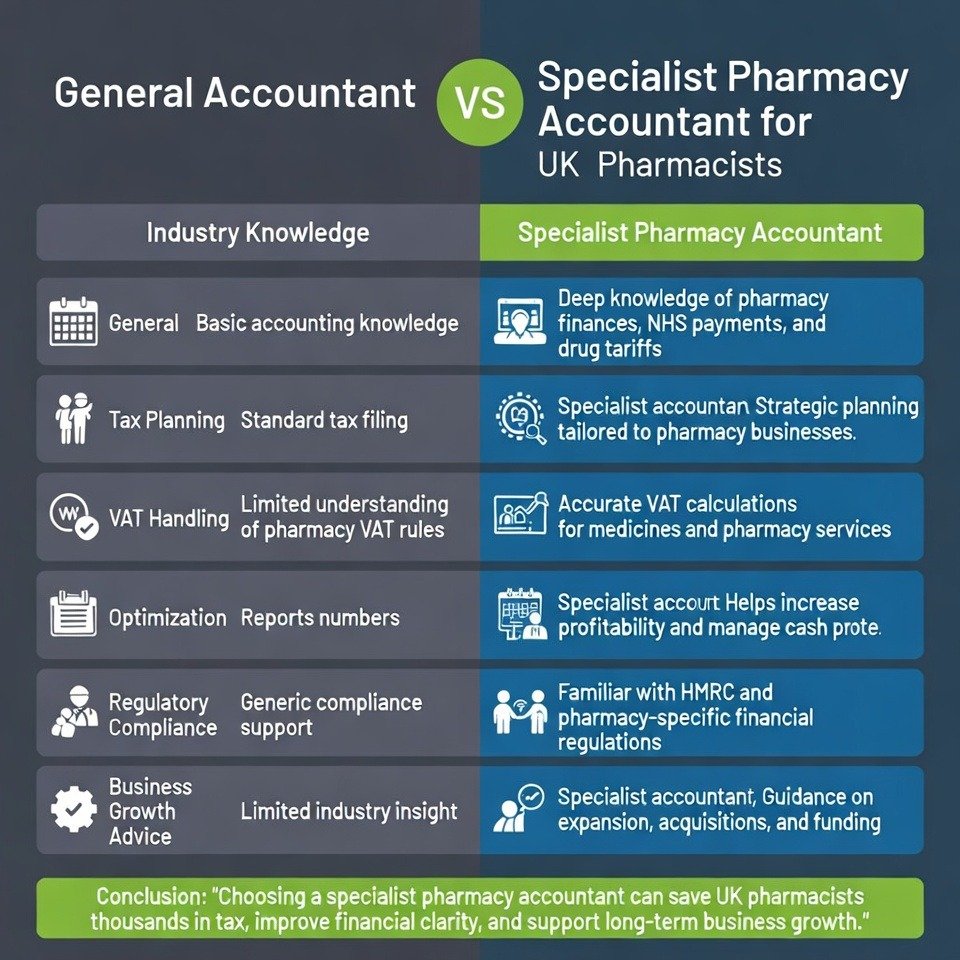
2. Why a Specialist Accountant Is Different From a Regular Accountant
A regular accountant might know how to file a tax return, but a pharmacy accountant in the UK knows how to read your FP34C.
Industry-Specific Knowledge
A specialist understands the Drug Tariff and Category M price adjustments. They know that your “cost of goods sold” (COGS) isn’t just a simple calculation; it’s a variable influenced by generic drug prices and government policy.
Understanding Pharmacy Regulations
From GPhC (General Pharmaceutical Council) compliance to the requirements of the NHS contract, a specialist ensures that your financial reporting aligns with your professional obligations.
Strategic Tax Planning
Generalists often miss pharmacy-specific tax breaks. For instance, can you claim Capital Allowances on a new automated dispensing robot? A specialist knows the answer is a resounding “yes” and knows exactly how to structure that purchase to minimize your Corporation Tax.
3. Key Accounting Services Pharmacists Need
To manage a modern pharmacy, you need a suite of services that goes beyond basic bookkeeping.
Tax Planning and Compliance
We handle the heavy lifting of Corporation Tax for pharmacy companies and Income Tax for partners. More importantly, we identify allowable expenses that others miss such as the cost of professional indemnity insurance, GPhC fees, and even specific clinical training courses.
Pharmacy VAT Management
VAT for pharmacies is a minefield. You are dealing with:
- Standard-rated items: OTC products like shampoo or vitamins.
- Zero-rated items: Most dispensed prescriptions.
- Exempt items: Certain healthcare services.
Because you deal with all three, you fall under Partial Exemption rules. This means you cannot claim back all the VAT you pay on your expenses. A specialist accountant for pharmacists uses the “Standard Method” or “Special Method” to ensure you recover the maximum amount of VAT possible without triggering an HMRC audit.
Bookkeeping and Financial Reporting
We use cloud-based platforms like Xero or QuickBooks, customized with pharmacy-specific charts of accounts. This allows you to see your Profit and Loss (P&L) in real-time, helping you make decisions about staffing levels or stock purchases based on data, not guesswork.
Payroll and Staff Management
Pharmacies often have complex staffing, including dispensers, technicians, and locums. We manage the payroll, ensuring pension contributions (NEST or NHS Pension for certain entities) are handled correctly and that “IR35” rules are applied to locum staff to protect you from employment tax risks.
4. Locum Pharmacists and Accounting Challenges
If you are a locum, you are essentially a mobile business. The accounting requirements for an accountant for locum pharmacists focus heavily on structure and mobility.
Sole Trader vs. Limited Company
Many locals wonder if they should incorporate. As a specialist accountant for pharmacists, we perform a “break-even” analysis. If you are earning over a certain threshold, a Limited Company might save you thousands in National Insurance, but it comes with more administrative responsibility. We help you choose the path that maximizes your take-home pay.
Managing Multiple Income Sources
Working for five different pharmacy chains in a single month means five different invoices and potential tax code chaos. We consolidate your income streams to ensure you don’t overpay tax throughout the year.
Expense Tracking
Locums often miss out on claiming:
- Travel and mileage to different pharmacies.
- Professional subscriptions (GPhC, RPS, PDA).
- Home office costs for administrative work and CPD.
5. How Specialist Accountants Help Pharmacists Reduce Taxes
Tax efficiency isn’t about avoiding tax; it’s about utilizing the law to its full extent.
- Dividend vs. Salary Strategies: For Limited Company owners, we calculate the optimum “tax-free” salary combined with dividend payments to keep you in the lowest possible tax bracket.
- Business Structures: If you own multiple branches, should they be under one company or separate entities? We structure your business to protect assets and optimize tax groups.
- Capital Allowances: Renovating your consulting room or installing a 24/7 prescription collection point can be written off against your profits.
6. Financial Planning and Growth for Pharmacy Businesses
Improving Cash Flow
We help you understand the “lag” in NHS payments. By analyzing your FP34s, we can forecast cash flow shortages before they happen, allowing you to secure working capital or negotiate better terms with wholesalers.
Business Expansion and Valuation
Are you looking to buy another branch? We perform financial due diligence, checking the “script count” and “turnover” to ensure you aren’t overpaying. Conversely, if you are looking to retire, we provide valuations that reflect the true “goodwill” of your pharmacy.
7. Common Accounting Mistakes Pharmacists Make
In our years of experience, we consistently see the same errors when pharmacists use non-specialist advisors:
- Incorrect VAT Calculations: Failing to properly apply Partial Exemption rules, leading to under-recovered VAT or HMRC penalties.
- Poor Bookkeeping: Not reconciling NHS BSA statements against bank deposits.
- Missing “Clawback” Data: Not accounting for future deductions, leading to an overestimation of profit.
- Late HMRC Filings: Missing the specific deadlines for Corporation Tax or P11D filings due to the high-pressure nature of pharmacy work.
8. Benefits of Hiring a Specialist Accountant for Pharmacists
The most significant benefit isn’t just the money saved, it’s the time reclaimed. As a pharmacist, your value is in your clinical expertise and patient care. Every hour you spend trying to figure out VAT partial exemption is an hour you aren’t growing your business or helping your patients.
By hiring a specialist, you gain:
- Better Tax Efficiency: Ensuring you keep more of your hard-earned money.
- Reduced Compliance Risk: Peace of mind that HMRC and the GPhC requirements are met.
- Strategic Growth: A partner who can help you scale from a single shop to a small chain.
How Lanop Business & Tax Advisors Help Pharmacists
Lanop Business & Tax Advisors provides specialised accounting and tax support tailored specifically for pharmacists and pharmacy businesses in the UK. Their team understands the financial and regulatory complexities pharmacists face, including NHS income structures, VAT rules, and strict HMRC compliance requirements.
Lanop helps pharmacists with tax planning, bookkeeping, financial reporting, and VAT management, ensuring that pharmacy finances remain accurate and compliant. They also support locum pharmacists and pharmacy owners by advising on tax-efficient business structures, allowable expenses, and profit optimization strategies.
Beyond compliance, Lanop offers proactive financial guidance, helping pharmacists manage cash flow, plan business growth, and make informed financial decisions. With expert support, pharmacists can focus more on patient care while Lanop handles the financial side of their business.
Frequently Asked Questions About Accountant for Pharmacists
1. What makes a specialist accountant different from a general accountant for pharmacists?
A specialist accountant has in-depth knowledge of the pharmacy sector, including NHS contract payments, Drug Tariff reimbursements, dispensing fees, and pharmacy-specific tax reliefs. A general accountant may lack this expertise, potentially leading to missed deductions or compliance errors unique to the profession.
2. Why is the NHS payment structure so complex that pharmacists need specialist accounting help?
NHS pharmacy payments involve multiple income streams dispensing fees, establishment payments, advanced services, enhanced services, and Pharmacy Quality Scheme (PQS) payments. Each is treated differently for tax and accounting purposes, and only a specialist accountant will know how to correctly categorise and report them.
3. Can a specialist accountant help with Drug Tariff reimbursements?
Yes. Drug Tariff reimbursements can create timing differences between when a pharmacy buys stock and when it is reimbursed. A specialist accountant understands how to handle these cash flow mismatches and ensure they are correctly reflected in your accounts and tax returns.
4. Are there specific tax reliefs available to pharmacists that a general accountant might miss?
Absolutely. Pharmacists may be entitled to capital allowances on dispensing robots, IT systems, and pharmacy fit-outs, as well as relief on professional indemnity insurance, GPhC registration fees, and CPD costs. A specialist accountant knows exactly what to claim and how to maximise these reliefs.
5. How can a specialist accountant help with VAT in a pharmacy business?
Pharmacy VAT is notoriously complex. Prescription dispensing is VAT-exempt, but OTC sales are standard-rated, creating a partial exemption situation. Getting this wrong can lead to overpaying or underpaying VAT, both of which carry serious consequences. A specialist accountant ensures your VAT position is correctly calculated and reported.
6. Do locum pharmacists also need a specialist accountant?
Yes, perhaps even more so. Locums operate as self-employed individuals and must manage their own tax returns, National Insurance contributions, IR35 considerations, and expense claims. A specialist accountant can help locums structure their affairs tax-efficiently, whether operating as a sole trader or through a limited company.
7. How does a specialist accountant help when buying or selling a pharmacy?
Pharmacy acquisitions and disposals involve complex valuations based on goodwill, NHS contract value, and dispensing volume. A specialist accountant can advise on the tax implications of a sale or purchase, structure deals to minimise capital gains tax, and ensure due diligence is carried out correctly.
Conclusion
The financial landscape for UK pharmacists is becoming increasingly complex, with challenges such as NHS payment structures, VAT rules, and rising operational costs. Without proper financial guidance, pharmacists may unintentionally overpay taxes or miss important deductions that could improve profitability.
Working with a specialist accountant for pharmacists ensures your finances are managed accurately while keeping you fully compliant with HMRC regulations. Lanop Business & Tax Advisors offers tailored accounting and tax support for pharmacists, helping you optimise tax planning, manage finances efficiently, and focus on what matters most running a successful pharmacy and serving your patients
