
Introduction
Real estate has long been considered one of the most reliable ways to build wealth and generate passive income. However, purchasing and managing physical properties often requires significant capital, time, and expertise. This is where Real Estate Investment Trusts (REITs) come into play. The topic covered at https://fintrustadvice.com/real-estate-investment-trusts-reits focuses on helping investors understand how REITs provide access to income-producing real estate without the challenges of direct property ownership.
REITs have transformed the investment landscape by allowing everyday investors to participate in commercial real estate markets. Through publicly traded shares, investors can gain exposure to office buildings, apartments, shopping centers, warehouses, healthcare facilities, hotels, and data centers while benefiting from potential dividend income and long-term appreciation. REITs were created to make real estate investing accessible to a broader audience and remain one of the most popular options for income-focused investors today.
This guide explores everything you need to know about REITs, including how they work, their benefits, risks, types, investment strategies, and future prospects.
What Are Real Estate Investment Trusts (REITs)?
A Real Estate Investment Trust (REIT) is a company that owns, operates, or finances income-producing real estate. Similar to mutual funds, REITs pool capital from multiple investors and use that capital to acquire or finance real estate assets. Investors purchase shares in the REIT and receive a portion of the income generated from the underlying properties.
REITs were established in the United States in 1960 to give ordinary investors access to large-scale commercial real estate investments. Since then, the industry has expanded globally and become an important asset class for individual and institutional investors.
Unlike direct property ownership, REIT investors do not need to worry about maintenance, tenant management, financing arrangements, or property administration. Professional management teams handle these responsibilities while investors receive returns through dividends and share price appreciation.
How REITs Work
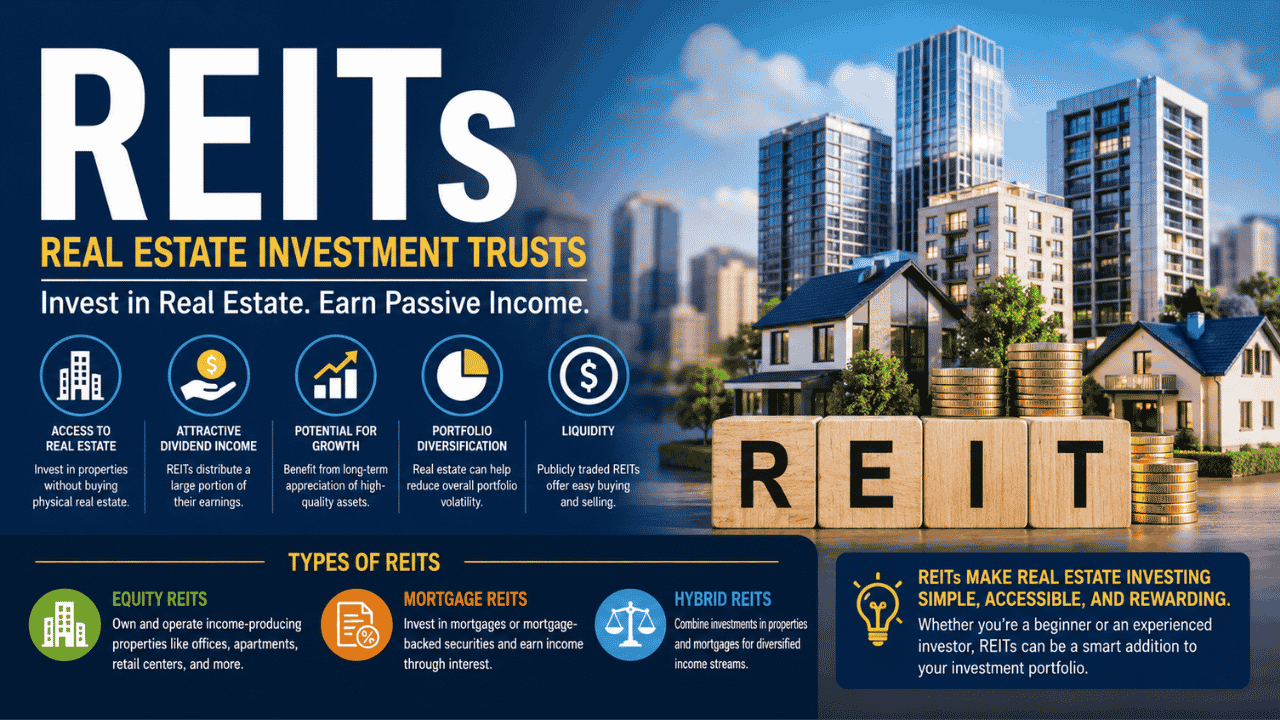
The basic structure of a REIT is straightforward. Investors purchase shares in a REIT, and the company uses the funds to acquire, operate, or finance real estate properties. Income generated from rents, leases, interest payments, or property operations is distributed to shareholders.
Many REITs are publicly traded on major stock exchanges, making them easy to buy and sell like traditional stocks. This provides liquidity that is often unavailable in direct real estate investments.
To maintain REIT status in many jurisdictions, including the United States, companies must meet specific requirements, including distributing a large portion of their taxable income to shareholders. This structure is one reason REITs are known for their attractive dividend yields.
Types of REITs
Equity REITs
Equity REITs are the most common type of REIT. They own and manage income-producing properties such as:
- Apartment complexes
- Office buildings
- Shopping centers
- Warehouses
- Hotels
- Healthcare facilities
Revenue primarily comes from rental income generated by tenants occupying the properties. Equity REITs often provide both dividend income and capital appreciation potential.
Mortgage REITs (mREITs)
Mortgage REITs do not typically own physical properties. Instead, they invest in mortgages and mortgage-backed securities.
Their income primarily comes from interest earned on these financial instruments. Mortgage REITs may offer higher yields but often carry greater interest rate sensitivity.
Hybrid REITs
Hybrid REITs combine characteristics of both equity and mortgage REITs. They own properties while also investing in mortgage assets, creating multiple income streams and additional diversification.
Public and Private REITs
REITs can also be classified according to how they are traded:
- Publicly traded REITs
- Public non-listed REITs
- Private REITs
Publicly traded REITs generally provide the highest liquidity and transparency for investors.
Benefits of Investing in REITs
Passive Income Generation
One of the biggest attractions of REIT investing is the opportunity to earn regular dividend income. Because REITs distribute a significant portion of their earnings to shareholders, they are often favored by income-focused investors.
Portfolio Diversification
Real estate often behaves differently from stocks and bonds. Including REITs in an investment portfolio can improve diversification and potentially reduce overall volatility.
Liquidity
Unlike physical real estate, publicly traded REIT shares can generally be bought and sold during market hours. This provides investors with flexibility and easier access to their capital.
Lower Investment Requirements
Purchasing commercial real estate directly often requires substantial capital. REITs allow investors to participate in large-scale real estate portfolios with a relatively small initial investment.
Professional Management
REITs are managed by experienced professionals who oversee acquisitions, leasing, financing, maintenance, and strategic planning. Investors benefit from professional expertise without having to manage properties themselves.
Risks Associated with REIT Investing
Interest Rate Risk
Interest rates have a significant impact on REIT performance. Rising rates can increase borrowing costs and reduce the attractiveness of dividend-paying investments relative to fixed-income alternatives.
Market Volatility
Publicly traded REITs are affected by stock market conditions. Share prices may fluctuate even when the underlying real estate assets remain stable.
Economic Conditions
Economic downturns can reduce occupancy rates, lower rental income, and impact property values. Different property sectors may experience varying levels of economic sensitivity.
Sector-Specific Risks
Each property type carries unique risks. Retail REITs may face challenges from e-commerce growth, while office REITs may be affected by remote work trends. Healthcare, industrial, and data center REITs each have their own market dynamics.
Popular REIT Sectors
Residential REITs
These REITs invest in:
- Apartment communities
- Student housing
- Single-family rental properties
Residential REITs often benefit from population growth and housing demand.
Office REITs
Office REITs own business and corporate office spaces. Their performance depends on occupancy rates, lease agreements, and economic conditions.
Retail REITs
Retail REITs focus on:
- Shopping malls
- Retail centers
- Grocery-anchored properties
Their success often depends on consumer spending trends.
Industrial REITs
Industrial REITs own warehouses and logistics facilities. The growth of e-commerce has increased demand for industrial properties.
Healthcare REITs
Healthcare REITs invest in:
- Hospitals
- Medical office buildings
- Senior housing facilities
Aging populations often create long-term demand for healthcare-related properties.
Hospitality REITs
Hospitality REITs own hotels and resorts. Revenue can fluctuate significantly based on travel and tourism activity.
Data Center REITs
Data center REITs own facilities that support cloud computing, digital storage, and internet infrastructure. As digital transformation continues, this sector has attracted growing investor interest.
Key Metrics for Evaluating REITs
Funds From Operations (FFO)
FFO is one of the most important measures used to evaluate REIT performance. It adjusts net income to account for depreciation and certain gains or losses from property sales.
Adjusted Funds From Operations (AFFO)
AFFO builds upon FFO by incorporating maintenance and capital expenditure adjustments, providing a clearer picture of sustainable cash flow and dividend-paying capacity.
Dividend Yield
Dividend yield indicates the annual income generated relative to the share price. Many investors use this metric when comparing REIT investment opportunities.
Occupancy Rate
Higher occupancy rates generally indicate stronger property performance and more consistent rental income.
Net Asset Value (NAV)
NAV estimates the value of a REIT’s underlying assets relative to its liabilities and outstanding shares.
REITs vs Direct Real Estate Ownership
Advantages of REITs
- Lower capital requirements
- Greater liquidity
- Professional management
- Diversification across properties
- Easier portfolio integration
Advantages of Direct Real Estate
- Full control over assets
- Potential tax advantages
- Direct leverage opportunities
- Ability to make property improvements
The best choice depends on an investor’s goals, experience, available capital, and desired level of involvement.
How Beginners Can Start Investing in REITs
For beginners, investing in REITs is relatively simple:
- Open a brokerage account.
- Research publicly traded REITs.
- Evaluate property sectors and management quality.
- Review dividend history and financial metrics.
- Diversify across multiple REITs.
- Consider REIT-focused exchange-traded funds (ETFs).
Investors should focus on long-term objectives and avoid making decisions based solely on short-term market movements.
Future Outlook for REITs
The future of REIT investing remains promising. Trends supporting REIT growth include:
- Urbanization
- Population growth
- Digital infrastructure expansion
- Healthcare demand
- Logistics and e-commerce development
New investment structures, including emerging small and medium REIT models in some markets, are also expanding investor access to real estate opportunities.
As economies evolve, REITs continue adapting to changing consumer behavior, technology adoption, and demographic shifts.
Conclusion
The information at https://fintrustadvice.com/real-estate-investment-trusts-reits explains why REITs have become one of the most accessible and effective ways to invest in real estate. By combining professional management, diversification, liquidity, and income potential, REITs allow investors to participate in commercial real estate markets without directly owning properties.
You May Like: Make1m.com Millionaire Life: How to Build Wealth, Mindset, and a Lifestyle of Financial Freedom
