
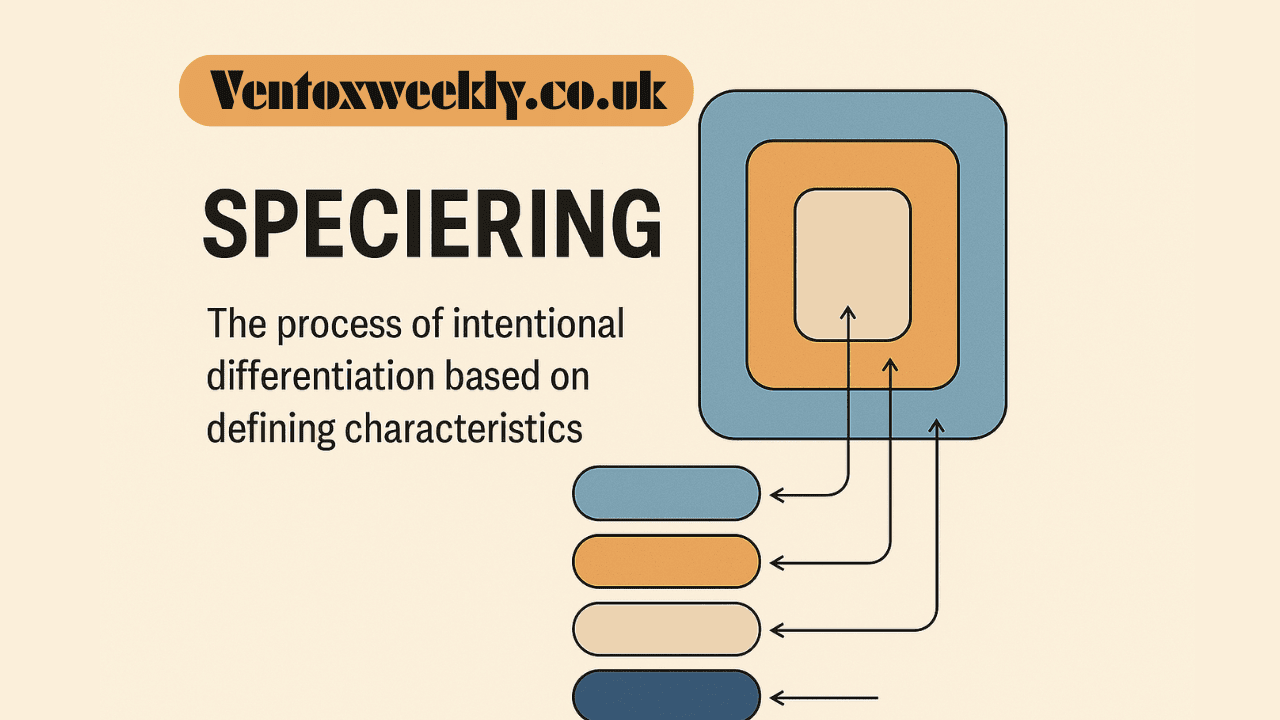
Speciering is a term that has begun to surface in digital conversations, academic discussions, and strategic frameworks, though it is not yet formally standardized in traditional dictionaries. Despite this, speciering carries an increasingly clear conceptual meaning: the process of intentional differentiation, categorization, or specialization based on defining characteristics. In an era driven by data, niches, and precision, speciering represents a way of thinking that emphasizes clarity, distinction, and purpose. This article explores speciering in depth—its meaning, origins, applications, advantages, and future relevance.
What Is Speciering?
Speciering is the deliberate act of dividing a broad category into more precise, identifiable, and meaningful subgroups. Unlike vague classification, speciering focuses on relevance and function. It is not simply about labeling things differently, but about understanding why those differences matter.
At its core, speciering answers questions such as:
- What makes this entity distinct?
- How does this difference create value?
- Why does specialization improve outcomes?
Speciering is often confused with related concepts such as classification or segmentation, but it goes further by emphasizing intentional refinement rather than surface-level grouping.
The Conceptual Origins of Speciering
While speciering is not a formally defined academic term, its conceptual roots can be traced to several established disciplines:
- Biology, where differentiation and specialization are essential for survival
- Business strategy, where niche positioning outperforms generalization
- Information science, where data becomes useful only when properly categorized
- Marketing, where targeting is more effective than mass messaging
Speciering borrows ideas from all these areas and unifies them under a single guiding principle: precision leads to effectiveness.
Speciering vs Generalization
One of the most important aspects of speciering is how it contrasts with generalization.
Generalization aims to appeal broadly, often at the cost of relevance. Speciering, on the other hand, intentionally narrows the focus. Rather than trying to serve everyone, it identifies a specific subset and optimizes for it.
For example:
- A general business sells “software”
- A speciering-driven business sells “AI-powered accounting software for freelance designers”
The second approach is clearer, more targeted, and easier for the right audience to connect with. Speciering is not about exclusion—it is about alignment.
Applications of Speciering in Business
In business environments, speciering plays a critical role in strategy and growth. Companies that embrace speciering often outperform competitors by becoming known for one thing done exceptionally well.
Product Development
Speciering helps teams identify which features matter most to a specific user group. Instead of bloated products, companies create focused solutions.
Brand Positioning
Brands that practice speciering communicate a sharper identity. Customers understand instantly who the product is for and why it exists.
Competitive Advantage
When markets become crowded, speciering allows businesses to escape price wars by offering specialized value rather than generic options.
Speciering in Marketing and SEO
In digital marketing, speciering is especially powerful. Search engines reward relevance, and audiences respond better to content that appeals directly to their needs.
From an SEO perspective, speciering supports:
- Long-tail keyword targeting
- Intent-based content creation
- Higher engagement and lower bounce rates
Instead of writing for “everyone,” speciering encourages marketers to write for a specific audience. This clarity improves rankings and conversions simultaneously.
Speciering in Knowledge Organization
Speciering is also highly relevant in information management. As data volumes increase, the ability to meaningfully organize information becomes essential.
Libraries, databases, and AI systems rely on speciering principles to:
- Reduce noise
- Improve retrieval accuracy
- Enhance decision-making
Without speciering, information becomes overwhelming. With it, complexity becomes manageable.
Psychological and Cognitive Benefits of Speciering
Speciering is not just practical—it aligns with how humans think. The brain naturally looks for patterns, distinctions, and categories.
By applying speciering:
- Cognitive load is reduced
- Decision-making becomes faster
- Understanding deepens through clarity
This is why expert knowledge often feels “simple”: experts practice speciering instinctively, knowing exactly which distinctions matter and which do not.
Challenges and Misuse of Speciering
Despite its advantages, speciering can be misused if taken too far.
Over-specifying can lead to:
- Fragmentation
- Overly narrow focus
- Missed opportunities for scalability
The key is balance. Effective speciering refines without isolating. It creates focus while maintaining adaptability.
The Future of Speciering
As personalization, AI, and data-driven systems continue to evolve, speciering will become even more important. Algorithms already rely on micro-categorization to deliver relevant experiences, and businesses that understand speciering will be better positioned to adapt.
In the future, speciering may evolve from a conceptual term into a recognized framework used across industries, especially where clarity, efficiency, and relevance are critical.
Conclusion: Why Speciering Matters
Speciering represents a shift away from vague generalization toward intentional precision. It is about understanding differences, valuing specialization, and creating meaning through clarity.
You May Like: Dihward: Meaning, Applications, and Why the Concept Is Gaining Attention
